The Isle of Wight’s First TT

Wednesday 13th – Sunday 17th October 2021

The Diamond Races is an all-new motorcycle road racing festival, featuring some of the top names in the sport and expected to attract around 50,000 people, extending the island’s summer season.

The Isle of Wight’s first TT is looking likely to be held on the above dates (at the end of the 2021 British Superbike calendar), with a 12.4 mile-long course (see centre pages 18-19) in the south of the Isle of Wight playing host to the event.

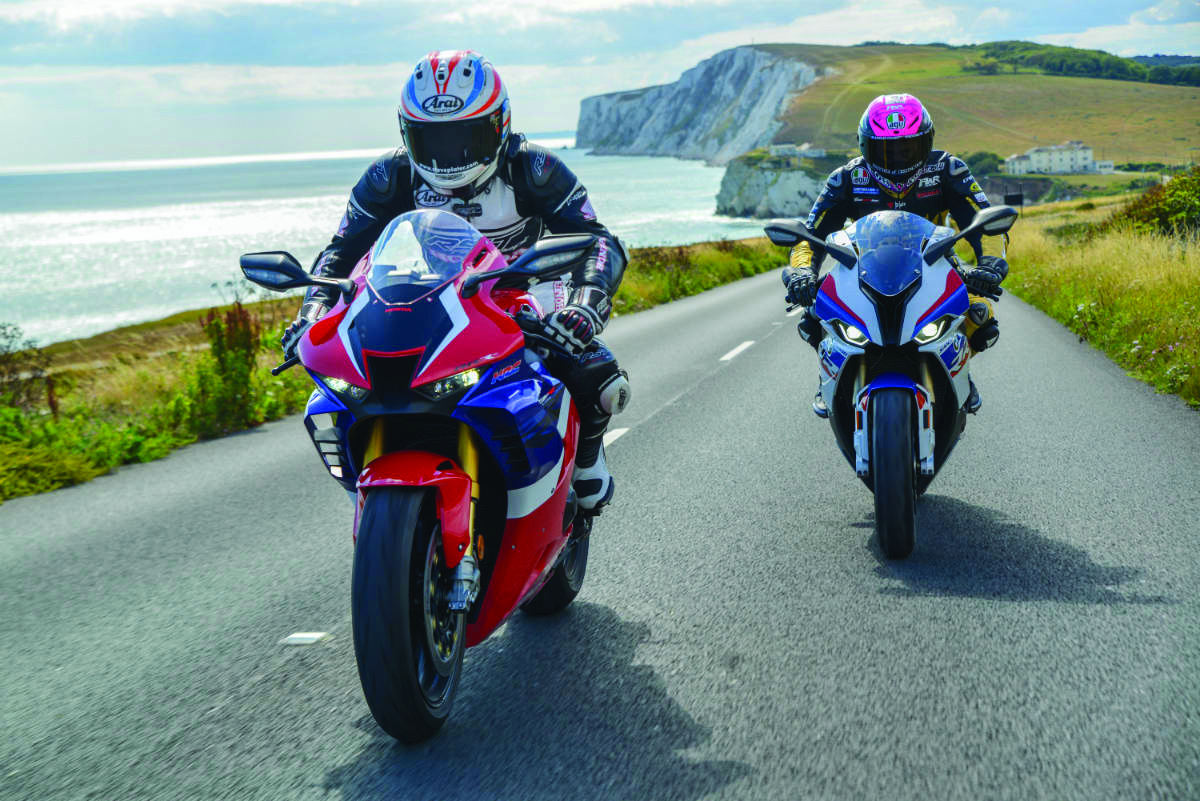
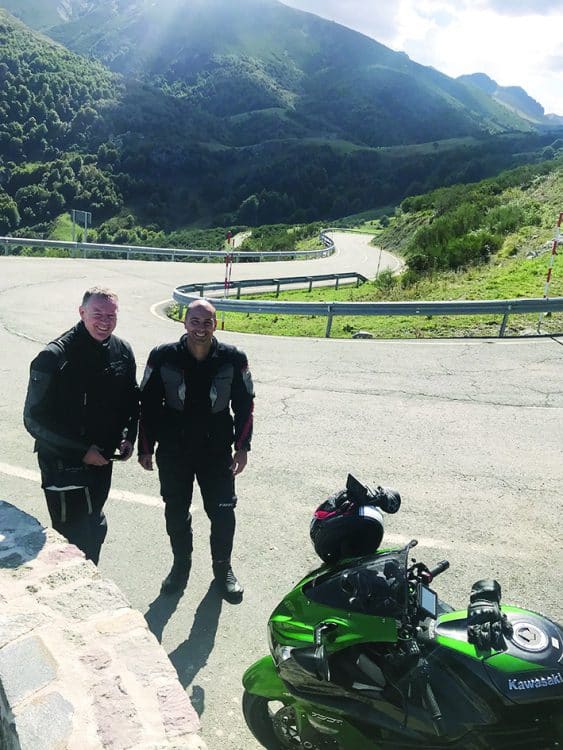
Steve Plater and James Hillier check out the course along the Military Road.

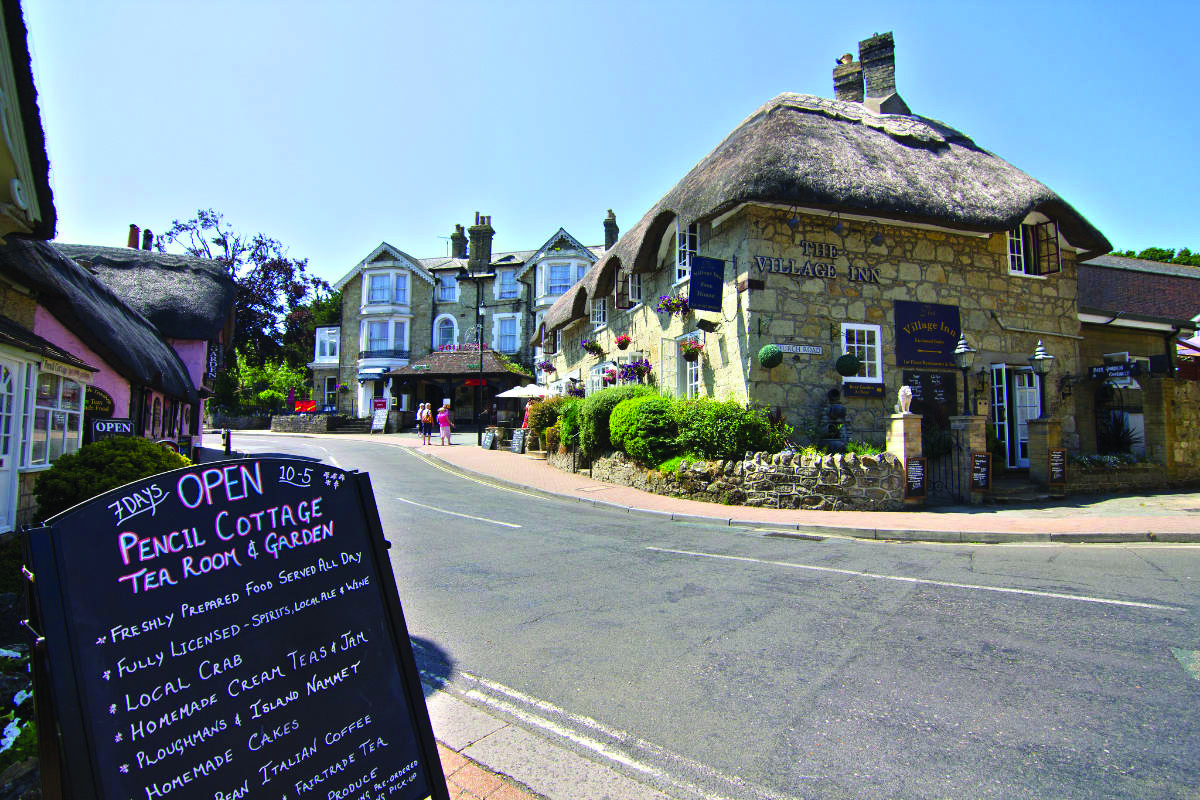
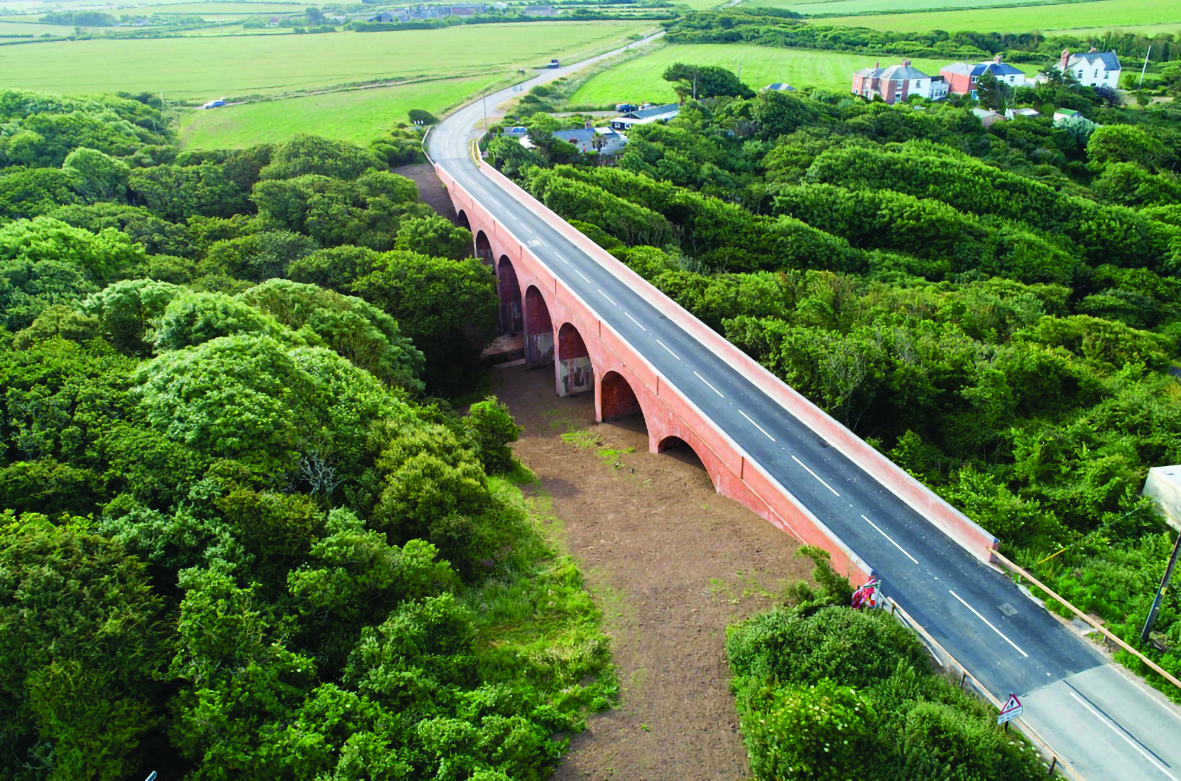
Gary Thompson was Clerk of the Course at the TT, Classic TT and Manx GP for ten years and set the course. Three quarters of it is very technical and curvy, and competitors will complete time trials through the picturesque villages of Chale, Kingston, Shorwell, Limerstone and Brighstone, often flanked by trees or bushes before hitting the last third which runs along the coast via the Military Road and is said to be a stretch at least as fast as the Sulby Straight at the Isle of Man TT with 200mph+ in the offing. The section is about twice as long as on the Isle of Man.

The technical part will also offer fast passages, some of which are driven in fourth gear, but also many tight bends or blind crests. The road surface is described as good with no potholes or bad surfaces. The start/finish and the hospitality unit will be set up on the Military Road,

Steve Plater and James Hillier.

Is the Isle of Wight ready for this?

The key players behind the conception and organisation of this event include Gary Thompson MBE (Isle of Man TT Clerk of the Course), Steve Plater (past Isle of Man TT Senior winner and ex British Champion), Neil Tuxworth (ex-Honda Racing Manager) as well as James Kaye (ex British Touring Car Championship driver and Diamond Races co-founder) and Matt Neal (three-time British Touring Car Champion and Honda UK ambassador), not forgetting James Kaye and Paul Sandford, the two Isle of Wight residents who first came up with the idea.

The races will see two days of practice, on the Wednesday and Thursday, as riders get used to the course. Friday will be a rest day and everything kicks off at the weekend, with Saturday being race day. Sunday may include some limited public riding. In its first year there are expected to be somewhere between 30-36 riders, with the bikes setting off from the start line every ten seconds.

If you are a keen TT attender, it’s another one for the calendar – let’s hope it happens!

First published in Slipstream September 2020

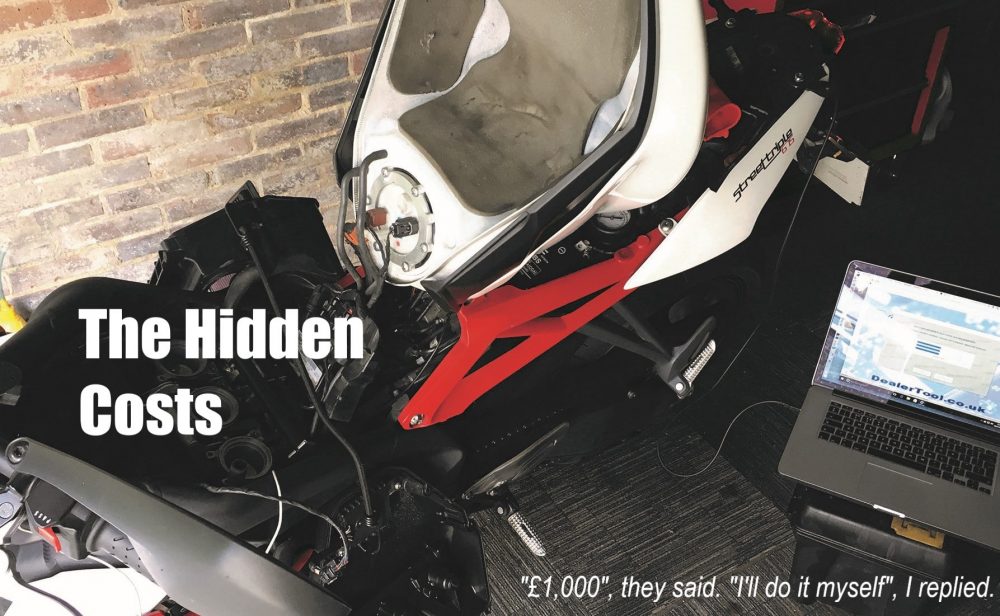
The Hidden Costs

How much does a modern motorcycle cost?

As with perennial questions regarding the length of a piece of string, the answer is always “it depends”. But it’s easy to forget that the showroom price tag is just the tip of the iceberg. Every year you pay for your share of the potholes with the road tax licence, shield yourself from unforeseen events with insurance, and pay your local MOT tester to confirm that your machine meets the minimum possible safety standards. On top of that you’ll be paying for fuel and servicing, both of which increase proportionally along with how much you actually ride.

These are the costs that are often forgotten when the smiling salesperson at your local motorcycle dealer is explaining just how cheap owning a brand-new high-tech, high-powered dream-machine could be. They’re keeping you focused on the cost of the equipment, and you’re forgetting that the cost of actually using it can be far higher. I’m sure that I’m not the only person who’s ever been caught in horrified surprise when the bill for the annual service is presented.

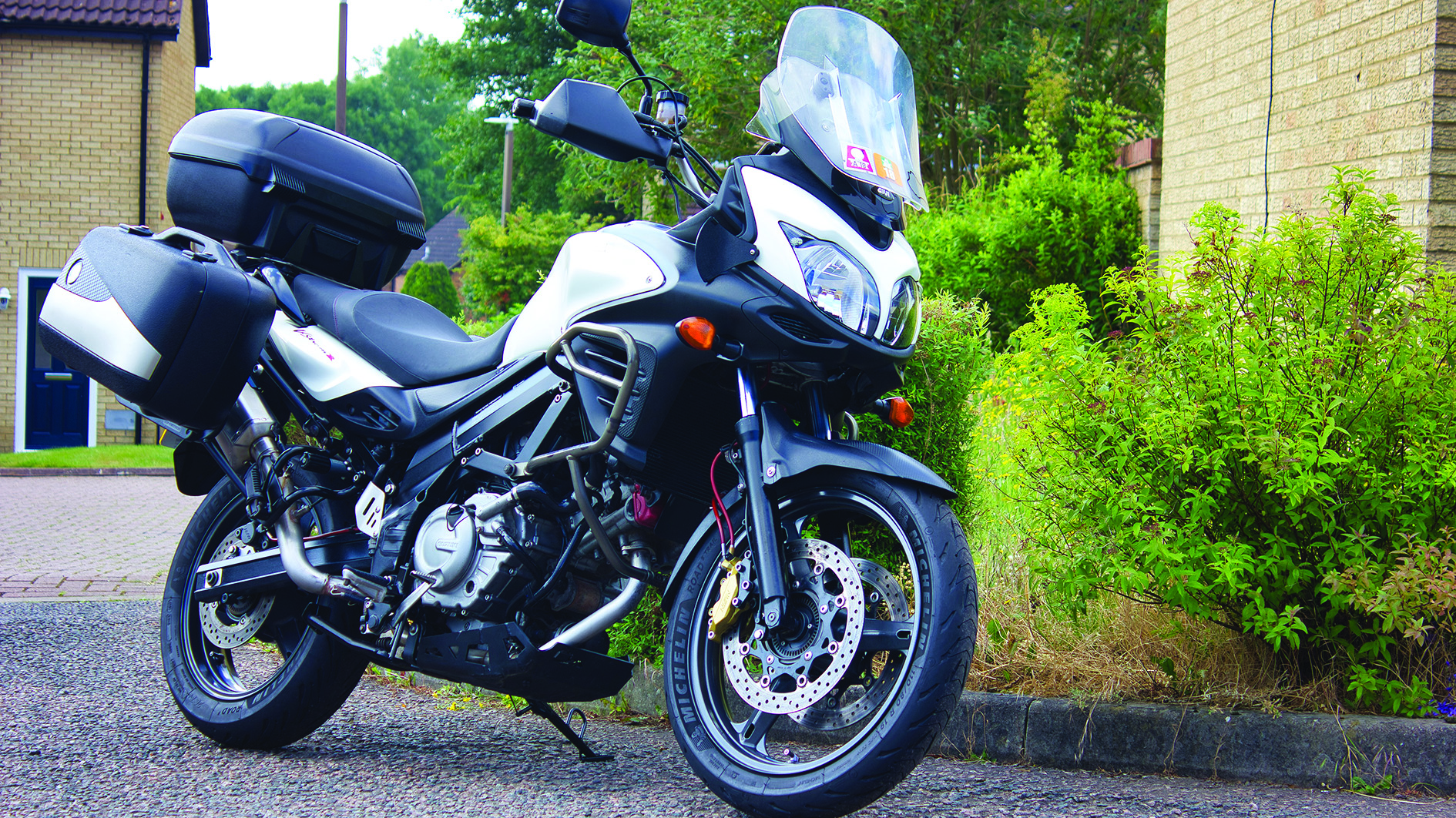
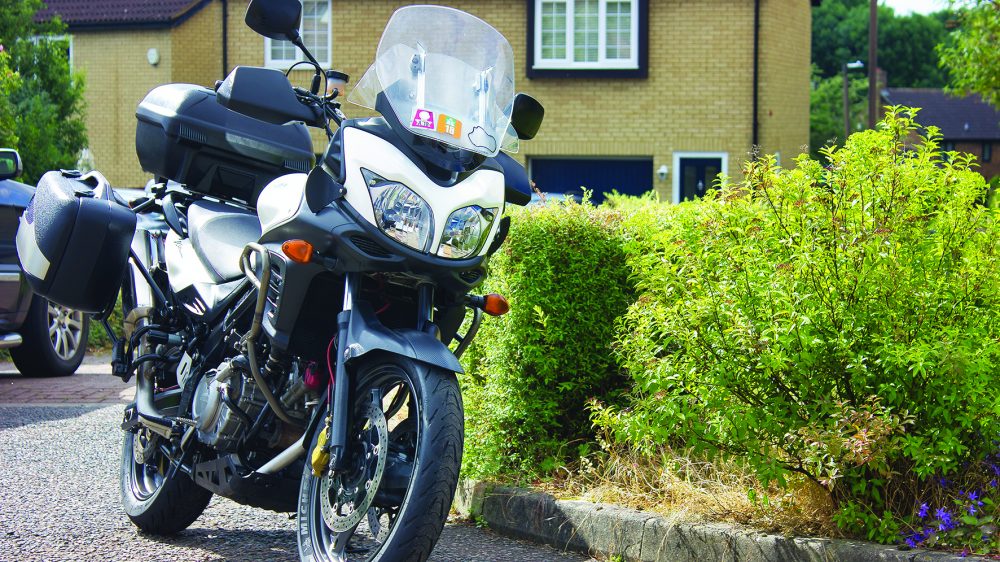
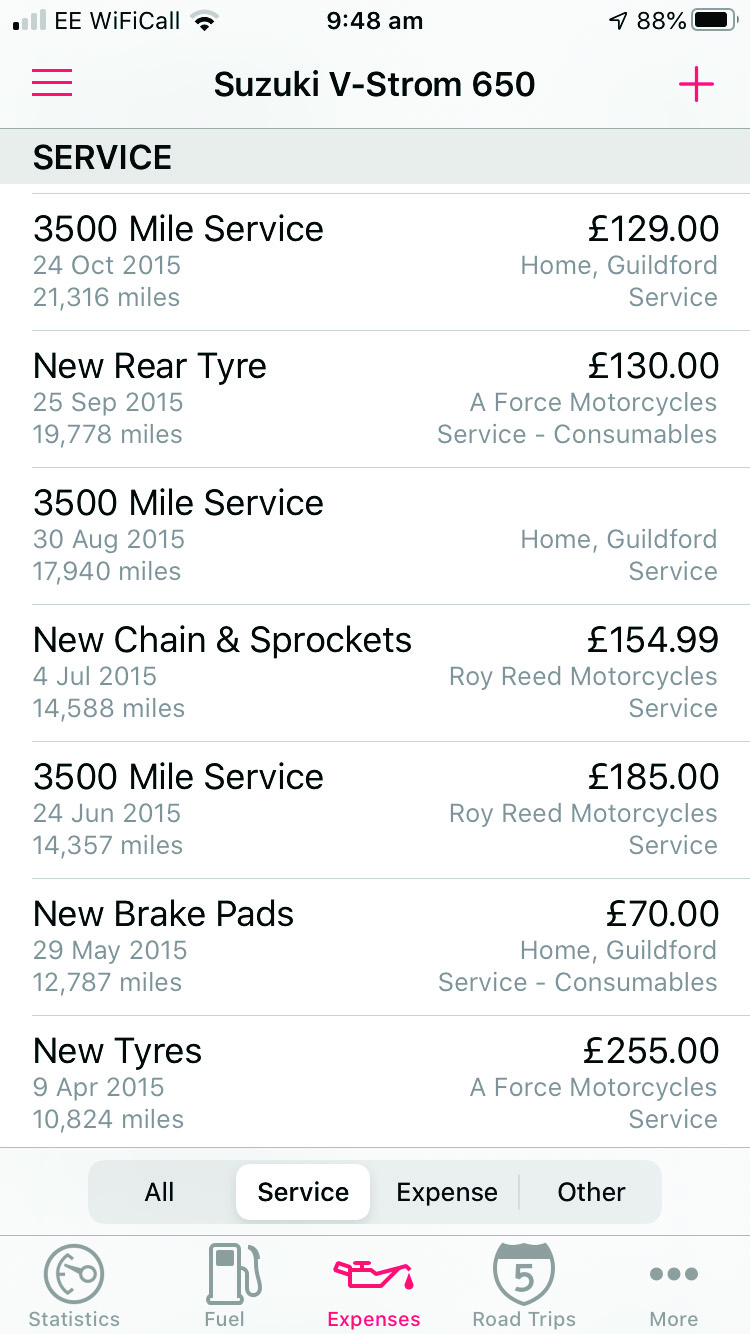
I’m always shopping for new bikes in one way or another, and at the moment I’m semi-seriously planning for my V-Strom 650’s eventual retirement. With my annual mileage, I could easily see 100k on the clock before the end of next year, which seems like a reasonable life expectancy for a well-maintained modern machine.

Are cheaper bikes actually cheaper to own over the long haul …?

It’s wearing its miles well, but I’ve decided that it’s time to figure out what I’m going to be riding for the next 100k. The great news is that there’s never been a better time to shop for an upright do-it-all motorcycle, so it’s time to do some maths.

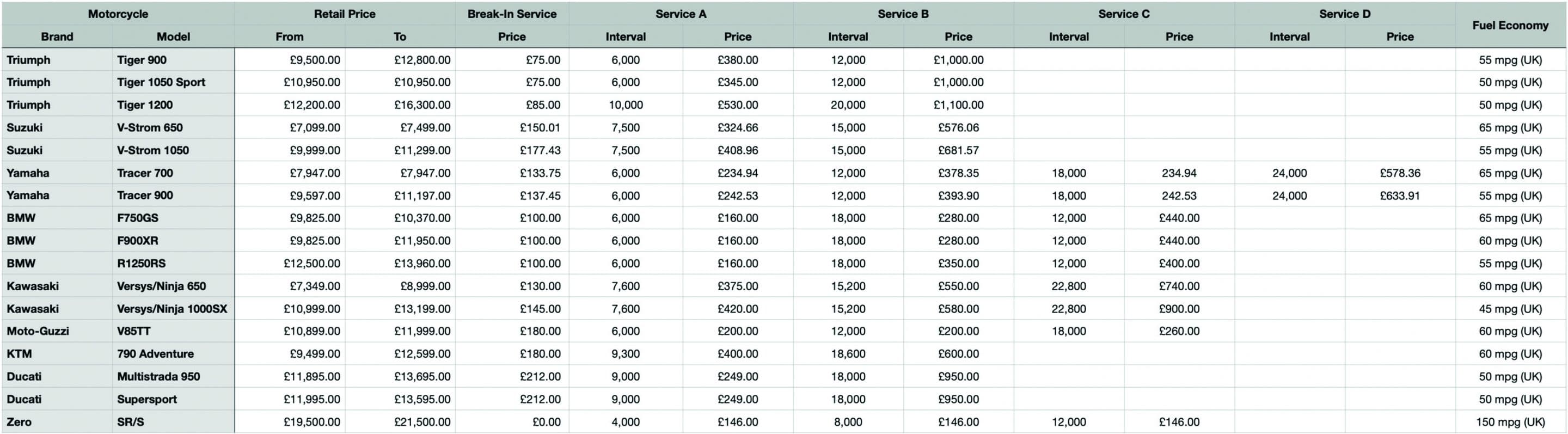
My loose requirements have led me to a long list of Adventure-Sport and Sport-Touring motorcycles which, in their base spec, can be ridden away for £13,000 or less. That being said, I usually choose a higher-spec to start with and it’s always worth remembering that adding luggage usually costs extra still. Comparing apples to apples is very difficult indeed. I’ve used www.fuelly.com to estimate real-world fuel economy to the nearest 5 mpg (UK), and used my current local petrol prices of £1.069 per litre to calculate the cost-per-mile to fuel each bike.

I’ve also contacted dealers for each manufacturer to confirm the service intervals and pricing for each bike on my list. Some brands were a pleasure to deal with, and for some brands it was like trying to get blood out of a stone. Special mention must got to Blade Motorcycles Cheltenham who had one of their service managers call me directly to answer my questions and provide some valuable insights. Sales staff are trained to be friendly when they’re trying to take your money; knowing your dealer has a similar approach to their after-sales service is well worth while.

Despite my considerable efforts, the miles are starting to take their toll.

I’ve given up trying to get numbers from Honda, so their bikes aren’t represented in my data. I’ve called and emailed half a dozen dealers, and was basically fobbed off or ignored entirely. It’s also worth remembering that while manufacturers will specify the number of hours each service takes and the parts needed for each one, individual dealers control their own labour rates and part markups. The data I’ve gathered should be used as a guide only, and I always recommend getting quotes in writing from your local service department for any motorcycle you are considering, and then follow up with your own calculations.

Most bikes have a different service schedule, but all follow a fairly similar pattern that then repeats as mileages continue upwards. For example, every bike I’m looking at needs a break-in service at 600 miles, and most then follow with minor/major alternating services at fixed mileage intervals. In most cases, a major service includes a valve clearance check and adjustment, which dramatically increases the cost due to the time involved. Moto-Guzzi’s air-cooled engines need their clearances checking and adjusting at every service, but Yamaha’s only need doing every 4th visit.

To smooth things out and give a realistic estimate of long-term total cost of ownership I added up the total cost of servicing up to the point when it started to repeat, and then divided that by the number of miles it took to get there, giving me an approximate cost-per-mile for maintenance that I could extrapolate from. None of this included suspension servicing, time-based maintenance such as brake fluid or coolant changes, and tyres and other consumables need to be added on as well. But without any reliable data to draw from, estimates for those costs would be so inaccurate as to be worthless, and so I’ve ignored them here.

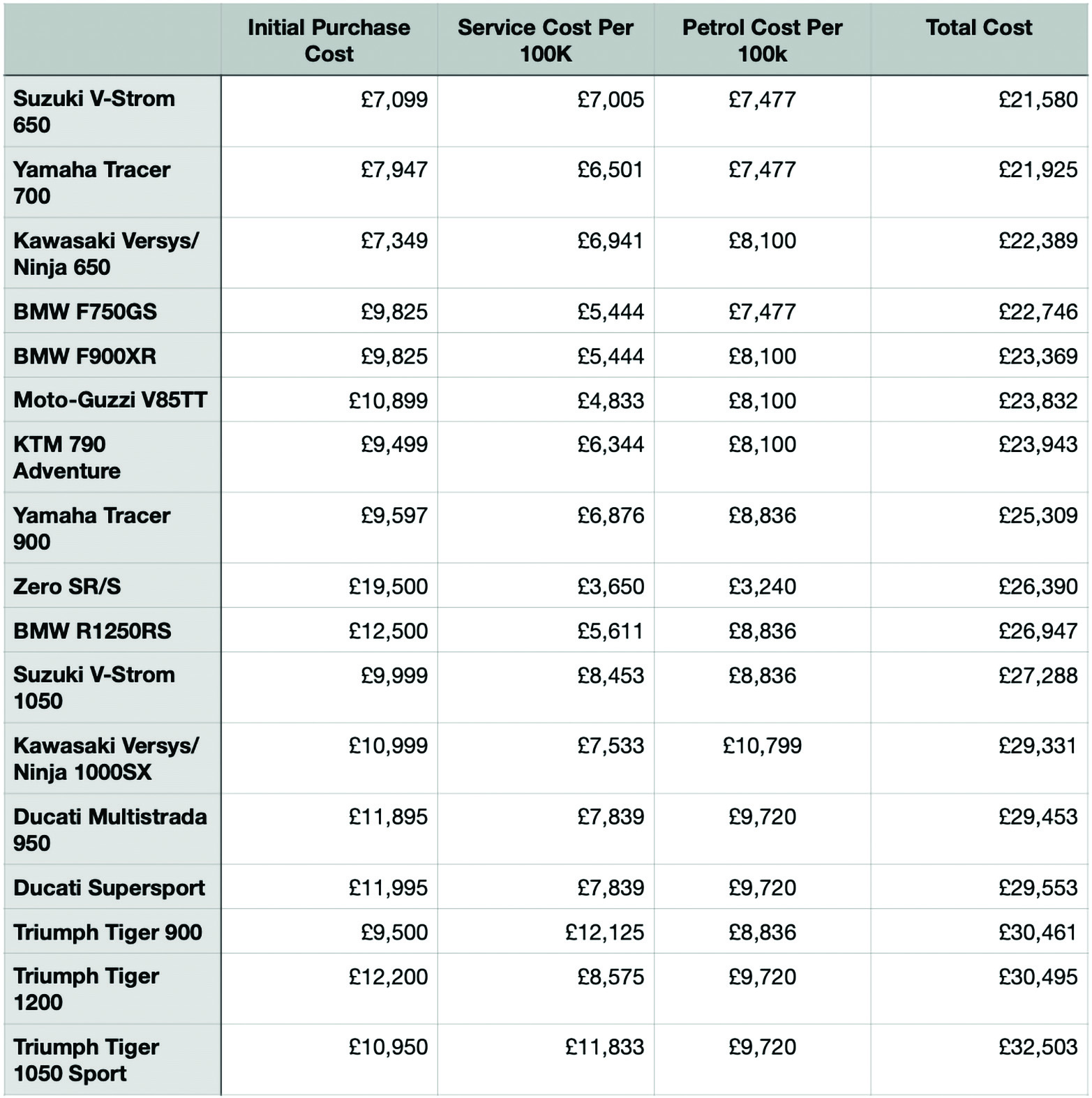
Finally, in order to get a comparable lifetime cost, I’ve assumed 100,000-mile ownership, multiplying the cost-per-mile of fuel and servicing by that number to get those total costs, then adding them to the original base-model purchase price of the vehicle. Again – these numbers are for comparison only, and your mileage will literally vary. But what we do see in these results is very interesting indeed.

I’m making a couple of assumptions (purchase/petrol price) but the numbers don’t lie.

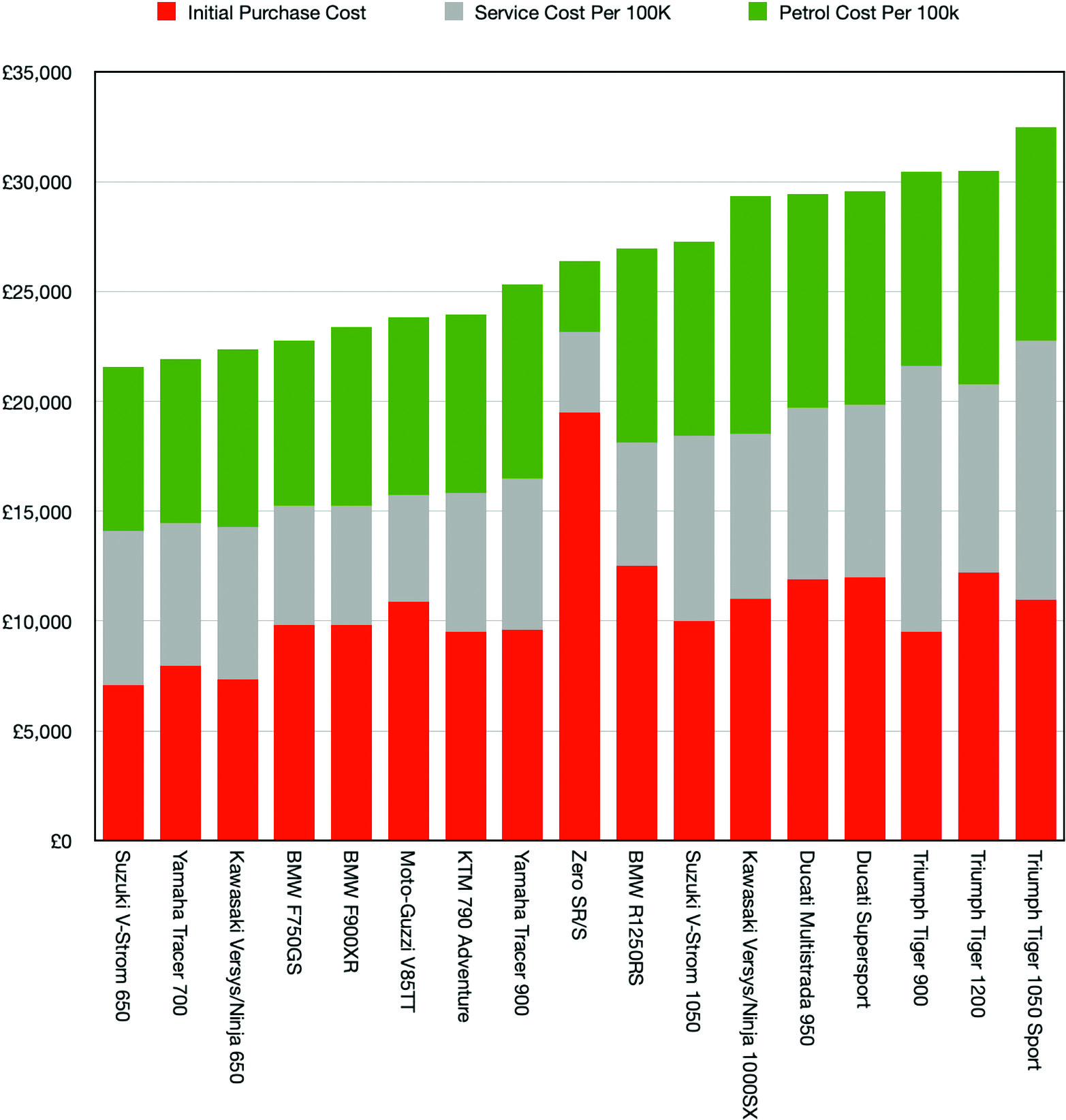
Sorted by total cost, the results are somewhat surprising.

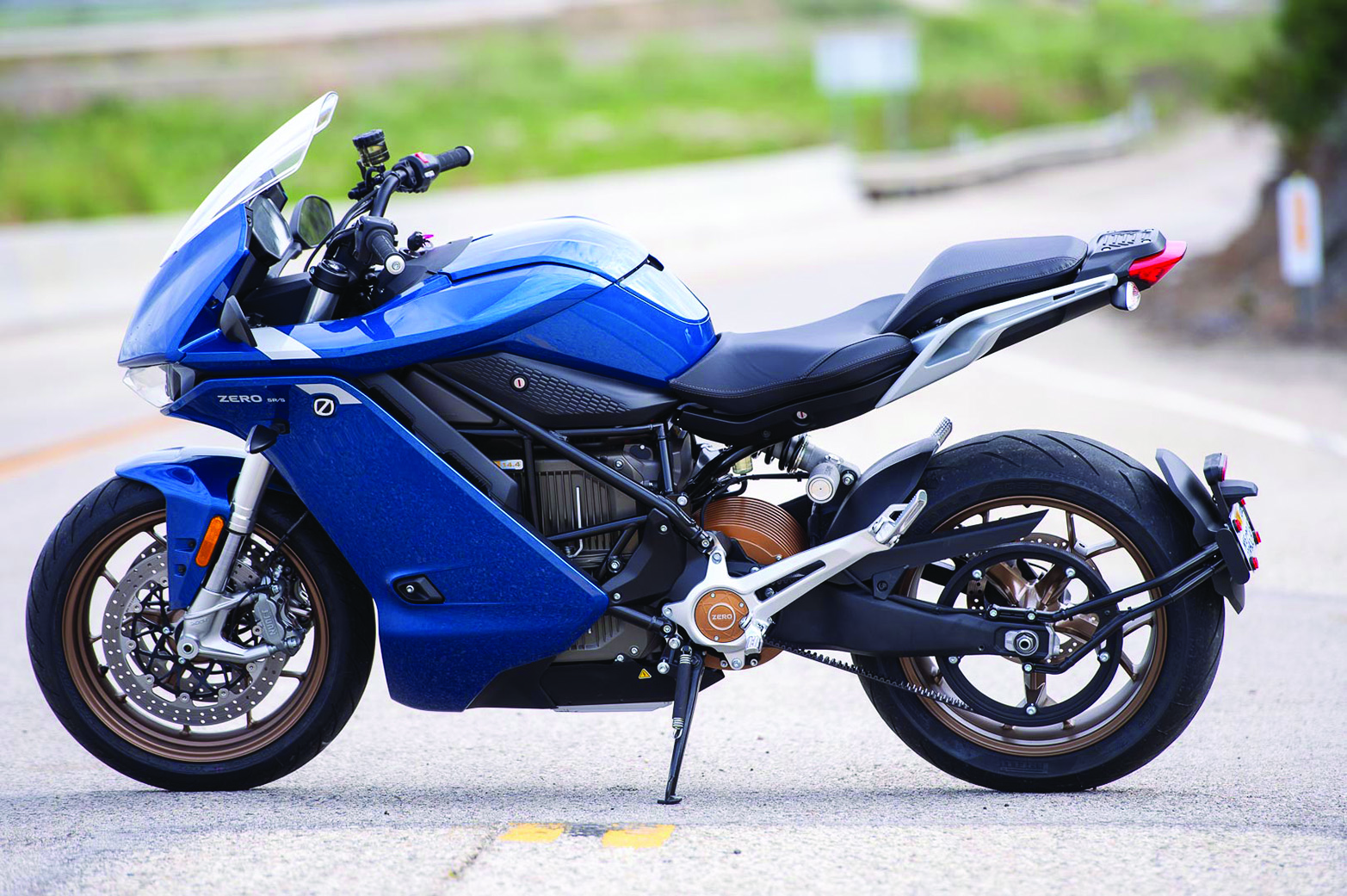
First up, some motorcycles and brands are incredibly expensive to maintain. Secondly, while some bikes are more expensive to buy up-front, their reduced fuel consumption and servicing costs can make them more competitive than they would initially seem. The obvious example here is my wildcard electric motorcycle, the Zero SR/S. Almost £20,000 for the base model with no extras, but cheap(er) servicing and tiny fuelling (electricity) costs mean that it sits right in the middle for total cost of ownership. An interesting detail here is that Zero want you to bring their bikes in for a service every 4,000 miles, something their dealer was unable to give me a good explanation for. An electric motor requires no servicing, so the only things your dealer is charging you (hah!) for are checking that nothing’s worked loose and inspecting the brakes and tyres. If there was ever a candidate for home-servicing, it would be this one.

Here it is: the most expensive all-round motorcycle you can own.

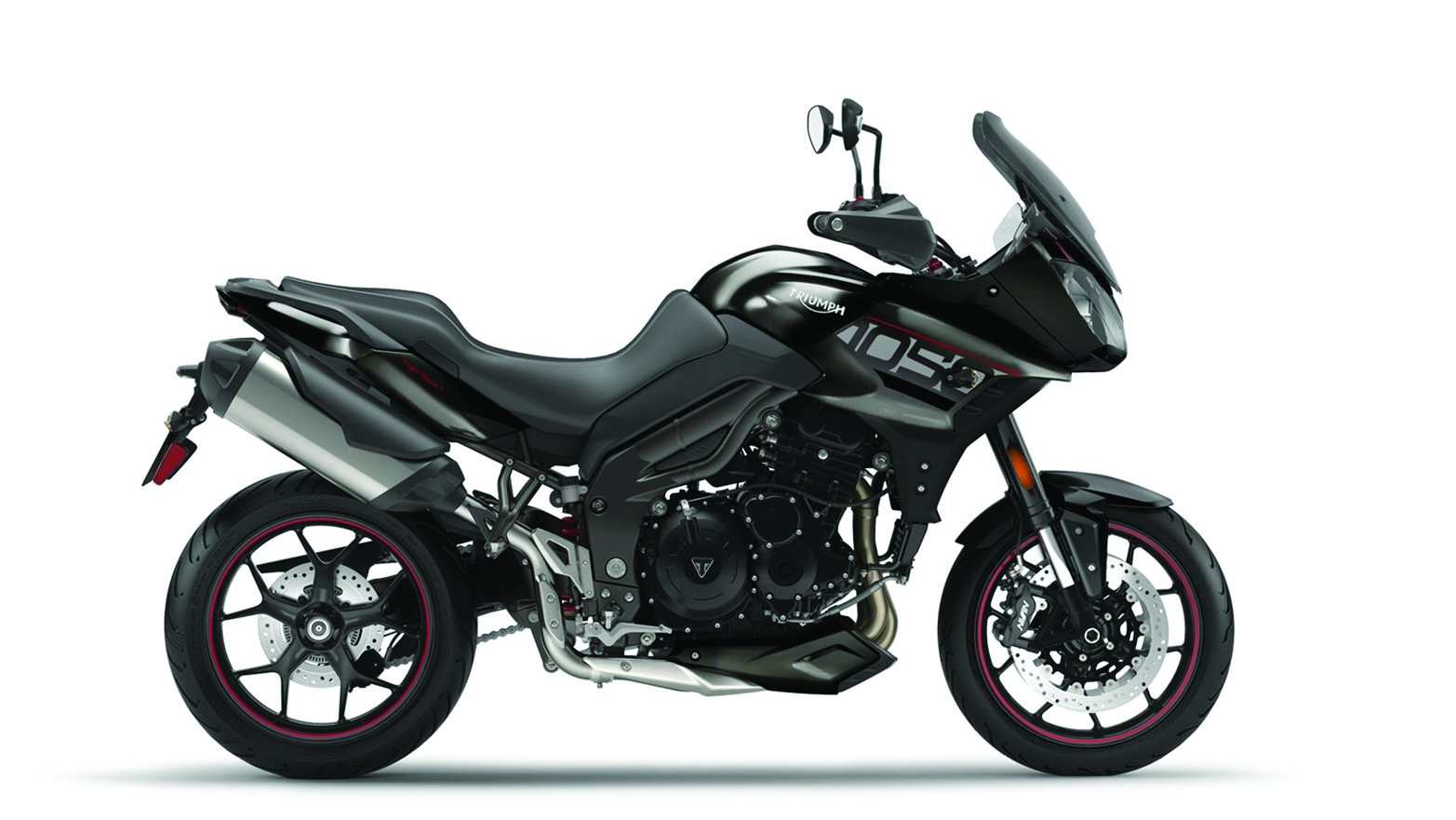
Triumph unfortunately lose this competition right away. Not only are their bikes priced quite high thanks to their features and technology, the relatively frequent servicing costs are truly eye-watering. The bigger Tiger 1200 fares a little better here with its impressive 10,000-mile service intervals, but the thirstier engine and high purchase price cancel out the gains almost exactly compared with the cheaper Tiger 900. Clearly Triumph’s engineers are placing ease of servicing very low on the priority ladder. That being said, the tick-sheets I’ve seen suggest that some of this is at least due to a far more thorough schedule of work – no other manufacturer that I know of includes greasing suspension linkages and changing fork oil as official service items.

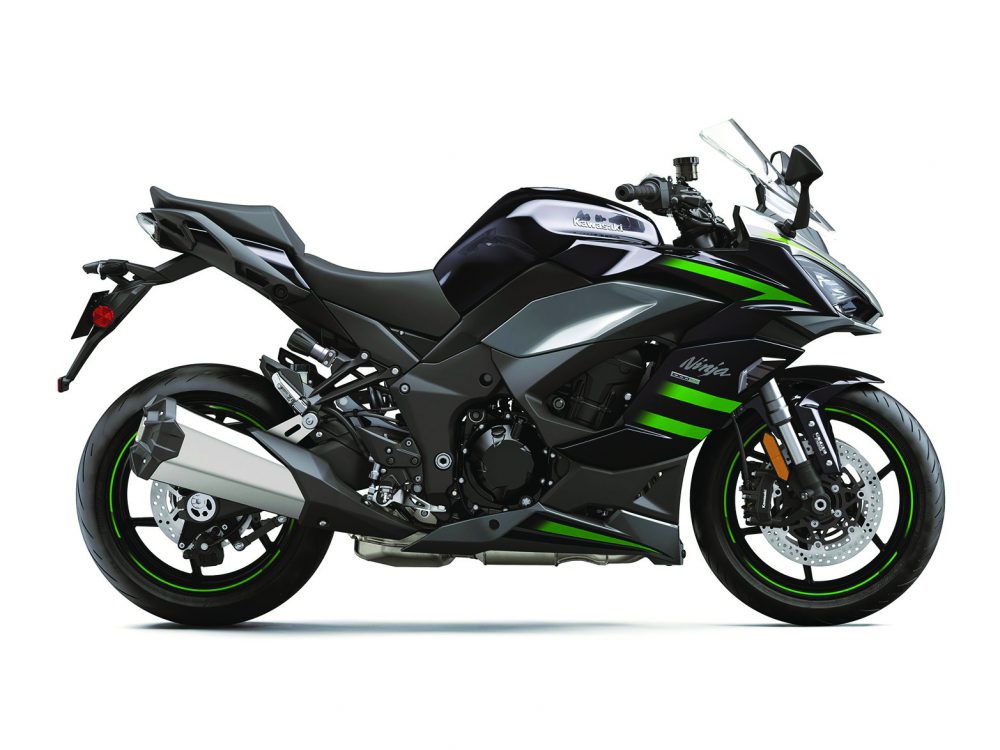
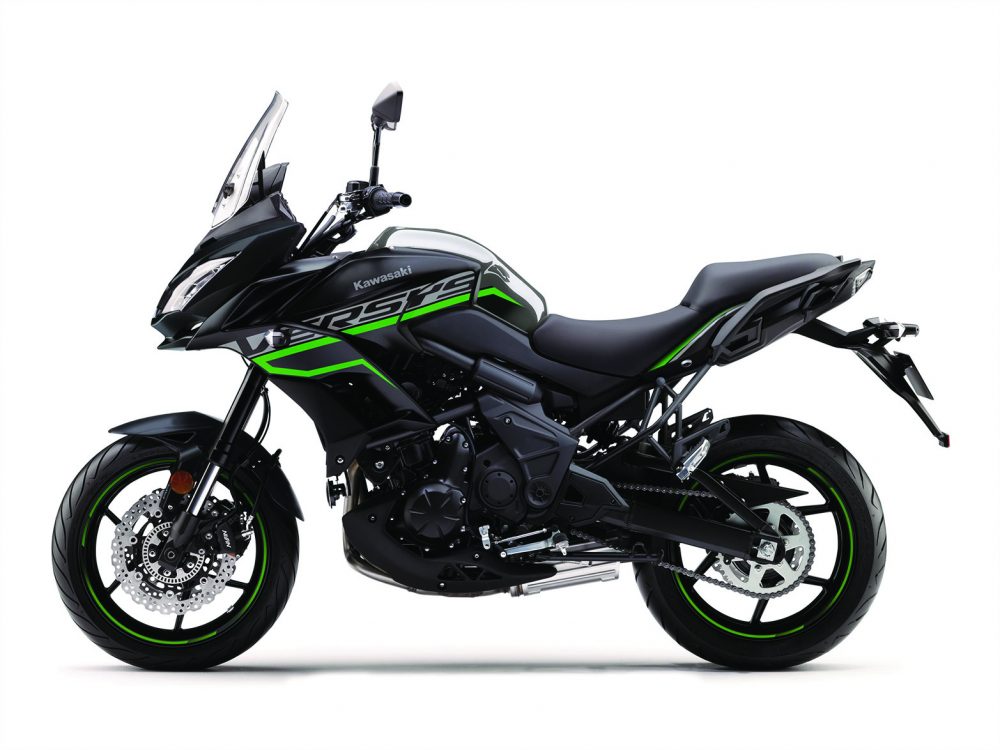
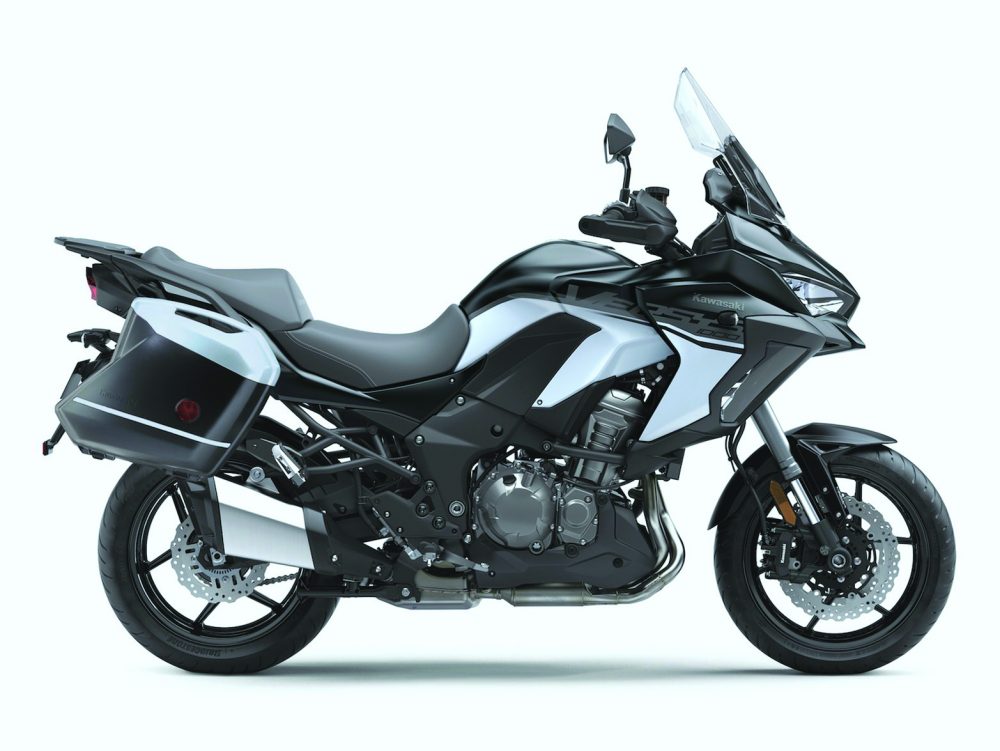
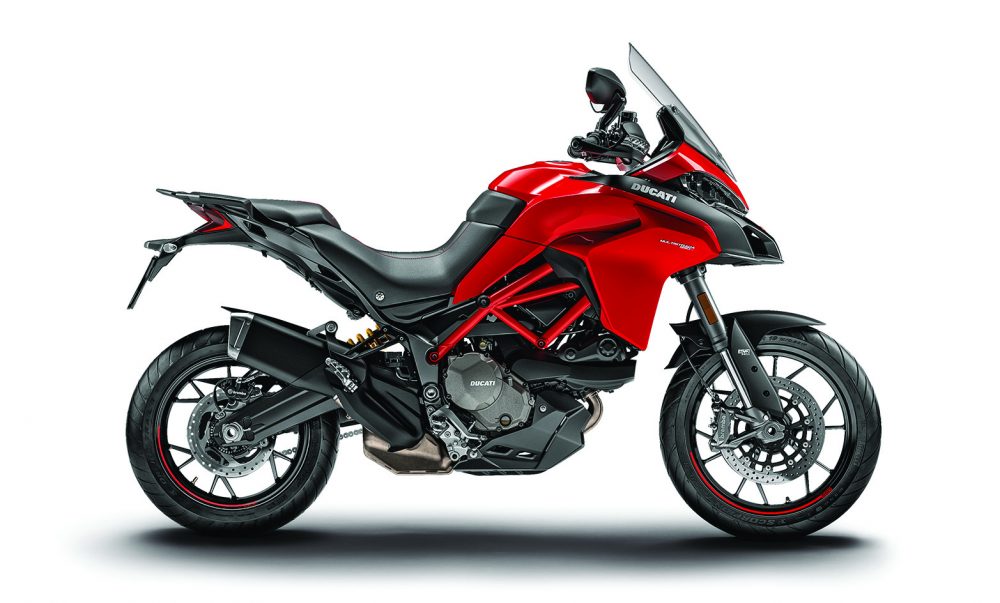
Seeing Ducati taking a dishonourable second place shouldn’t really be a surprise – they’re expensive to buy, you expect them to be expensive to service, and that turns out to be true. The Italians have tried to improve matters in recent years by increasing the intervals with which your dealer will empty your wallet, but empty it they will. More surprising is to see Kawasaki nipping at their heels, with the Z1000SX and Versys 1000 siblings costing almost as much to run in the long term. It’s a triple-threat here, with Kawasaki pushing their pricing up in recent years as they’ve piled on the technology. This combines with frequent and expensive servicing and a relatively ancient engine design that delivers fairly shocking fuel economy figures.

Modern design and electronics, but thirsty and difficult-to-service engine raise costs.

Cheap to buy, frugal on fuel and low-cost servicing, but questionable reliability.

Almost as surprising was to see Suzuki’s V-Strom 1050 close behind. Suzuki is another once-budget brand that has recently developed up-market aspirations, and the elevated purchase price coupled with eye-watering service costs make for unflattering comparisons with the competition. BMW’s big 1250cc boxer needs servicing slightly more often than Suzuki’s venerable v-twin, but the ease with which the mechanics can access those exposed cylinder heads means that servicing is some of the cheapest around. You can push the purchase price up with frightening ease once you dip into the not-really-optional extras, but it’ll still work out cheaper in the long run than the decidedly less sophisticated Suzuki.

Yamaha’s Tracer 900 suffers from the same problem as other Japanese motorcycles. It’s becoming an expensive bike, especially if you start adding on luggage and opt for the better-equipped GT model I recently reviewed. But because valve clearances only need checking or adjusting every 24,000 miles, maintenance costs are kept under control, and like the big BMW it manages impressive fuel economy for such a powerful motorcycle. I’ll get to this later, but I’m also more inclined to believe that the Tracer 900 would last 100,000 miles without too much trouble, whereas I’m not sure the R1250RS would.

Same exposed cylinders and also no chain or coolant to replace.

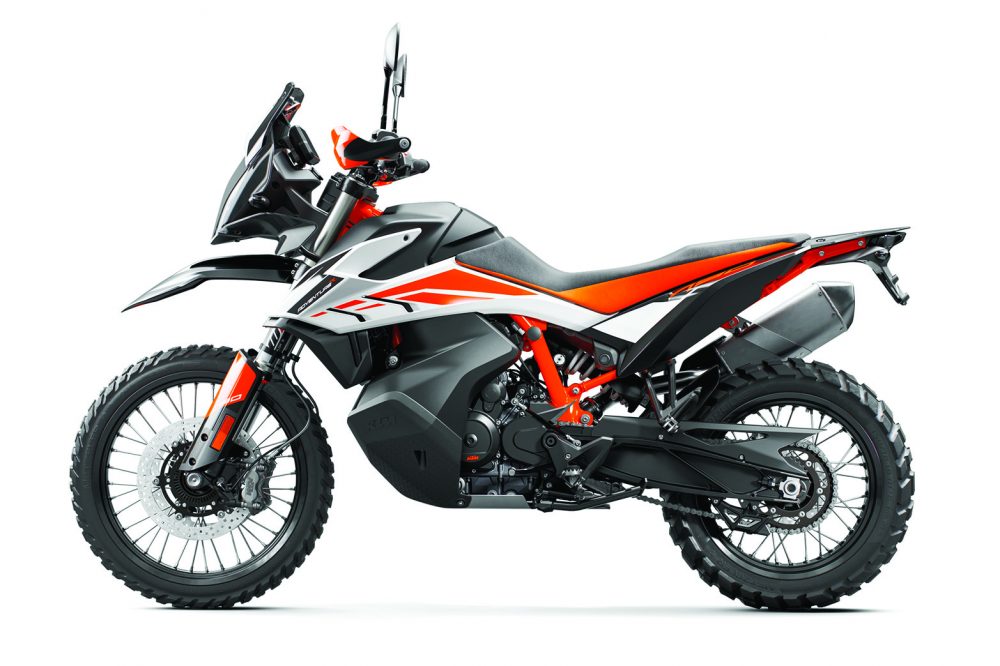
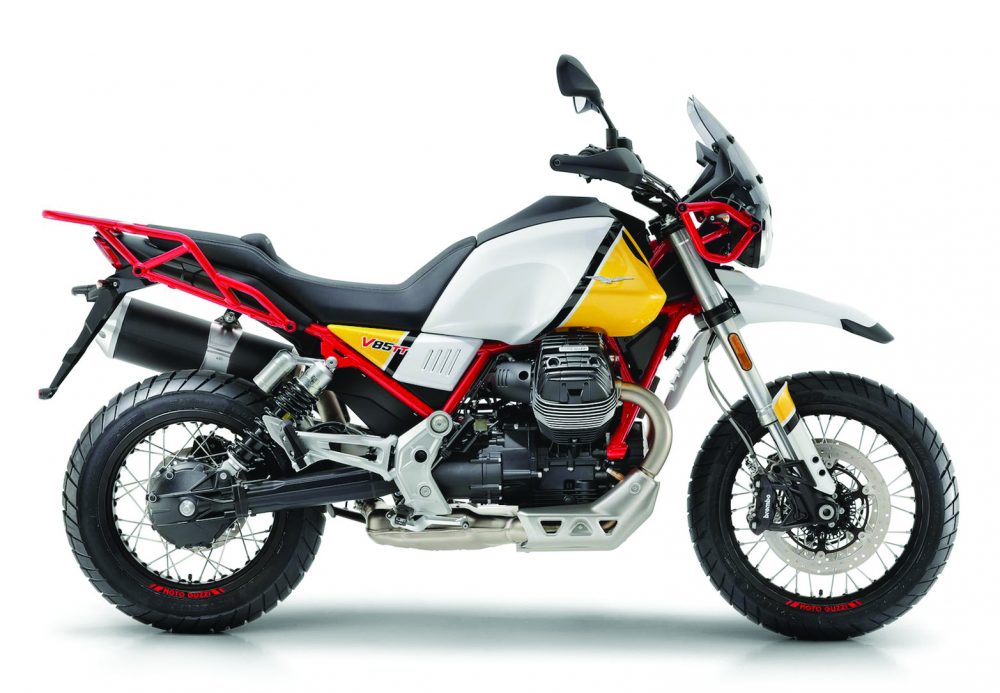
Our two oddballs come next, coming within spitting distance of each other. In KTM’s case, it’s because the 790 Adventure only requires the attention of a mechanic every 9,000 miles, and owners are easily returning an impressive 60mpg (UK). Reliability is a concern, with recent KTMs becoming infamous for requiring unscheduled dealer visits even during the warranty period. Not a problem for some, but a deal breaker for me I’m afraid. The Moto-Guzzi needs more frequent servicing, but that work is very cheap thanks to the exposed cylinder heads and relatively low-tech engine. The V85TT also boasts shaft-drive meaning that chain and sprocket replacements will never be necessary. What’s more, an air-cooled engine means it will never need coolant changes, a further cost saving compared to all the other bikes I’m considering. A very tempting choice indeed.

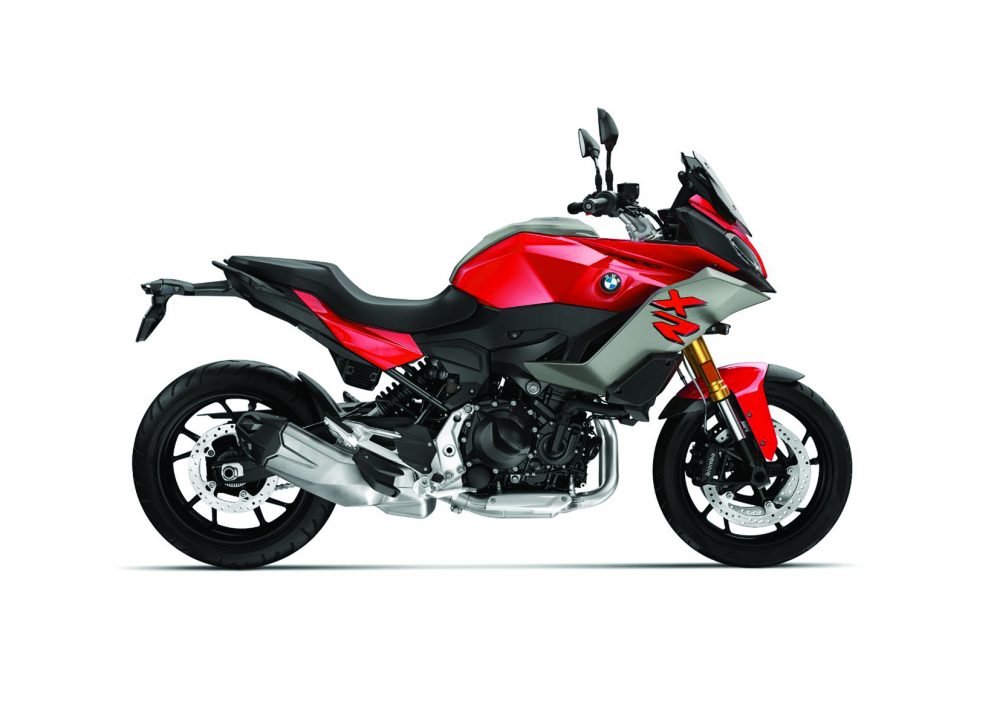
Next comes another surprise. Despite featuring an increasingly-common parallel twin engine layout, the BMW F750GS and F900XR are apparently very easy to work on, resulting in very cheap servicing, even at a BMW main dealer. They’re not cheap to buy, especially when you pile on the usual practically-mandatory option packs, but genuinely impressive fuel economy helps to push ownership costs down further still. These new engines are made in China, not Germany, so reliability remains to be proven, and BMW haven’t exactly been winning awards on that score of late in any case. But if you got lucky, either bike represents a very affordable way to enjoy that BMW ownership experience.

Next comes another surprise. Despite featuring an increasingly-common parallel twin engine layout, the BMW F750GS and F900XR are apparently very easy to work on, resulting in very cheap servicing, even at a BMW main dealer. They’re not cheap to buy, especially when you pile on the usual practically-mandatory option packs, but genuinely impressive fuel economy helps to push ownership costs down further still. These new engines are made in China, not Germany, so reliability remains to be proven, and BMW haven’t exactly been winning awards on that score of late in any case. But if you got lucky, either bike represents a very affordable way to enjoy that BMW ownership experience.

Surprisingly cheap to own, but BMW reliability has been slipping of late.

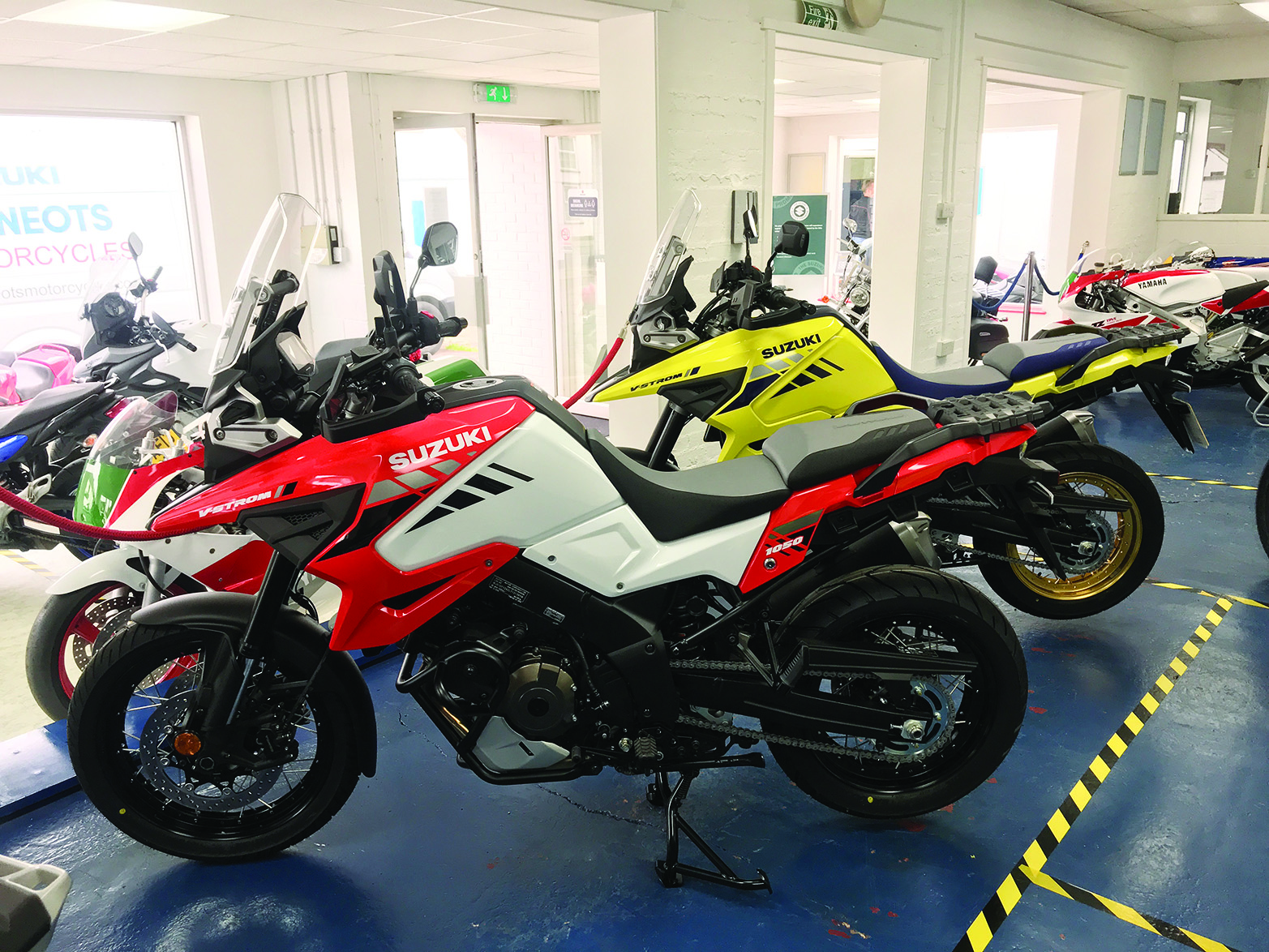
Bringing up the rear in the best possible way are the quartet of Kawasaki’s Versys/Ninja 650 pairing, Yamaha’s smaller Tracer 700, and in last (first?) place, Suzuki’s own V-Strom 650. I didn’t do these sorts of detailed calculations before choosing my own V-Strom back in 2015, but it’s interesting to see that even if I’d bought new and paid a dealer to take me all the way to 100,000 miles it would still have been the cheapest bike in the segment to own. In my case I’ve saved money by doing my own maintenance, then spent it again on performance modifications, but so far my own records suggest that I’m coming in way under-budget. This is important, as all four of these smaller-engined ~70bhp machines still require a big-bike-sized amount of regular maintenance. Good fuel economy and low purchase prices help keep the numbers down, but their comparatively low-tech nature makes them prime candidates for learning to change your own oil and check your own valves.

Mechanically simple engines present a realistic home-servicing opportunity.

With rising price tags, the Japanese bikes are now competing directly with the Europeans.

We can draw some interesting overall conclusions from all of this. Firstly, while recommended retail price is a good indicator of lifetime ownership costs there are enough outliers to warrant closer inspection. Secondly, if a bike looks easy to service, then it probably is. Exposed cylinders make for quick, and therefore cheap, valve clearance checks, while complex multi-cylinder engines are generally difficult to work on. Thirdly, the Japanese manufacturers may want to be careful about how quickly they’re moving their products up the premium bike ladder. Most consumers – and in some cases, their own build quality and dealership/ownership experience – still mark them as more budget offerings compared to their European competition. If they drive pricing up to far too quickly, they’ll find that they’ll lose more budget-oriented customers to previously-dismissed players like Moto-Guzzi, while still being unable to tempt customers away from their new premium competition at Triumph, Ducati, and BMW.

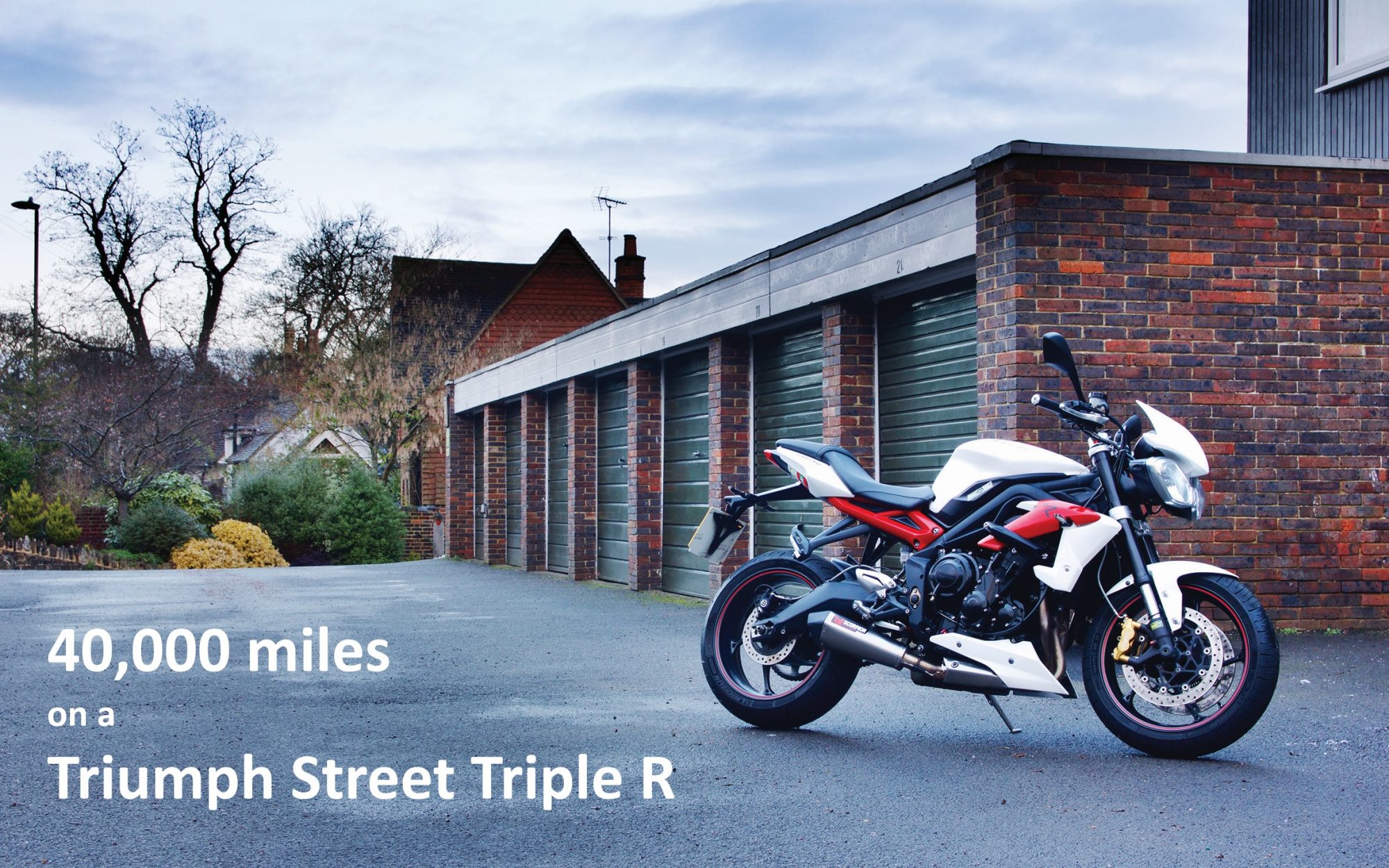
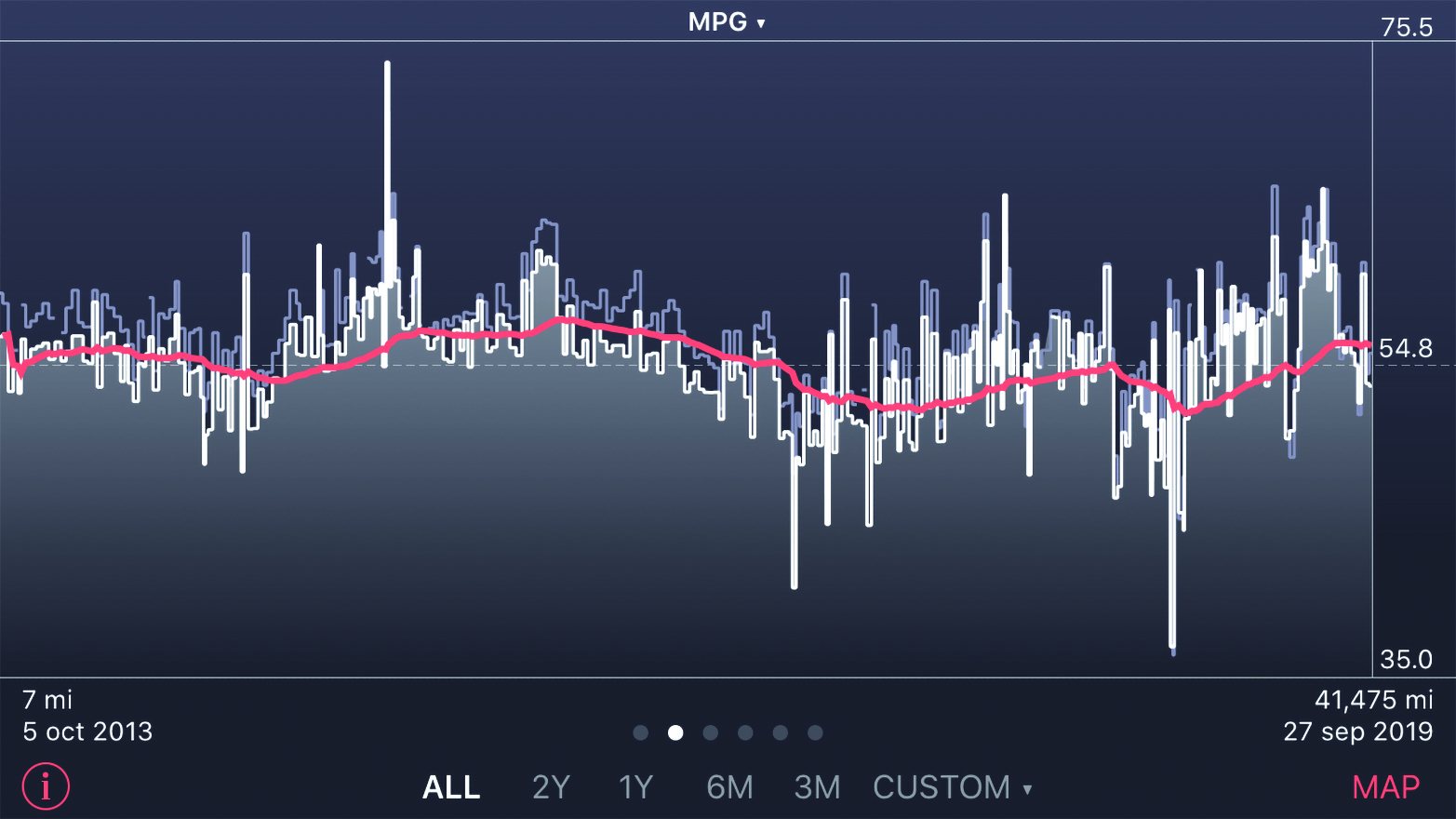
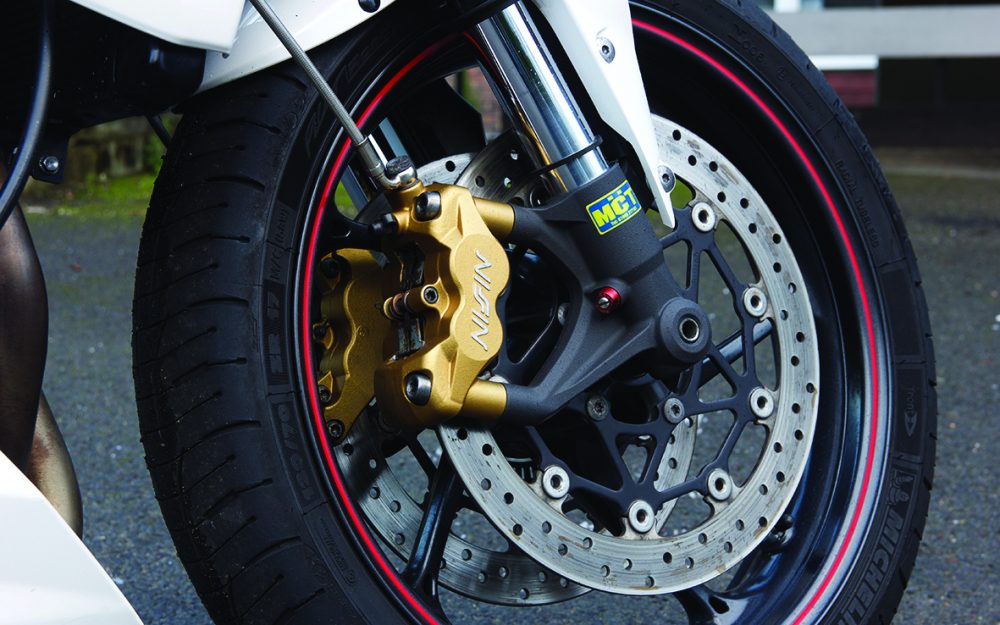
Fourth, Triumph needs to get their act together. I stopped taking my own Street Triple R to my dealer very early on because of the laughable quotes I was being given for scheduled maintenance, and it looks like the latest evolution of that engine is even more expensive to work on. Ducati has worked hard to shed it’s expensive-to-maintain reputation because it was genuinely hurting sales. If Triumph can’t engineer their bikes to be easier and therefore cheaper to service then it won’t be long before they pick up that particular thorned crown.

Fifth, electric bikes are getting very close to where they could be seriously considered as sensible all-weather, all-purpose commuters. The range and charge time mean that touring is out of the question, but if you rack up big mileages riding to work you can just about break even with the petrol-powered competition. Just as we’ve recently hit a breaking point in electrically-powered cars, practical home-charged motorcycles could be just around the corner. It will be interesting to see what Fuell’s upcoming offerings look like in this regard, and even Honda are said to be preparing an electric version of their CBF300 with a focus on affordability.

Sky-high purchase prices are coming down but frequent servicing is a puzzler.

But as I’ve suggested earlier on, you’ll want to do your own calculations and see how the numbers stack up for you, but this should at least get you started and it’s enabled me to draw some interesting conclusions. Most bikes will never see the sort of mileages I’m suggesting, which is just as well as I don’t trust a lot of them to last that long. What’s more, while bikes like my V-Strom are proven to be reliable well beyond their warranty period, owning the likes of a BMW could potentially get very expensive once coverage expires. I’ve never seen a high-mileage Multistrada, but don’t know whether that’s because no-one rides them that much or because they all explode long before they reach six digits. I do know that my local independent Ducati mechanic is always over-subscribed, but maybe their newer engines are more long-lasting than their old air-cooled stuff.

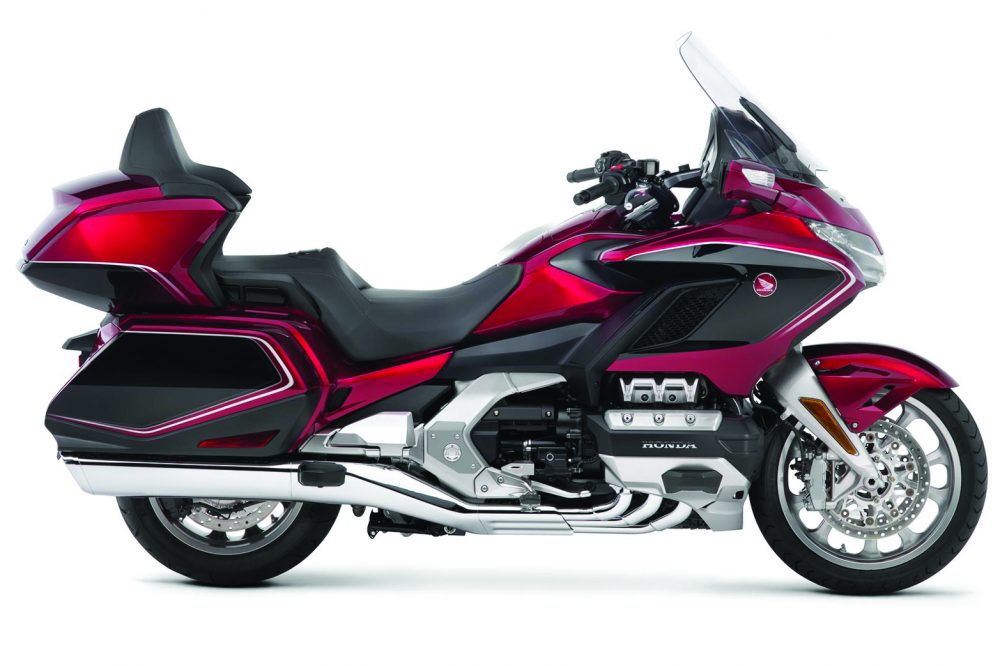
One final point to remember is that every motorcycle is designed to a brief – it’s designed to fulfil certain criteria, and longevity is one of those. Honda know that Goldwing riders will hit six digits with ease and regularity, and a reputation for reliability is what keeps them coming back. That’s why Honda’s engineers spend extra time, money, and resources ensuring that those bikes probably will hit 100,000 miles without breaking a sweat. And I’ve seen a 50,000-mile tear-down of a modern Tiger 1200, and absolutely everything was still perfectly in-spec, a good sign that the engine had been designed to do big miles.

Improved reliability, but would you trust it to last 100,000 miles?

Doing high mileage? Buy a bike that can handle it.

BMW once told me that their customers trade their bikes in for a new one on average every 20 months, after which the bike is sold into the used market. Cynically-speaking, that second owner matters far less to BMW than someone who guarantees them a regular income for years to come by buying their bikes brand-new. If that first-owner, the person they’re trying to impress and keep coming back never sees 30,000 miles on any one bike, how much effort and money do we really think their engineers are spending to ensure that those engines will last two or three times that long?

Honda has an incentive to ensure that Goldwing owners’ reliability expectations are met.

But just as important as the design brief are your requirements as a customer, as a motorcyclist. If you like buying new bikes fairly regularly and never rack up big mileages, then long-term servicing costs probably won’t matter to you. If you ride infrequently, then the difference between 40 and 50mpg is completely irrelevant. And if you don’t depend on your bike for daily transport or regularly take long trips, then maybe you’re happy to risk needing that warranty every now and again. And let’s face it, thanks to PCP, a lot of people spend more on their monthly phone contract than it would cost for some new motorcycles. If that’s you, then knock yourself out – go enjoy the incredible variety of choice available to you at your local showrooms.

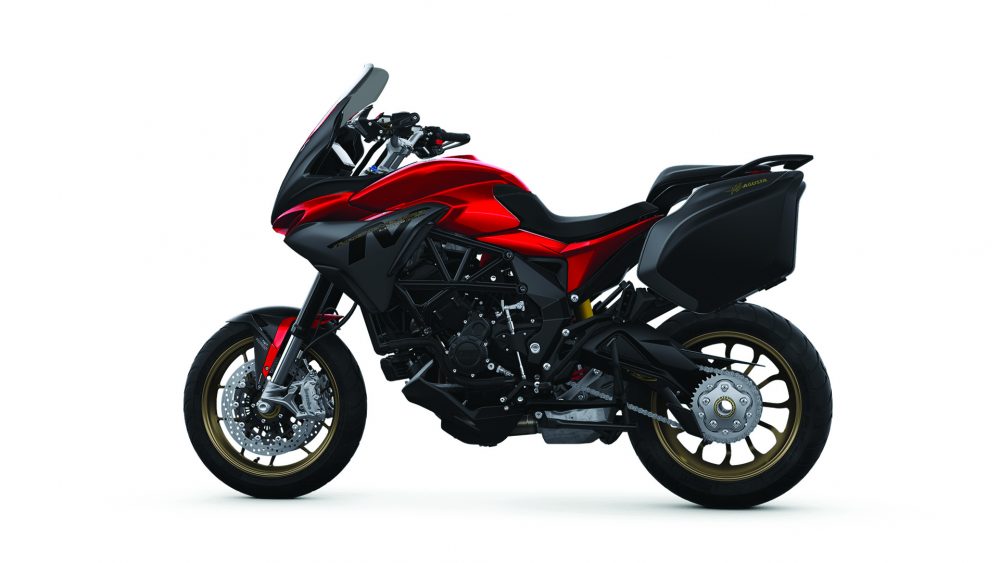
MV Agusta TVL: Money or reliability no object, my perfect motorcycle. But sadly, both are factors

But if, like me, you want to buy and keep a bike long-term and expect to put big miles on an engine without dealing with unexpected repairs, I suggest you be a little bit more discerning. Choose a bike that the manufacturer intended for that purpose. Do the maths and make sure you aren’t going to encounter any nasty financial surprises, and maybe you’ll find that some options you’d previously dismissed become viable choices after all. Do your homework and you can sometimes extend that new-bike honeymoon period to the full 100,000 miles.

Nick Tasker

First published in Slipstream September 2020

An A-Z Guide to Motorcycling in France

ccidents – Those things that only happen to other people – hopefully. But if you do come across one be aware that there is a legal duty to “assist persons in danger” so theoretically you could be prosecuted if you don’t stop and help.

Accotements Non-Stabilisés (Unstable Verges) – Like it says, don’t stray off the black stuff.

Alcohol – They make it very easy to get hold of alcohol, and very hard if you drive with some inside you. The permissible limit is much lower than UK, random tests are common and if caught you can be arrested on the spot, your licence taken away and your vehicle impounded (see Justice). Enough said.

Autoroutes – Mostly as boring as UK motorways but at least a bit quieter and quicker. Most are Toll, except close to Paris and other large cities where they form part of the ring road network. Direction signs to autoroutes normally indicate whether it’s a toll (péage) one, and similarly show when you are entering a toll zone (Section a Péage).

Bicycles – A national sport, so cycles are treated more tolerantly by other road users than in the UK. Allow 1.5 metres clearance (1 metre in town) when overtaking. At weekends large groups of “cyclotouristes”, (un)suitably clad in full team lycra, take over the roads, keeping up a fair old pace. For major races the roads are closed – for the Tour de France in July they are barriered off, and you could wait for several hours while the whole circus passes through. In mountain regions the passes may be closed for days, and even when opened again will be full of German campervans and drunken Danes.

Bison Futé – Real-time information on road conditions throughout France (in English) – http://www.bison-fute.equipement.gouv.fr/diri/Accueil.do?langue=en.

Bis-Routes – Alternative routes using secondary D-roads intended for holiday traffic. Useful for making reasonable progress with better scenery, often include a few entertaining stretches. Look out for yellow and green “Bis” direction signs.

Breathaliser – It is compulsory to carry one, but the fine for not doing so is not currently being enforced – Gallic logic?

Camping Equipment – Size matters (the smaller the better), so e.g. an air bed is more compact (and comfortable) than a foam roll, a sports chammy is smaller than a towel and can be packed away wet, etc. See Luggage.

Camp Sites – Plentiful but, apart from a few holiday areas, most only open for the peak holiday period. Those that are open earlier and later cater mainly for a steady stream of caravanning or campervanning Dutch pensioners. Municipal sites are good value and have adequate facilities if you’re in transit; private ones are more geared to a longer stay. In July and August sites in popular areas (including near Channel ports) can get busy so book ahead if possible. Info and bookings via http://www.campingfrance.com/index.jsp?lg=uk. Pick sites in easy walking distance of town/village centre, or with on-site bar-restaurant, so you don’t have to get kitted up to go out for a meal (and you can have a drink with it – see Alcohol) and to fetch the compulsory baguette and croissants for breakfast; some sites may have a baker who delivers in the morning. Anywhere near water can suffer from biting insects early in the season. Many sites are on soft sandy soil so don’t forget a decent “puck” to put under the stand. You’d think this would make it easy to push the tent pegs into the ground, but the sand is usually only about 5 cm deep before you hit the rocks beneath. Unfortunately, in these economically difficult times, sites in or near industrial towns may have a significant population of what the French term “SDFs” (sans domicile fixe – no fixed abode) i.e. homeless people, sometimes in casual jobs who may work (and come and go) at unsocial hours, as well as giving the site an uneasy ambience.

Chambres d’Hote – Bed, breakfast and evening meal, but don’t be late (see Eating).

Chaussée Deformée (Bumpy Road Surface) – A rare sight nowadays, and often no worse that your average UK road.

Code de la Route – Several non-government concerns, e.g. Michelin, publish an illustrated book with this title. Sort-of equivalent to our own Highway Code, but with added test questions, so more a primer for people taking the theory test. Copies available in hypermarkets or newsagents/booksellers e.g. Maison de la Presse, but at 15€ a throw and upwards they make ours look something of a bargain.

Corner-Cutting – A bad French habit, which they aren’t about to abandon just because some Brit biker is riding for a view (or because there’s a solid line down the middle of the road, for that matter). Remember SSV, and be prepared to give up some of that view on blind right-handers in case something suddenly looms into view on “your” bit of road.

Crit Air Vignette – This air quality certificate is a vignette issued to show a vehicle’s compliance with European emission standards and is required for some of its cities. To find out the latest requirements and buy one for €3.62 if needed visit https://www.certificat-air.gouv.fr/en/

Currency – A sore point at the moment, and not likely to get much better in the near future, so it’s even more important to find the best possible deal. Get a few Euros “float” from the Post Office before you go, but for best rates go to a cash point in France using a cash card issued by e.g. Nationwide. Some credit cards, including those from Nationwide and Halifax Clarity, also give the spot market rate but charge a cash withdrawal fee, and also charge interest from the day of withdrawal. Most other cards take an “exchange fee” of around 2%, which may still be better value than bureaux de change in the UK or on a ferry. Pay for as much as possible (petrol, hotels, meals etc.) with a credit card (Carte Bleu or CB)to minimise the need to obtain cash. Inform your card issuer(s) of where and when you are going to avoid the possibility of the card being refused. Failing all that, at current exchange rates you could always sell your bike for a profit at the end of your holiday and hitch-hike home.

Customs Checks – Quite common on roads near land borders, but possible almost anywhere. Unlikely to be an issue when you’re on a bike, unless you bought a lot of cigs or whisky in Andorra.

Département – Equivalent to a county in UK, but with greater autonomy in certain respects. Often referred to by its number, e.g. 62 is the Pas de Calais – see a road map for the full list.

Direction Signs – Generally clear and consistent. On autoroutes signs show distances to the final destination(s) and one or two intermediate major towns/cities; separate signs also show the places served by, and the distance to, the next exit. As a rule, on N-roads signs will show a major destination (which may be quite a long way away) and the next town, plus intermediate towns if appropriate. Signs on other roads usually only show the next couple of places, with sometimes a longer-distance destination, so navigation using D-roads generally requires more detailed route planning.

Documents – I.D. (passport), driving licence, V5 and insurance certificate (and probably MoT – there is currently no equivalent for bikes in France but you may need it if you stray further afield) must be carried at all times. Also carry EHIC (European Health Identity Card – at least valid until 31st December 2020) and travel insurance document (see Health). Take backup photocopies packed separately, and/or scan documents and post to an accessible site. I also carry scanned copies on a memory stick. See also Other Paperwork.

D-Roads (Routes Départementales) – Where the fun starts (possibly). Sort-of equivalent to UK B-roads, but cover a much wider range, from stretches of almost motorway standard, through fast and open to extremely twisty or just one damn village after another. When planning a route using D-roads check on a reasonable-scale map if you want to make decent progress. D-road numbers are often not shown on direction signs, only on Km posts on the verge. Note that a D-road’s number usually changes when it crosses from one département to the next; surface quality often changes abruptly too. See also Bis-Routes.


Eating – That’s one of the main reasons you came to France, right? But it’s just as easy to get mediocre food in France as anywhere else – try to eat where the locals do. Menus translated into English rarely bear any resemblance to what finally arrives on your plate – better to get the French version and use a phrase book. Set menus are always better value than a la carte. Most of France strictly observes standard mealtimes – 12:30 for lunch and 19:30 for dinner – arrive much later and you risk being turned away.

Emergency Phone Numbers – The French have traditionally had separate numbers for fire, police, non-emergency ambulance etc. but to keep it simple the standard European emergency number, 112, will get you through to the Pompiers (fire brigade and first response team).

Emergency Kit – Contrary to what ferry companies would have you believe when trying to sell you an overpriced “continental touring kit”, it is not compulsory to carry a warning triangle, first aid kit or spare bulbs on a bike, but carrying (not wearing) a hi-vis bib has been compulsory since 1st Jan 2016. Nonertheless, it is good practice for at least one member of the party to be suitably prepared – see Tools and Spares.

Eurotunnel – The quickest, but not the cheapest, option. Ride on, stay with the bike, ride off, simple. Take a stout rubber band to tie the front brake lever back to prevent the bike shifting due to the movement of the train. Disadvantage is you don’t get a chance to have a rest and a meal or a coffee like you do on a ferry.

Falling Rocks – The danger is not so much of a rock falling on your head (though it has happened), more of finding a pile of large, razor-sharp lumps lying across the road, waiting to shred your tyres or worse.

Ferries – Old hands will probably prefer to strap their own bike down but newbies may want guidance – some companies are more helpful than others – P&O now says it’s your responsibility. When tying down in the usual way with a single ratchet strap, put the bike on the sidestand (never the centre stand) and put your weight on the seat to load the springs as you ratchet it down. Not all the straps provided have a pad to stop it digging into the seat, so be prepared to use something like a folded-up pair of jeans (protected by a plastic bag) for this purpose.

Filtering – Although filtering is officially a no-no, (except for a few areas where it is under review), French drivers actually expect bikes to filter and overtake at every opportunity, and many will helpfully move over even in the most inappropriate places. So if you just want to go with the flow make your intentions clear by staying well back. See also Roundabouts.

Gendarmes – See Police

Gloves – It has recently become compulsory for riders and passengers to wear CE-marked gloves. However, any proper bike gloves should be OK, unless a gendarme is having a really bad day.

Gravel – The French are even worse than UK roadmenders at not sweeping up excess gravel after resurfacing. They also have a bad habit of scattering loose gravel onto roads where the tar is in danger of melting in the summer. Usually there will be warning signs but it can’t be guaranteed, nor is it easy to tell when the danger has passed.


Hazard Warning Lights – Should be used when there’s a sudden reduction of speed ahead.

Headlamps – Motorcycles must use dipped headlights which should be adjusted if necessary so as not to dazzle oncoming traffic – stick-on beam adjusters are normally unnecessary so long as you can adjust by other means. The law also says the dipped beam should illuminate the road at least 30 metres ahead. In practice there shouldn’t be a problem.

Health – The EHIC (European Health Insurance Card) will allow you to get emergency treatment at any hospital or clinic affiliated to the French national health scheme – at other clinics you may have to pay and claim back later. With Brexit it is valid until at least 31st December 2020. You will probably also get a bill for the extra treatment cost over and above the official minimum, plus other things like an ambulance if required, hence it’s wise to take out top-up travel insurance that will cover these extras. Be sure the policy covers motorcycling as most insurers consider it a “hazardous activity” and load the premium.

Helmet Reflectors – 4 reflectors of a certain minimum size, placed front, rear and either side of the helmet, are compulsory. However, I’ve done a lot of miles in France without, and never had a problem. Cheaply available on ebay etc.

Hi-vis Riding Gear – It was proposed a while ago to make this compulsory, but for the time being at least it has been dropped.

Hotels – Budget chains (Formula 1, Premiere Classe, Ibis Budget, B&B etc.) are usually cheapest but do not have restaurants (though there may be one in the vicinity) and parking is often not secure. Hotels affiliated to Logis de France (www.logisdefrance.com) are often not much more expensive and many serve top quality food. Many small family-run hotels close for at least one day per week, especially out of season.


Indicators – Used sparingly and don’t necessarily mean what Brits might think they do, so best to ignore and play safe. The exception to this rule is on dual carriageways/autoroutes, where the left-hand indicator is kept on angrily throughout a passing manoeuvre, particularly when pushing hard behind someone else in the overtaking lane.

Insurance – Your UK insurance will, as a minimum, give basic third-party cover for the EU – possibly fine for a quick day trip to Calais but not enough for a decent touring holiday. Check your policy gives adequate cover, for the necessary length of time, and inform the company/broker of the dates when you’ll be away. Make sure you have the emergency number to ring (NOT a UK 08….number).


Justice – The French legal system is very different from ours. They have only recently adopted the principle of innocent until proven guilty, which is nice, but can still be a bit trigger-happy in locking up anyone suspected of a serious offence, including those relating to road traffic. Make sure your travel insurance includes legal cover.

Kit – If you’re planning to go somewhere a bit warmer, a tricky one. Even if the UK is in the grip of a heat wave when you leave, you can be sure it will be back to normal by the time you get home, and northern France can be just as inhospitable as England. But standard UK kit will be uncomfortably warm in the 30°+ you’ll be hoping to find down south. You won’t have the space to pack a second, lightweight, suit while leaving enough room for the bulkier items in your luggage when you change, so the best compromise may be a ventilated touring suit or leathers (or a mixture) together with a waterproof oversuit, plenty of layers and the essential spare pair of gloves – do make certain there’s somewhere to put everything when you take it off or switch from one outfit to another. Black absorbs the sun’s heat, so choose a lighter colour if you’re buying kit specially for this sort of trip. A lightweight neck tube will stop insects from buzzing down your front. Of course the locals ride around happily in T-shirts and flip-flops, and no doubt the hospitals are expert at treating gravel rash, but you wouldn’t want to put them to the test, would you?

Luggage – No point in covering this in depth here, you may well already have some for your bike and if not you’ll have a good idea of what’s suitable. So just a few comments. Firstly, do a thorough “shake-down” run with all your intended luggage, suitably packed, well before you set off. This should not only sort out any issues with the luggage itself and make sure you (and your passenger) can live with it, but also show up any handling problems that might arise when the bike’s fully laden. Secondly, respect load limits stated by the manufacturers of both the bike and the luggage. Thirdly, stuff you need “en route” must be readily accessible. Finally, pack everything in plastic bags or waterproof liners, even if you have hard luggage.

Millau Viaduct – Famous toll bridge carrying the A75 autoroute over the valley of the Tarn, bypassing the eponymous town. A magnificent structure, best appreciated from below. A layby with a good view has been built on the old road as it drops down into Millau from the south. Further north on the A75, but equally impressive considering its epoch, is Eiffel’s Viaduc de Garabit carrying the railway over the River Truyere – excellent view from the Garabit service area on the A75, accessible from either direction.

Mobile Phones – As in the UK, use of a hands-free mobile is permitted but a hand-held mobile is not. In recent years the law has changed to outlaw any in- or on-ear devices (headphones or ear buds) except for those built-in to the helmet. This applies also in Spain, where even earplugs are, I’m told, illegal. As in the UK, the law is widely flouted – it’s common to come round a bend on a twisty mountain road to be confronted with someone attempting to steer one-handed while concentrating on telling the wife what to cook for dinner. For now we are still able to use our present calling plans at standard rates.

Number Plates – The French system of vehicle registration changed from a local to a national one in 2009. Up to that date the last two digits on the number plate indicated the vehicle’s home département, which could be useful for gauging likely driving styles – cars on their home turf may be driven much more aggressively than when they’re away. Parisians are notorious for this, excelling at carving through the capital’s traffic but holding everyone up on twisty mountain passes. There was an outcry in the provinces when the national scheme was announced, along the lines of “How are we going to tell who are the plonkers from Paris if they don’t have a ‘75’ plate?” The new-style plates, which now stay with the vehicle throughout its life, do normally have an indication of where they were issued, but it’s much harder to read and may not be relevant to the current owner. Also the plates will have been issued the first time the vehicle changed hands after 2009, so are no indication of the age of the vehicle.

Number plates can also be useful to spot other nationalities, the following being a somewhat biased guide to what to expect:

  • Andorran – Total nutters, wrong side of the road, crazy overtakes, the whole works – give as wide a berth as possible
  • Austrian – We used to rule the Hapsburg Empire, you know, so don’t mess with us!
  • Belgian – Oops, we’ve taken our camping car up this narrow mountain road and now we can’t turn round and go back
  • British – Timid unless driving a big 4×4, in which case “Get outta my way, Johnny Foreigner!” (said in a Jeremy Clarkson voice).
  • Danish – Bringing home the bacon – carefully
  • Dutch – The caravan shtopsh ush sheeing the long queue behind ush, sho we’ll jusht pretend it’sh not there
  • German – Fast but usually disciplined – the least-worst drivers in Europe?
  • Italian – Not as loony as their reputation would suggest, at least once they’re away from home territory
  • Polish – You should know by now
  • Portuguese – Is anybody actually in control of that car?
  • Spanish – Similar to Italian
  • Swedish – My headlights are on and I’m going quite fast enough, thankyou
  • Swiss – Opposite of Italians – so repressed at home they go bonkers once they’re let out, nearly as bad as Andorrans

Other Paperwork – Books, maps etc. are generally pricier than in the UK, and if you want guide books in English you probably need to get them before you go anyway. A one-sheet 1:1 000 000 map of France is handy for long-distance route planning but not much use locally, and a full 1:200 000 road atlas is a bit too bulky on a bike – the IGN or Michelin 1:200 000 sheet maps of individual regions are a good compromise. Depending on your choice of accommodation you may need campsite or hotel information, either from the web or as booklets. Local tourist information offices are a useful source of (usually free) leaflets, often available in English. Finally, take a copy of the owner’s handbook for your bike, in case you need to change or adjust anything, and for the alarm if it has one.

Overtaking – see Filtering

Petrol – As in the UK, least expensive at supermarkets, rip-off on autoroutes. Plenty of 24/7 self-service card-payment stations – most can now accept UK credit/debit cards, though there’s no way of telling until you put your card in the slot. Generally most supermarket fuel stations will have a choice of 95 or 98 octane, the latter being only a little more expensive. 95-E10 (10% ethanol) is becoming common, and at some pumps has replaced ordinary 95, so check if your bike will be happy with this stuff. Apart from service areas on autoroutes and a few other major trunk routes assume manned opening hours will be 09:00-12:00 and 14:00-18:00 Monday-Saturday, with only a few private garages open on Sundays. Travelling any distance on Sunday away from the autoroute network, or towns with supermarkets large enough to have 24/7 pumps, can be a bit of a lottery.

Poids Lourds (HGVs) – Often subject to deviations to avoid town centres etc. Ignore such signs.

Police – There are three separate police organisations – the military gendarmerie and the civilian police nationale together enforce traffic laws, while the police municipale look after things like parking. Gendarmes’ vehicles are dark blue, while police cars are white or light blue with a “Police” stripe on the side. Police motorcyclists always travel in pairs.

Priorité à Droite (priority to traffic from the right) – Still the default rule at junctions that aren’t otherwise marked. Slow down and give a wide berth to any junction or entrance on the right-hand side that doesn’t have an obvious stop or give-way line, in case someone (usually an older person who has been driving since the liberation) shoots out. See X Sign and Yellow Diamond Sign.


Queues – Contrary to rumour, French queues are usually fairly orderly. But as can happen anywhere, the locals may try to get one over the visitors, whether French or foreign.

Radar – Fixed cameras may be forward or backward facing, are sometimes preceded by a large and very obvious sign or a display of your speed, and often have a reminder of the limit in force as well, so really no excuses for getting caught by one of these, even if the camera box or post itself is not always easy to spot. Mobile speed traps used to be mostly found just outside the local café in the middle of villages on main roads, but now crop up almost anywhere – happy hunting grounds are typically the edge of a village, a three-lane stretch with plenty of pent-up overtaking and of course autoroutes, often using what looks like a broken-down estate car half-hidden up a slip road. On the autoroute you may not know you’ve been nicked until you’re pulled over at the next toll booth. On-the-spot fines are the rule for foreigners. Being flashed by oncoming traffic usually means a mobile speed trap ahead. Your SatNav is not allowed to have camera warnings in France – most software adheres to this.

Rappel – Thought by some to be the most common place name in France, actually just means “reminder”.

Recovery – May be included with your insurance (e.g. Carole Nash), and if the bike is new it might come with full recovery including continental use – check the details. Otherwise shop around for the best deal for the features you need.

Région – Just what it sounds like, a group of Départements, also with considerable autonomy (France is a big place).

Roundabouts – Unless otherwise signed, rules here are basically as UK, i.e. give way to traffic already on the roundabout. Frequently a sign on the approach stating “Vous n’avez pas la priorité”, and/or a cancelled Yellow Triangle, supplements the standard “Cédez le Passage” (Give Way) sign on the actual junction. But despite a good quarter-century of practice, many French drivers still haven’t quite got the hang of roundabouts. On a two-lane entry it is common to find the outer (left-hand) lane empty, which can be a good opportunity but be prepared for a vehicle intending to turn left actually entering in the right-hand lane and tiptoeing all the way round the outside. Sometimes the left-hand lane may actually be closed off on the approach and exit, either by hatching or a physical barrier. Indicators, if used at all, are as often as not misleading, the favourite being to indicate left when actually intending to go straight on. Mini-roundabouts are starting to make an appearance – be prepared for traffic to go either way around these.

Safety Wear – A helmet to EC standards is compulsory, and now EC-approved gloves are too; other gear is not, at least not yet (though you do need to carry a hi-vis bib to wear in emergency).

Secours (Help in Emergency) – e.g. “Au secours!” = “Help!”, Poste de Secours = First Aid Post.

Security – Down to common sense, and no different from what you’d do in the UK. The French as a whole are pretty law-abiding but there’s always a criminal element on the lookout for easy pickings. Alarms are only useful if you’re close to the bike, e.g. at motorway service areas. Take a decent lock and chain if you’re planning on leaving the bike in city centres to do some sightseeing, otherwise a good cable is easier to carry. Also consider how secure your luggage is in these circumstances. If using hotels, try to avoid having to park on the street – vandalism can be just as much a problem as theft. Keep essential documents and keys, including spare ones, on your person at all times. Campsites are usually no problem – just chain the bike to the nearest tree or lamp post (and tell the dog-walkers to steer clear).

Service Areas (Aires de Repos) – On autoroutes full service areas (i.e. with Petrol and at least a coffee shop) are spaced every 50 Km or so, with one or two simple rest areas (w.c. and picnic tables) in between. Signs indicate the facilities available. There should be at least one tap for drinking water.

Shopping – A few food shops (bakers, butchers, small convenience stores) are open on Sunday mornings; most others, including the big hypermarkets, are closed (except in the run-up to Christmas). Some shops also close on Mondays, either all day or just the morning. Only larger stores, and some city-centre shops, stay open over lunchtime.

Speed Limits – Very simple rules – unless otherwise posted by a red-circle sign it is:

  • 50 in towns and villages (starts and ends as you pass town/village name sign)
  • 80 on single carriageways (recently dropped from 90)
  • 110 on dual carriageways (100 in the wet)
  • 130 on motorways (110 in the wet) – interpretations of the meaning of “Wet” vary considerably.

Posted 70 limits are common on the edges of major towns and through hamlets on through-routes. Some town/village centres have 30 zones (with or without other traffic calming measures).

Limits may be qualified and only apply to specific types of vehicle, e.g. over a certain weight, caravans, even bikes (“Motos” – these most often where crosswinds are a problem), so check whether a limit applies to you or not.

The end of a posted limit, particularly 30 zones and temporary limits for roadworks, is not always signed as such. What we in the UK know as a NSL sign (black diagonal line on white circle) just means “end of” in France, e.g. at the end of road works with 30 limit in town it means revert to 50, NOT NSL.

Leeway allowed over the limit is less than UK – 5 Km/hr or 5%. A vehicle exceeding the limit by more than 50 Km/hr may be confiscated.

See also Radar

Tolls – Apply on major bridges and most autoroutes. A pain for bikers (and solo drivers of r.h.d. cars). Best way to pay is by credit card, acceptable even for small amounts, though Maestro is NOT accepted. Increasingly exit tolls are unmanned so you may have to pay (at the car rate) by card.

Useful non-toll autoroutes and major dual carriageways (other than ring roads) include:

  • A16 Boulogne-Calais-Dunkirk-Belgian border
  • N225/A25/A23 Dunkirk-Lille-Valenciennes (for Ardennes region and southern Belgium)
  • A28 Abbeville-Rouen (for the south-west and to skirt around the west of Paris via the A154)
  • A154/N154 South of Rouen-Evreux-Dreux-Chartres (for Orléans or Chateauroux)
  • (Parts of) A77/N7 Fontainbleu-Nevers (for Magny Cours)
  • A20 Vierzon-Chateauroux-Limoges-Brive (but toll thereafter – something to do with Mme Chirac being from Brive)
  • A75 Clermont-Ferrand-Beziers (to pick up Mediterranean coast road) – except toll over Millau Viaduct

Tools and Spares – As an absolute minimum you should be able to deal with a puncture and change a bulb in the headlamp, indicators and stop/tail lamp, so you need a bulb kit, a tyre repair kit and inflator, plus a decent compact torch. Other basics include chain lube, insulating tape, bits of wire and cable ties, spare fuses and a few basic tools, even if only enough to re-adjust levers and mirrors if you’re unfortunate enough to drop the bike. Hand wipes are also a good idea. Beyond this you will probably need to rely on your Recovery service. If travelling in a party it makes sense for these essentials to be shared out. And don’t forget a spare set of keys for ignition/luggage/security lock.

Tunnels – Usually have a lower speed limit (and radar), headlights must be used even in short ones.


Urgence (Emergency) – The word to look for when searching for a hospital casualty department etc.


V.L. (Véhicules Légers – Light Vehicles) – Used e.g. where a deviation is only suitable for such vehicles (as opposed to Poids Lourds).

Voie Rapide – Literally “Quick Road”, denoted by a blue sign with a symbol of a car. Often, but not always, dual carriageways. “Motorway rules” apply, i.e. no stopping and no slow vehicles, cycles or pedestrians.

Voiture Sans Permis – literally “Car without Licence”. We have our Reliant Robins, the French have these stunted two-seaters (under)powered by a small single-cylinder diesel. The name says it all, really.

Waving – Other bikers (but not teenagers or locals on small bikes or scooters) are acknowledged with a nonchalant horizontal extension of the left hand. Drivers of cars who have moved over to let you through are thanked by a wave of the right leg. It takes a bit of practice to perfect this manoeuvre while accelerating and changing gear.

Waving – Other bikers (but not teenagers or locals on small bikes or scooters) are acknowledged with a nonchalant horizontal extension of the left hand. Drivers of cars who have moved over to let you through are thanked by a wave of the right leg. It takes a bit of practice to perfect this manoeuvre while accelerating and changing gear.

Weather – Detailed forecasts available on http://france.meteofrance.com/?LIEUID=FRANCE.

Wine – Another reason why you came, n’est ce pas? Just don’t expect to find much, if any, “foreign” stuff in the wine department of a provincial French supermarket. The more expensive wines from well-known regions such as Bordeaux, Burgundy or the better-known appellations of the Loire and Rhone are often not much cheaper than your local Sainsbury’s, while the cheaper stuff from those areas can be, shall we say charitably, an acquired taste. If you’re after real value you will probably do better elsewhere – Pic St Loup, St Chinian and Cotes du Roussillon Villages from the Languedoc-Roussillon region are reds which rarely disappoint. Also look out for the supermarket’s own recommendations. In a wine-growing area it’s nice to visit a vineyard or co-operative and taste some of their product, but don’t be surprised to find the same wine somewhat cheaper in the local supermarket.

XSign – Does NOT (necessarily) mean crossroads, it indicates that Priorité à Droite applies at the junction ahead. This could be any junction with 3 or more ways, so beware! For junctions where you do have priority a different sign is used, which can also apply to 3-, 4- or more way junctions.


Yellow Diamond Sign – Indicates that the road you are on has priority. Conversely, if the diamond has a slash through it you no longer have priority; i.e. you may be approaching a major road or a Roundabout, or be about to enter a zone where Priorité à Droite applies.


Zip-Merging – Frowned on. At the first sign of traffic backing-up on approach to a lane closure everyone will move out of that lane, while police, if present, will enforce this and lorries will straddle the white line to enforce “le fair-play”. Fortunately bikes seem to be exempt (see Filtering).


First published in Slipstream August 2020

Our thanks to Bob Harrison – yes it is his bike…

Does Suzuki Have a Future?

With the global economy about to swan-dive into depths not seen for more than a century and many European governments piling on the pressure to speed up the transition to zero-tailpipe-emissions motoring, many are arguing that motorcycling faces an uncertain future. Some manufacturers are well-positioned and making positive steps to prepare for difficult times ahead, but many other old and established brands may well be caught short.

I’ve covered more miles on Suzuki motorcycles than all other brands combined, either owned or borrowed. Both of those I paid for with my own money were workhorses, used for everything from commuting to trackdays to touring, and while masters of no individual discipline they were undoubtedly competent at all of them. But miles travelled don’t translate to profits – quite the opposite, in fact, as those who actually use their bikes as practical daily transport contribute less to manufacturer’s bottom lines than our fair-weather brethren.

After 70 years, is Suzuki’s motorcycle business running out of steam?

We perhaps spend more on tyres, but dealer service schedules and pricing are directly at odds with the penny-pinching mindset of the year-round rider. And while modern motorcycles are more than capable of shouldering six-digit figures on their odometers without exploding, the market is skewed to undervalue well-used examples. PCP doesn’t work when a three-year-old bike already has 30,000-60,000 miles on the clock, and the steep depreciation hit makes regular replacement uneconomical. So we run our bikes until they literally fall apart, maintaining them ourselves to extract the best value-for-money from our investments.

The problem with building a great bike is that there’s no incentive for customers to upgrade.

The result is that brands who specialise in sunny-Sunday toys that get replaced every 18 months with well-padded profit margins have flourished in recent decades, while those making more basic but long-lasting machinery have struggled to maintain, never mind grow, their market share. I find it unlikely that the likes of BMW, Ducati, and KTM deliberately engineer their machines to fall apart after 30,000 miles; I simply suspect they don’t bother to ensure that they don’t. Their marketing departments work hard to engender customer loyalty towards their brands as a whole, not towards the particular bike that they happened to choose this PCP cycle.

Supporting that regular upgrade habit requires that there be significant perceived improvements year after year, so that a three-year-old motorcycle will seem old-hat next to the current version. While top speed, weight, and power figures were once the way to woo buyers with wandering eyes and bulging wallets, these days electronics have to provide the incentive to trade in early. But that kind of technological arms race is expensive, and those without the resources to invest in future product risk falling behind. It’s a vicious cycle – without the fancy tech to tempt owners to upgrade you don’t earn the profits necessary to fund the development of the next wave of marketable bells and whistles.

Goldwings are famous for easily swallowing hundreds of thousands of miles.

Owners love their Bergmans, but not enough bought new ones to justify further updates.

This might not be the end of the world if a given manufacturer could simply continue to sell their existing models to their core customers. But even if those customers weren’t eventually lured away by the promise of newer, better motorcycles, emissions, noise, and safety legislation mean that some degree of ongoing product development is essential. Wait too long and you’ll find you’re no longer allowed to sell some of your bikes, and your product range gets whittled away to nothing. With limited budgets, you have to pick and choose where to spend your research & development funds. And just like a battlefield medic, you sometimes have to let some of your patients die in order to save others.

This is the exact situation that Suzuki seems to find itself in at the moment. When the 2007 financial crisis hit, the Japanese manufacturers battened down the hatches, freezing research & development spending and hoping to ride out the dip. A number of European manufacturers did the opposite, using the time to develop new technology and modernise their entire product range. The result was that, as economies improved and buyers returned to showrooms, they found that there was no reason to replace their 5-year-old Japanese motorcycle – the brand-new models were exactly the same as the ones they already had in their garage. But the likes of BMW had leapt ahead, offering a truly next-generation range of motorcycles, and converting customers in their thousands. The fact that exchange rates meant that European exotica was not dissimilarly priced to more basic Japanese fare merely accelerated this shift.

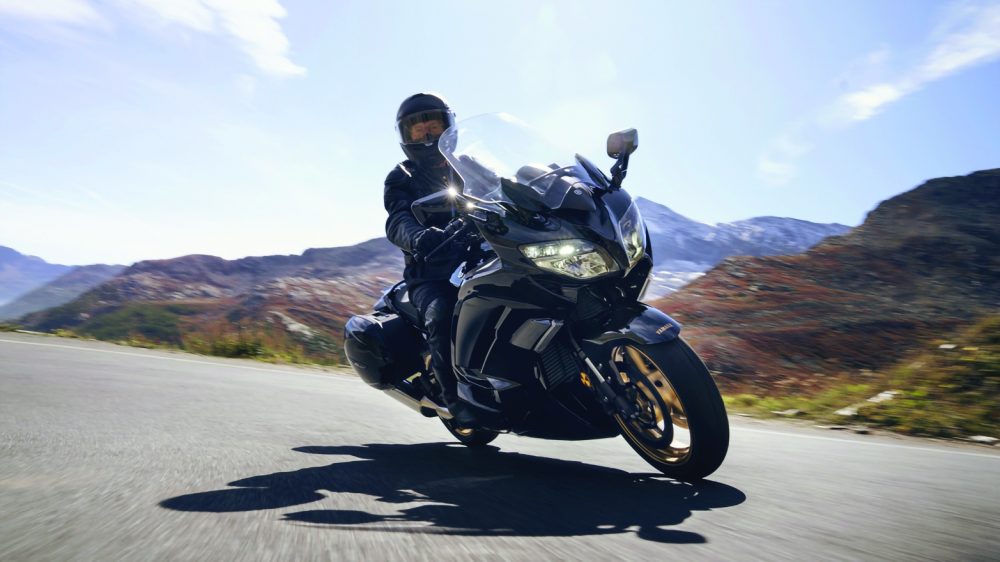
Yamaha rallied magnificently with their modular 700cc twin-cylinder and 900cc three-cylinder platforms, designed from the ground-up to be fun and affordable for all. Their range was almost completely renewed in just a few years, with the resultant profits providing the necessary funds to keep bikes such as the ageing FJR1300 compliant with government legislation. Honda dragged their heels a bit, reluctant to invest in genuinely new engines and platforms, but also used their NC-series to corner the commuter/courier market at a time when no-one else was even trying to cater to those buyers. What’s more, their small-capacity motorcycles and scooters continued to sell in incredible numbers in markets that would consider a 750cc bike to be grossly oversized.

It’s also worth remembering that motorcycles are just a small part of Honda’s business, the corporation having plenty of capital to invest in long-term product planning. Kawasaki is an even starker example here, with motorcycles representing a mere footnote in a corporate portfolio that includes gigantic cargo ships and military aircraft. They’ve been able to regularly renew and refresh popular bikes such as the Versys 650 and 1000, not to mention the best-selling Ninja 1000SX, providing them with comfortable margins and a loyal customer base.

Yamaha’s bulk sellers earn enough to cover the costs of keeping the FJR alive for now.

But Suzuki has none of these safety nets, and has been struggling to attract new customers for more than a decade now. Their car business folded entirely in the United States and is facing tough competition across Europe in the low-cost segments from the likes of Hyundai and KIA. Their small-capacity bikes remain popular in south-east asia, but profit margins are thin and increased competition from the Chinese manufacturers is eating into their volume. Europe and America used to be the cash cows whose high-margin product paid the research & development bills, but those funds have been drying up for a long time now.

The result is that Suzuki’s product range has stagnated, with key lines being forced to retire due to increasingly-stringent emissions legislation. What little money remains has been spent carefully, one bike at a time, in the hopes of striking gold and kick-starting a sales success that could, in turn, fund further development of their ageing lineup. But time and time again it seems that the upgrades and face-lifts are too little, too late, and always one or two steps behind their competition.

A popular, steady seller, but the money for Euro 5 upgrades just wasn’t there.

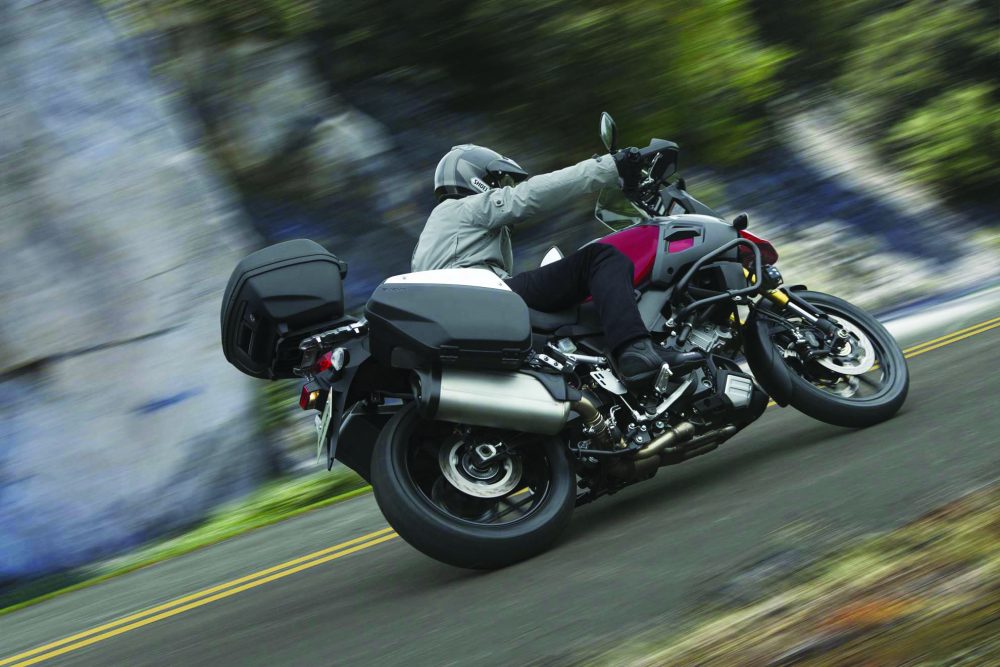
The V-Strom 650 remains a steady, if unspectacular seller amongst the practically-minded, which is probably why Suzuki has continued to spend the minimum-necessary funds to refresh the design and stay ahead of emissions legislation. The fully redeveloped V-Strom 1000 launched in 2014 with the fanfare befitting a major brand’s new flagship, but BMW had stolen their thunder with the all-new watercooled and tech-laden R1200GS just one year earlier, and buyers weren’t interested. With PCP the new and exciting way to make expensive bikes affordable, the lacklustre residuals of historically rust-prone Suzukis made their bikes deeply uncompetitive in this strange new financial landscape. It didn’t matter to most people that the retail price was thousands of pounds cheaper; if you were buying on PCP, then BMW offered you a lot more bike for very similar money.

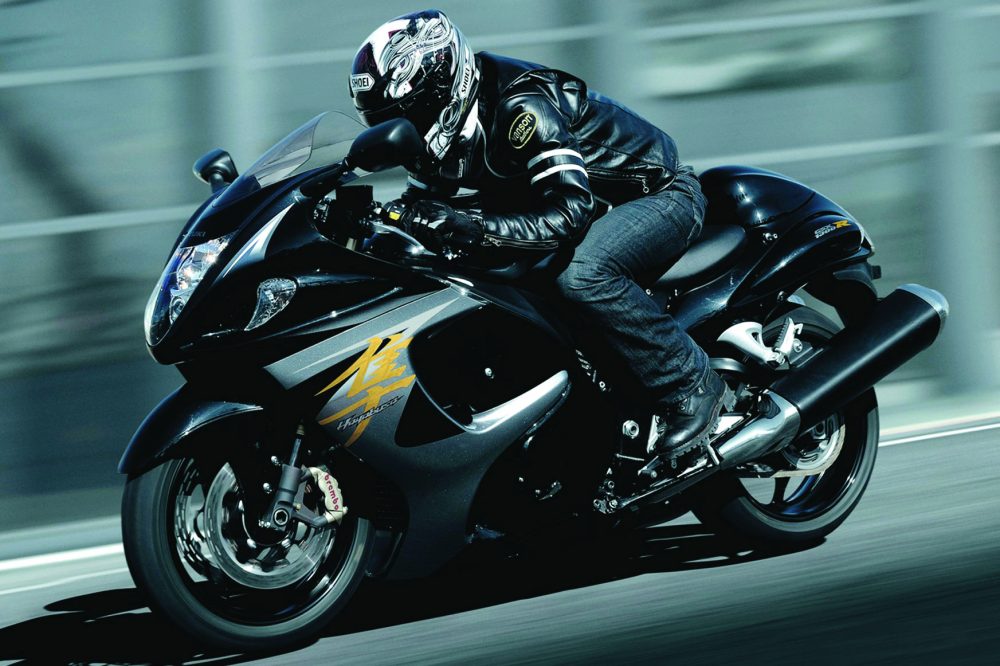
Pivoting towards their traditional cash-cow, the GSXR-1000, may have seemed sensible, and in 2017 we got an all-new litre-class sportsbike with modern electronics and segment-competitive horsepower figures. But this was the first serious effort in over a decade, and those traditional customers had moved on. With the Japanese brand now seen as a budget alternative to the more desirable European offerings, matching the now well-established upstarts on the spec sheet wasn’t enough to bring buyers back in sufficient droves. What’s worse, choosing to pin their hopes on these two big bikes meant that the money necessary to keep the GSX-R 600, GSX-R 750, Hayabusa, Bandit 650/1250, and even the Burgman 650 compliant with the latest round of European emissions regulations simply wasn’t there. Visit a Suzuki dealership today, and the choices are looking very limited indeed.

The 2014 V-Strom 1000 was fantastic, but customers ultimately voted with their wallets.

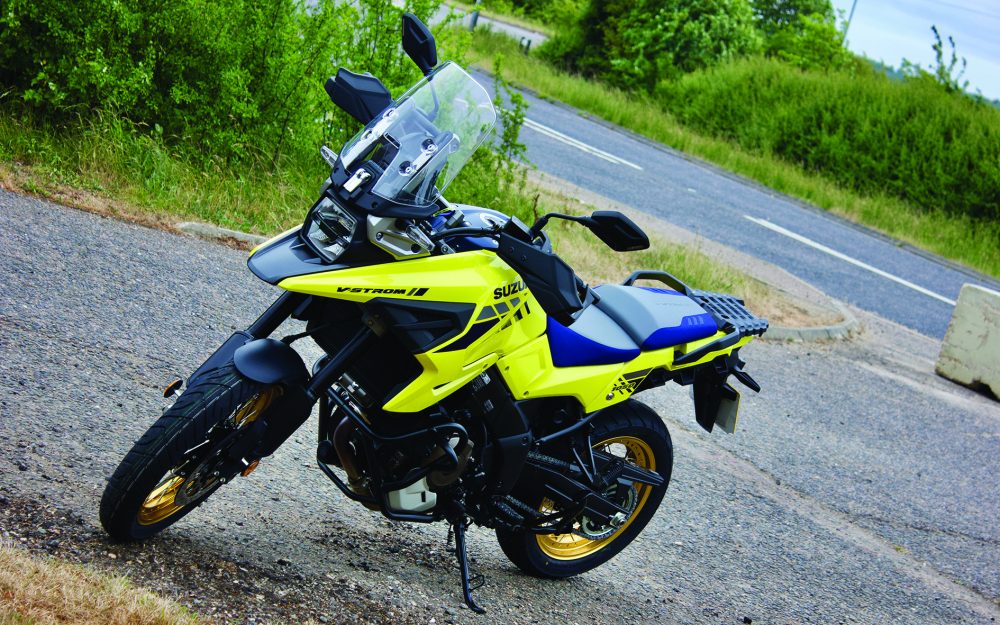
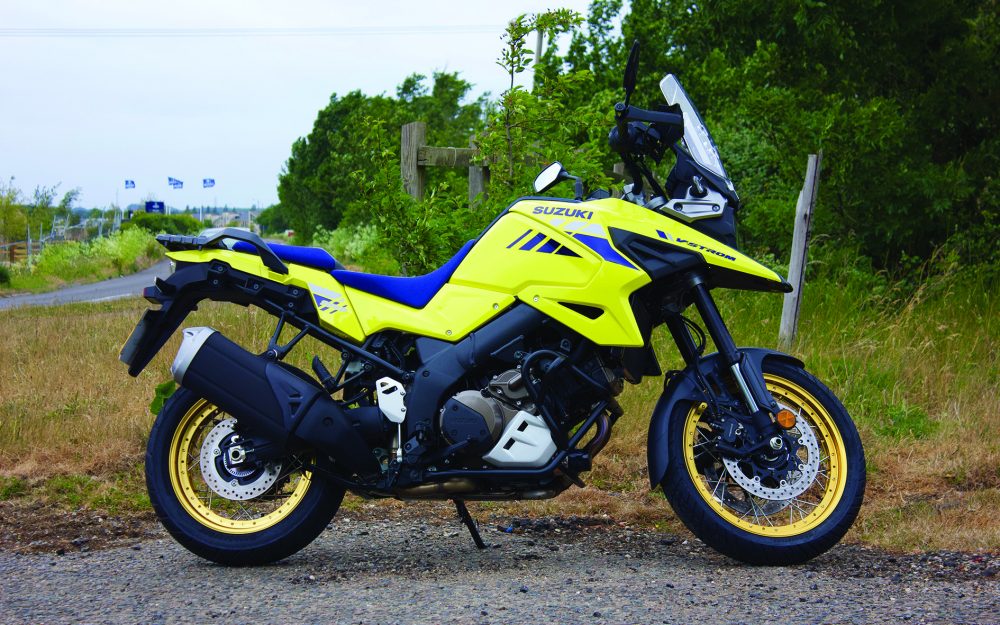
Which brings us to Suzuki’s latest refresh of their big adventure-tourer in the shape of the new(ish) V-Strom 1050. Suzuki is counting on the styling to do the lion’s share of the work, and it’s certainly succeeding in turning heads amongst the traditional motorcycle press. And if the public show the same interest, Suzuki is hoping that the technology upgrades will carry them the rest of the way to their cheque books. We’ve got cruise control, lean-sensitive ABS & traction-control, not to mention various gimmicks like hill-hold assist. We’ve also got a new LCD dashboard, just in time to be considered out-of-date next to the current crop of big-screen full-colour TFT dashboards the competition are triumphantly displaying. Still, it works, and it’s a pleasant enough bike that does a perfectly adequate job of being a good all-round motorcycle.

But while Suzuki have increased the spec to match their competition in the adventure-touring space, they’ve also upped the price to match, giving up their value card and going toe-to-toe with the likes of Triumph’s new Tiger 900 and Ducati’s Multistrada 950. And as much as I am a fan of Suzuki and their V-Strom line in particular, I don’t think this is a fight they can win. Personally, I’m not sure I trust Ducati’s engines to last 100,000 miles without serious work, and the servicing schedules and costs are clearly not designed with high-mileage riders in mind, but it’s a much more exciting bike to ride. My experiences with modern Triumphs suggest that they can shrug off salty British winters far better than a V-Strom can, but again – servicing costs become prohibitive when used regularly.

I’d like to say that this is an area where the new V-Strom has retained its edge, but dealer rates for both basic oil changes and valve adjustments are equally eye-watering. I’ve historically found that Suzuki’s motorcycles are very easy to service at home, so a competent home mechanic might perhaps choose the Japanese option for this reason alone. But as stated earlier, the people willing to spend £12,000 on a motorcycle and also get their hands dirty maintaining a 20,000-mile-per-year vehicle are a very small and unprofitable minority. Suzuki was hoping to lure in buyers from other brands, but I fear all they’ve actually done is freed up their existing customers to go elsewhere.

The new V-Strom 1050XT looks the part, but underneath it’s a 6-year-old bike. Competition is fiercer than ever, especially at this new, higher price point.

For my part, I’m planning to spend some more quality time with the top-spec V-Strom 1050XT soon. While my short initial ride failed to disappoint in the way that many over-hyped and over-priced alternatives have, it also failed to bowl me over. If my own personal V-Strom 650 exploded tomorrow and I wanted a well-specced replacement, it’s newer, bigger brother would do a fine job of filling those particular boots. But the market for sensible, upright, all-weather do-everything road bikes is now very, very crowded, especially at this price point. I’ve got an appointment to look at both Yamaha’s Tracer 900GT and have my name down for a ride on a Moto-Guzzi V85TT as soon as it’s available. Ducati’s Mulistrada 950 waits in the wings, and BMW are trying hard to tempt me with their new F900XR. And finally, there’s the Tiger 800 XRT that so impressed me last year, and its brand-new 900cc replacement.

If Suzuki can’t keep me as a customer, then who else is left?

Nick Tasker

First published in Slipstream July 2020

Yamaha Tracer 900 GT Review

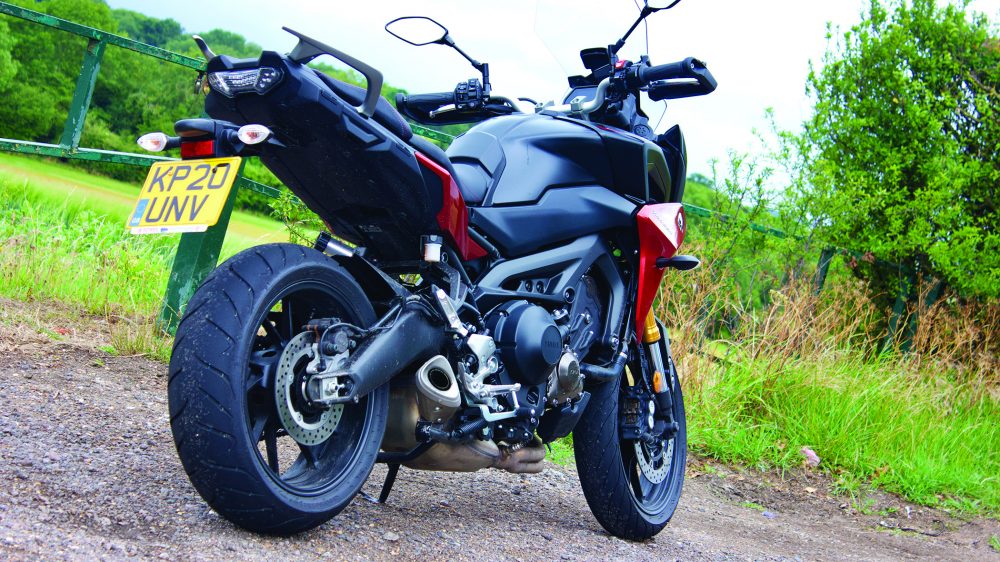
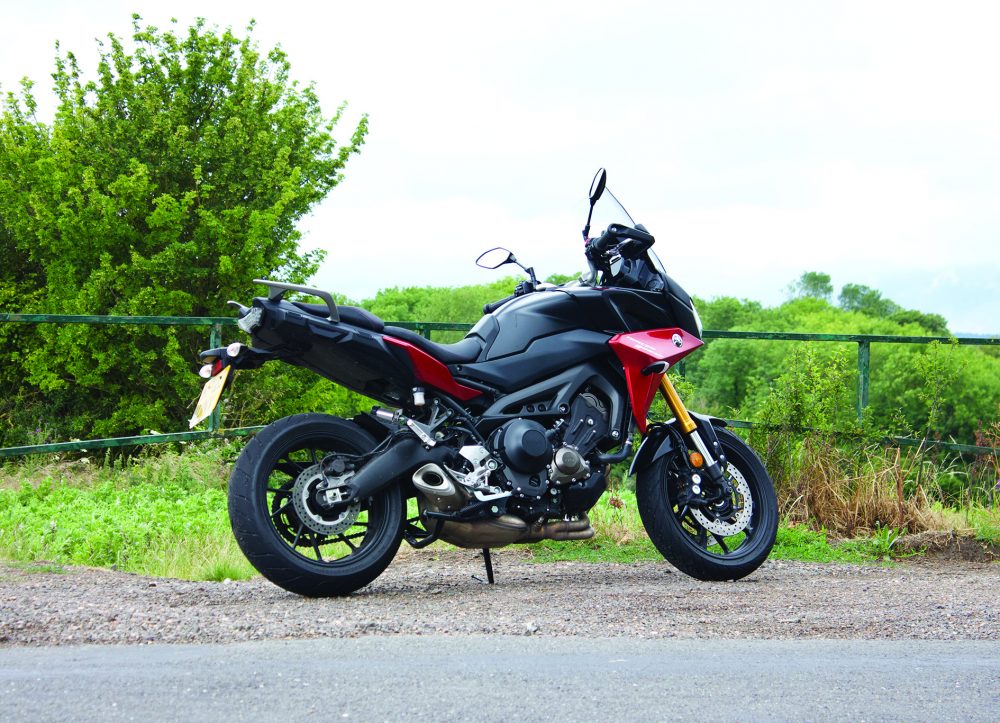
There are a lot of motorcycles that, on paper, look perfect. Ride enough bikes and apply a little critical thinking and you can start to spot the things you like and the things you don’t in each offering. Eventually, you build up a list of the best aspects of each, mentally combining them into one bike that, if it existed, would have no peer. For me, that bike could well be the Yamaha Tracer 900 GT.

Years ago Triumph emailed existing Street Triple owners like myself a survey in an effort to discover what features and technologies we would prefer they focus on for future versions of our bikes. Many of the items they proposed in that survey made it into the current 765cc Street Triples, but one major variant never materialised. I’d always believed that my Street Triple would be perfect with a small half-fairing and hard luggage. Triumph teased that very idea in the survey, but it would appear that more power and gadgets were more interesting to other respondents.

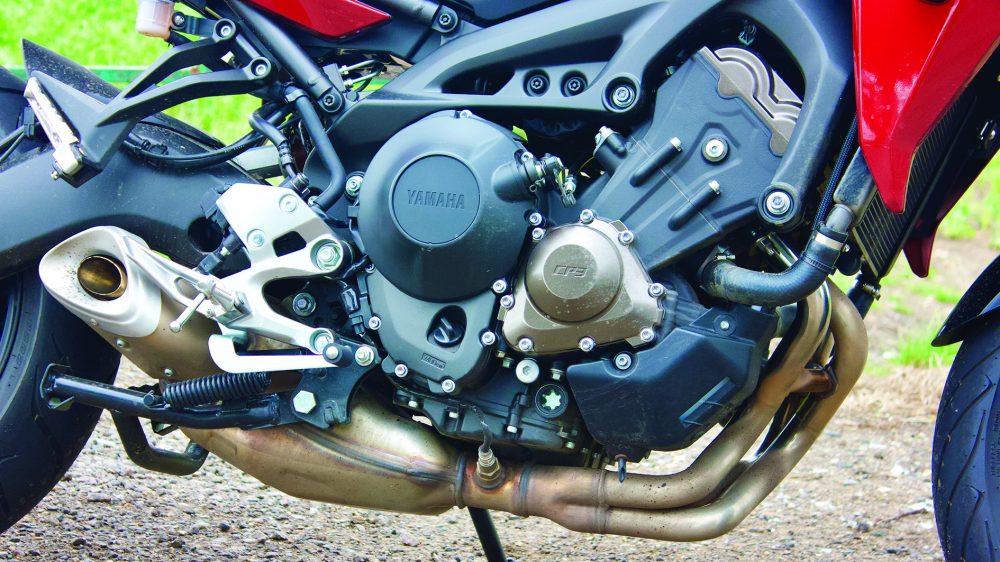
MT-09-derived 850cc triple provides smooth, balanced power across the whole rev range.

Now that platform sharing has become the new normal, bikes like the Tracer series are inevitable. Developing, and crucially homologating a road engine is an expensive business, so manufacturers have joyfully embraced the opportunity to cheaply fill out their product lineup by reusing the same architectures. Take BMW as an example; there are Naked, Sport-Touring, and Adventure motorcycles based on their 1250cc boxer engine and associated running gear. The same is true for their 1000cc inline-four, which can be had in Supersport, Naked, or Adventure- format.

Yamaha’s naked MT-07 and MT-09 motorcycles donated much of their engineering to their Tracer variants, and the 700cc engine has even arrived in Teneré format. But while the Tracer 700 has previously proven itself a worthy adversary for the Suzuki V-Strom 650, the Tracer 900’s 847cc three-cylinder engine means that the bigger bike has the potential to represent that most elusive of concepts: a perfect combination of sporting performance, touring capability, and every-day riding practicality.

Low-slung exhaust hides a modern bulky silencer better than many designs.

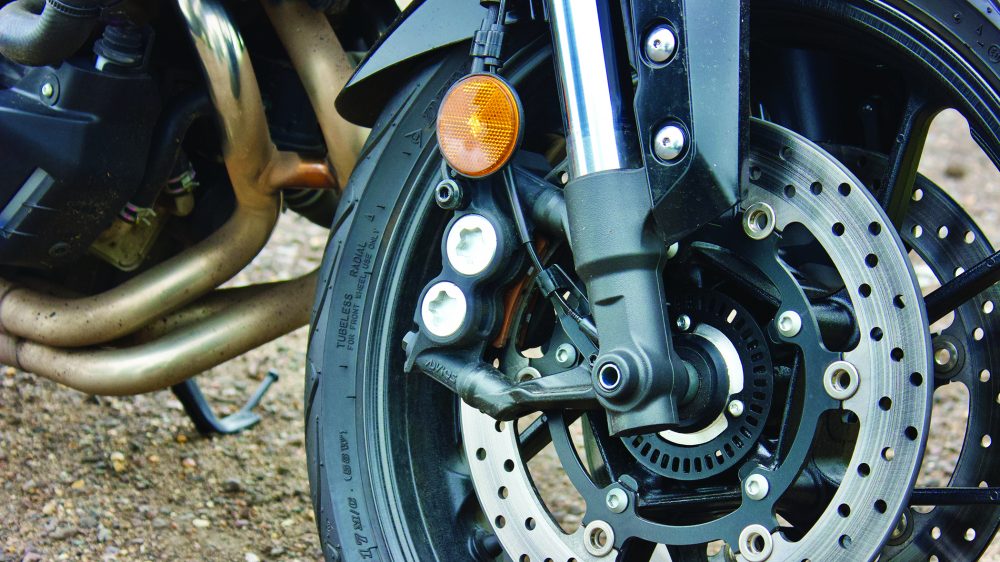
First impressions of the GT-variant Tracer 900 are good. Four-piston radial brakes on adjustable upside-down forks? Check. Smart half-fairing with adjustable windshield and standard-fit handguards? Check. Integrated scaffolding-free lockable panniers with optional top box? Check. Cruise control, TFT instruments, LED headlights, reasonably large fuel tank and surprisingly frugal engine? Check. While 200 miles per tank is nothing to write home about in my book, it’s still welcome in a world where manufacturers are increasingly using theoretical incremental gains in fuel economy to justify smaller and smaller fuel tanks. Heck, you even get a centre-stand, something many other bikes don’t even support, never mind fit as standard.

There are, of course, also a few disappointments right off the bat. While the design is, in my eyes, a significant improvement over the ugly original, there are still a lot of untidily routed and exposed cables and hoses. Unlike the V-Strom 1050, the mudguard is too short to do any useful work. And despite this being a top-of-the-range flagship model in 2020, Yamaha still ask you to pay extra for indicators that don’t rely on super-heated wire filaments for illumination.

Some of the plastics seem a little flimsy, some of the decals look a bit cheap, and after experiencing BMW’s beautifully animated and easy-to-use TFT dashboard, Yamaha’s version looks functional at best. Brake hoses are cheap-looking rubber as opposed to braided steel, and the clutch lever is non-adjustable – something I’d expect to find on a 125cc learner bike, not a premium Sports-Tourer. Features aside, the Tracer can’t quite shake its budget-bike roots. This is a problem when the GT model now costs more than £11,000.

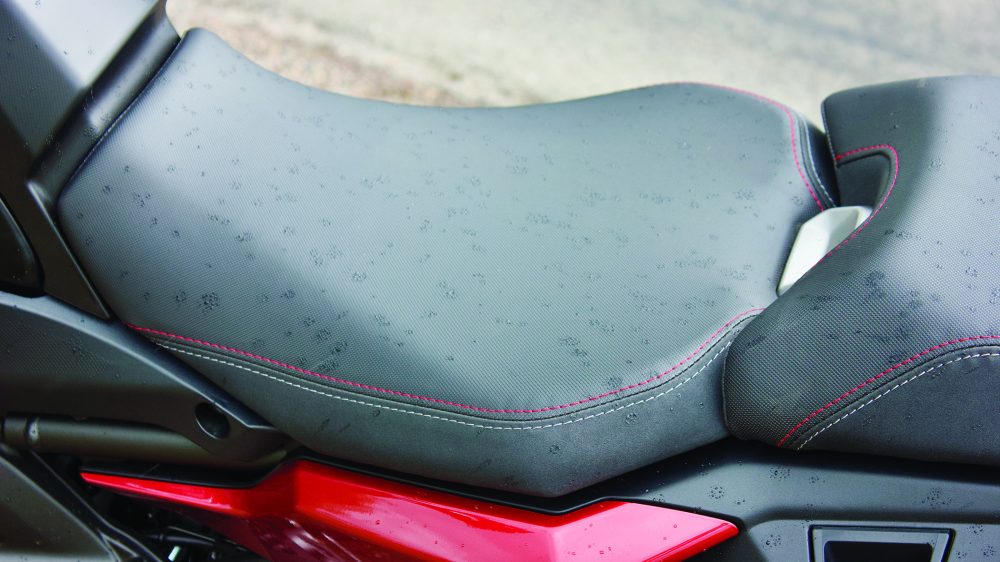
Pulling out into traffic, the riding dynamics of the Tracer don’t immediately impress either. When cold, throtte response is decidedly fluffy at lower rev ranges, and experimenting with the three throttle modes only seems to make things worse. Fixed in the lower of its two adjustable positions the seat seems to tip you forward into the tank, and even at its closest position, the brake lever is a bit of a stretch for small hands. The suspension seems fussy, never quite settling itself, as though the forks and swingarm are rubber-mounted to the frame. In reality, it’s likely that double-rate springs have been used in the forks, a common tactic in cheaper mass-produced units.

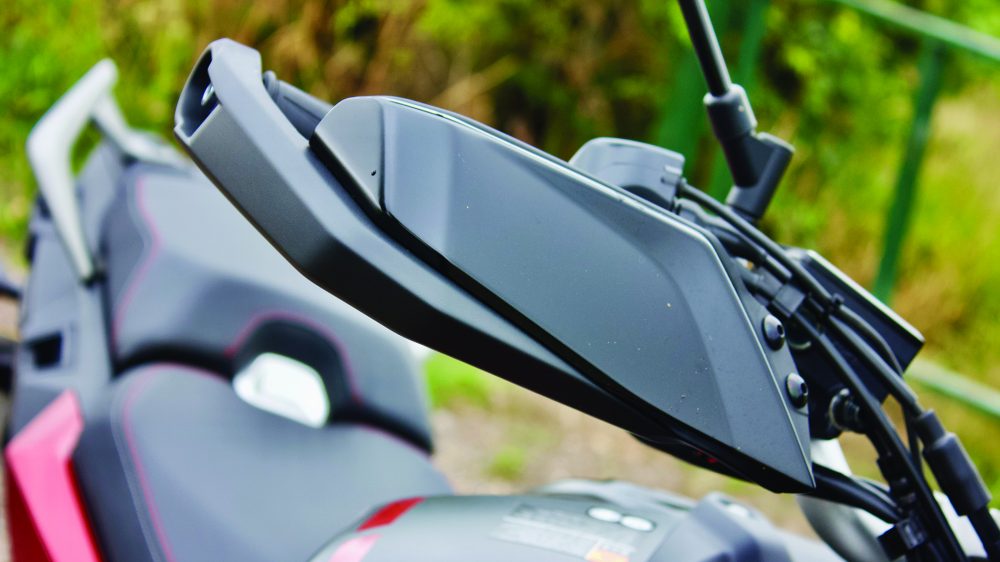
Handguards look small, but seem to be effective at deflecting wind and rain.

Once out of town and with the engine up to temperature, matters begin to improve. As familiarity with the light and sensitive throttle grows, so does the confidence to exploit more of the vast swathes of usable torque the three-cylinder configuration offers. Seemingly happy at any speed in any gear, choosing a different ratio merely changes how responsive the engine is to your throttle inputs. It sounds fantastic too, a rare feat on a standard exhaust system these days.

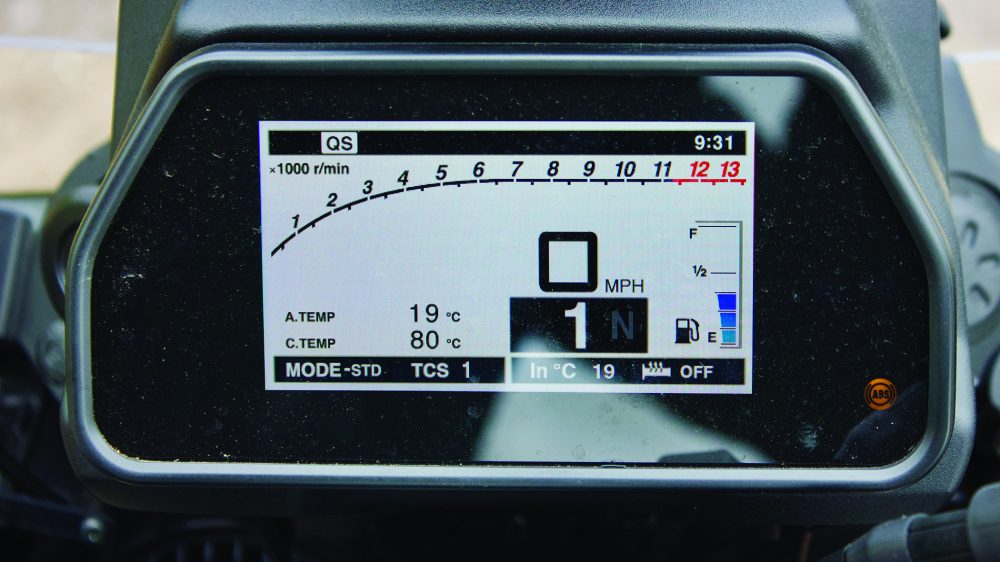
TFT dashboard is functional, but is beginning to look long in the tooth.

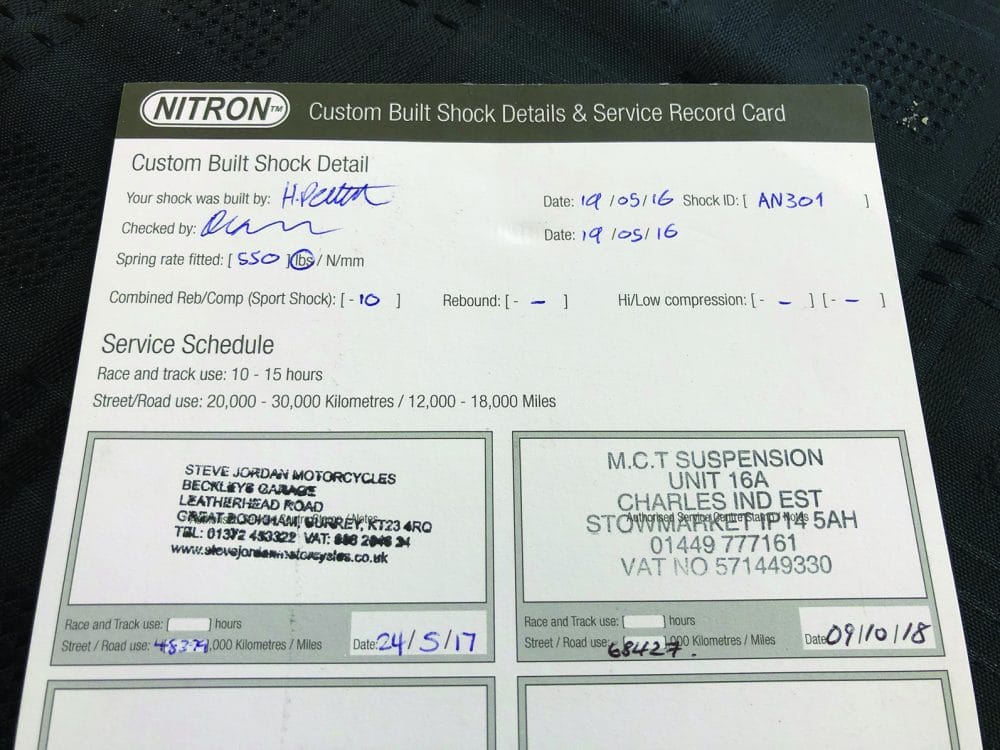
Front brakes work well, with plenty of power if not necessarily the instant bite I personally prefer, but further into the stroke the forks harden considerably causing the front wheel to chatter along the road surface and robbing you of any confidence during high-speed late-braking manoeuvres. Your mileage may vary along with your bodyweight, but once again we are reminded that motorcycle suspension will always be a one-size-doesn’t-fit-anybody affair. But while as a new owner my first stop would likely once again be MCT Suspension for a complete overhaul, once you start to turn the wick up it’s clear that the underlying chassis is excellent and the bike really starts to shine.

The riding position begins to feel much more Supermoto than Adventure-Tourer; you feel like you are sat much closer to the front wheel than on e.g. a V-Strom. I always believed that larger 19” wheels conferred an advantage on bumpy Northamptonshire B-roads, but Yamaha has clearly demonstrated that they can handle rutted surfaces just fine with the smaller, and therefore more accurate 17” wheel. There’s a sense of playfulness that other, similar bikes simply can’t match, helped of course by the class-leading 214kg wet weight. A modern frame and modern engine mean a 30kg mass advantage over many competitors, and the results are immediately apparent in how quickly the bike gains and loses speed.

It’s also a likely factor in how long the Tracer 900 can make its 18 litre petrol tank last. In mixed riding, the trip            computer reported that I’d managed 56mpg (UK), something that Fuelly.com confirms is a realistic and achievable real-world average. Take it easy, and pushing past 60mpg (UK) should be possible, a remarkable feat for a bike that, in the right gear, can build speed with deceptive and frightening ease. More than once I found my grumbling about brakes or suspension tempered when I glanced at the speedometer and found that I had wildly underestimated my rate of progress.

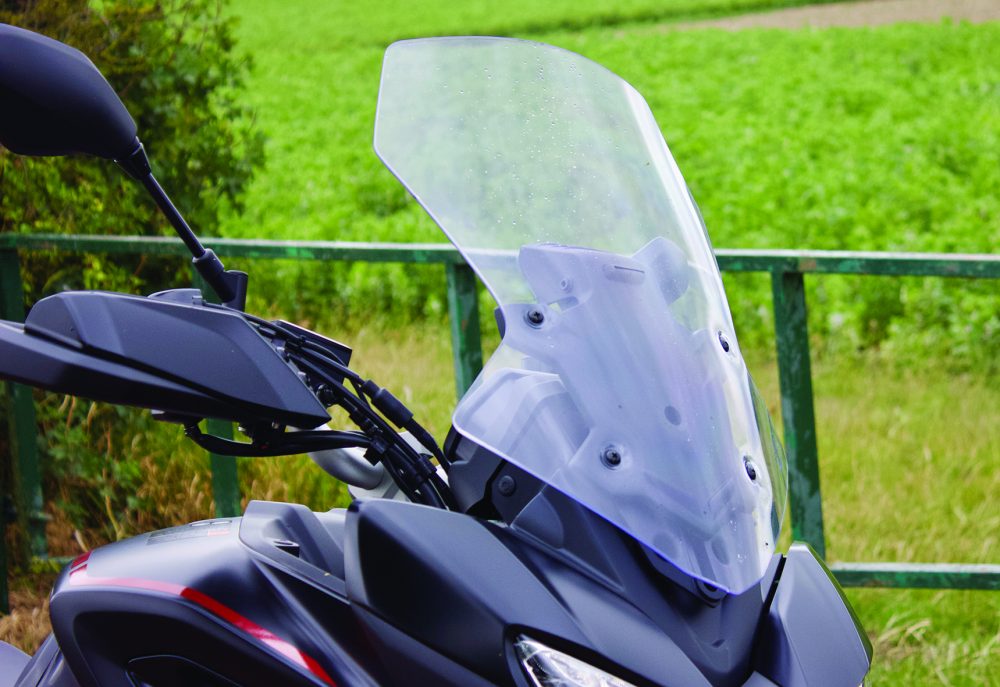
And you know what, I was having fun. It was hot, muggy, occasionally raining hard, and I was threading an unfamiliar bike along unfamiliar roads, and I was thoroughly enjoying myself. Yes, the stock suspension is far from perfect and would definitely benefit from the significant and expensive attentions of a specialist, but the potential is clearly there for this to be an exceptional multi-purpose motorcycle. And yes, the windshield, even in its highest position, is far too short for me, but ducking down just a little resulted in a bubble of silence with rain streaming off my visor. Clearly, a slightly taller windshield would do the trick, but it’s not something I would be enthusiastic about spending money on given the motorcycle’s stated touring intentions.

Four-pot calipers are fine, but let down somewhat by the front forks under hard braking.

Furthermore, the cruise control refused to engage in 30mph zones, a maddening oversight given the obvious licence-preserving benefit, and the right-side pillion footpeg can catch on your boot if you ride on the balls of your feet.

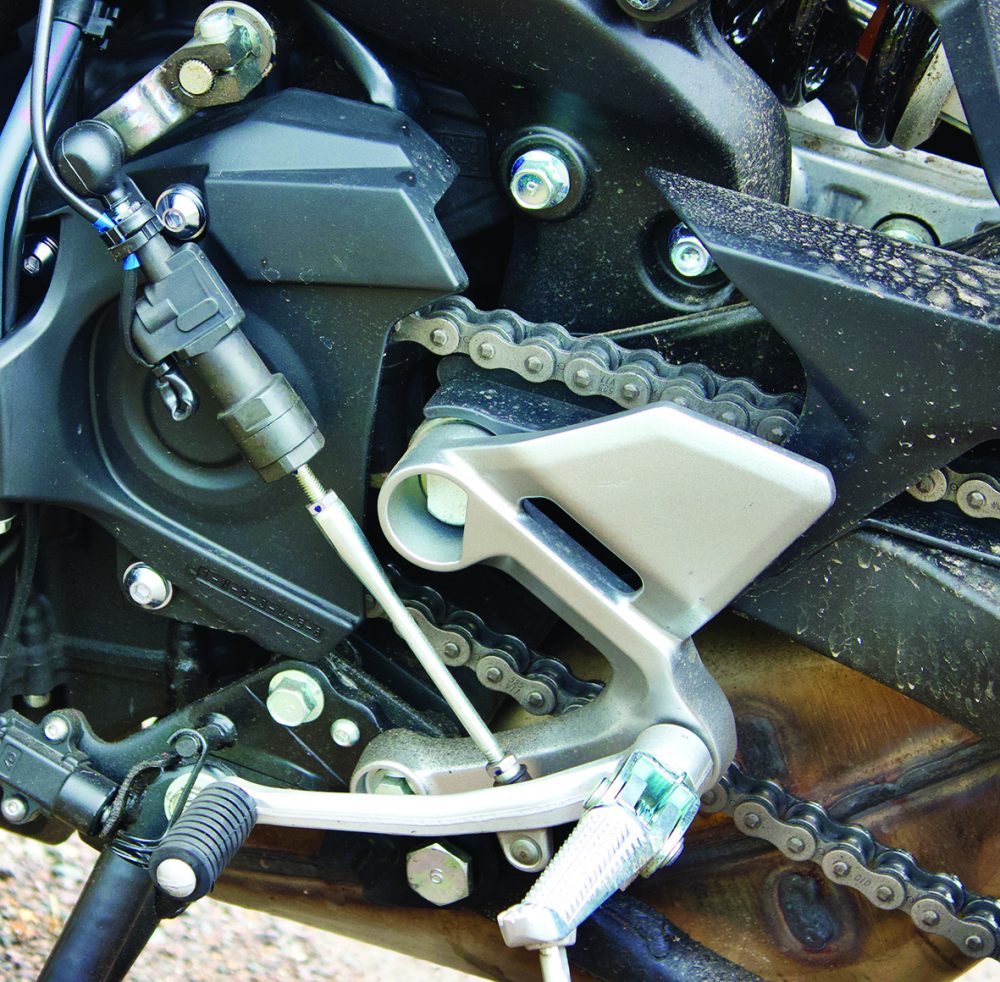
The minor annoyances continue with unintuitive on-screen menus, and the clickable scroll-wheel on the right-hand control cluster is stiff and awkward to use. Your left boot will catch on the footpeg when trying to lower the sidestand, and the up-only quickshifter is clunky at anything other than high-rev, high-throttle applications. The fuel gauge won’t tell you anything useful until after you have less than half a tank remaining, and activating or adjusting the heated grips can only be done by navigating into a submenu. It’s all a little bit…unrefined. Unfinished. And like Suzuki’s V-Strom 1050XT, at this price point the Tracer 900 GT is picking fights with Triumph Tiger 900s, BMW F900XRs, and Ducati Multistrada 950s – all bikes with more brand cache and decidedly more premium user experience.

Seat is two-position adjustable and both gel and heated alternatives are available.

Of course, buying European carries its own perils, not least of which are the cost and frequency of servicing. With valve clearance checks not due until 24,000 miles, the Tracer 900 costs just 6p per mile to maintain, and Yamaha regularly tops the reliability surveys that the likes of BMW and KTM sink to the bottom of. The Tracer is also noticeably lighter than anything in its class, a side benefit, perhaps, of dispensing with any off-road pretensions.

Windshield is adjustable while riding and well designed, but about 10cm too short.

Quickshifter only works going up the gears and is awfully exposed in this application.

As such, the Tracer 900 GT definitely makes my shortlist, in a way that I’m not sure the heavier, more expensive, and less exciting V-Strom 1050XT does. I’m still going to be sampling more of the competition first and may yet be swayed by the Moto-Guzzi V85’s charismatic air-cooled engine and shaft drive, or Triumph’s genuinely impressive build quality and uniquely-configured three-cylinder engine. As always, I’ll have to weigh up the pros and cons and may still decide that the Tracer 900 GT is the best choice for me, even with all its minor faults. So I can only recommend that you do the same and make up your own mind before handing over your credit card.

Nick Tasker

First published in Slipstream July 2020

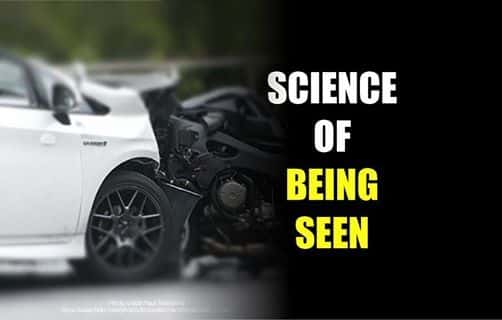
Science of Being Seen – Part 6

Looked but FAILED TO SEE!

Last time out I began explaining how in around one-third of all collisions, the bike was in a place the driver could have seen it but for some reason FAILED TO SEE the machine – a ‘detection error’ where the driver looked in the right place, but failed to identify the presence of a motorcycle in the moments before making his manoeuvre.

We need to look beyond ‘not looking properly’ as an explanation. Human visual perception isn’t ‘camera-perfect’ and it’s not true to say that “if it’s visible, and if you look hard enough, you’ll see it.”

Any illusionist or soldier knows that.

Motion camouflage

In the last article, I mentioned that we have some ability to detect light / dark contrast as well as sudden bright stimuli and movement in peripheral vision. Anything that gets our attention is called an ‘attractant’ because it automatically results in our eyes moving to focus on whatever caught our attention – and at that point (and not before) it pops into our consciousness. That’s when we ‘see’ the object.

The problem is that it’s LATERAL movement that we are sensitive to – that is, ACROSS the background.

Movement directly TOWARDS the viewer is much more difficult to pick up. It’s well-known – I was aware of the issue from my science degrees – that hunting animals stalking prey will approach along a line that keeps them motionless relative to the background from the perspective of the prey animal. If the prey animal moves, the hunter subtly adjusts their own path so that they stay on the same relative bearing. This is how big cats and dragonflies operate, and they are exploiting the phenomenon known as ‘motion camouflage’. The only clue to movement is that the apparent size of the hunting animal increases as it gets closer, but it can get remarkably close before it gets so ‘big’ that it suddenly dominates the background. At that point, the hunting animal is finally detected – this phenomenon is known as ‘looming’.

Think about the typical motion of a motorcycle, riding along a straight road and approaching a stationary driver waiting to turn at a junction – the most common collision of all. It cannot be seen moving across the background.

With no lateral movement, we are also motion camouflaged.

And now there’s a significant risk that a driver will fail to detect our approach until we’re right on top of him / her when we ‘loom’ into view by filling the background.

You can check this out for yourself on YouTube. Watch this:

https://www.youtube.com/watch?v=4iOoiEbtf2w

(PS – keep the volume down if necessary – there are some expletives!)

Even though we can hear the Spitfire’s engine, we cannot see it against the background for two reasons:

:: our eyes are focused on the presenter, so the plane is initially in peripheral vision

:: even when the camera shifts, giving us a hint where to look, there is no lateral movement to help us detect the plane – it’s motion-camouflaged.

It is not until the plane is almost on top of us that we see it –  a Spitfire is a LOT bigger than a motorcycle.

Saccadic masking

Here’s another issue. When we’re scanning left and right, we need to shift our eyes. But there’s a problem. This movement of the background is known to cause disorientation and dizziness.

So as we scan across a scene, we don’t move our gaze smoothly across the background although that’s what most of us think happens, and what most books on riding and driving imply we should be doing.

Our eyes don’t behave like a movie camera panning across the scene but work in a completely different way, much more like a still camera taking a series of snapshots of different parts of the view. Our eyes move in a series of jerks, pausing on one particular area – a ‘fixation’ – before moving very rapidly to the next. Then they move on again… and again… and so on.

The movements between the fixations are called saccades but unbeknownst to us, the brain ceases to process retinal images during these saccades. This is known as ‘saccadic masking’ or ‘saccadic suppression’.

Once again, this phenomenon has been known about for a very long time. It’s even exploited by dancers during fast turns – the dancer turns the body but ‘spots’ on a fixed location, then turns the head faster to catch up. Saccadic masking kicks in as the background blurs through the vision, helping maintain balance and prevent dizziness.

And now you can see why when we look left and right saccadic masking shuts down the visual processing system as our eyes move. Rather than ‘scanning’ right through the visual scene as we think we do (and as we’re told we should), it’s only where the eyes stop on an object of interest, in a stationary fixation (remember that from last time?) that we get a visual ‘snapshot’ that the brain can actually process. So rather than a ‘movie’, we get that series of snapshots interspersed by blank gaps.

But – just like the dancers – we are unaware of the shut-down and believe we have searched the entire scene because the brain synthesizes the missing visual data to give the impression of a continuous scan. Only if we are ALREADY tracking a moving object are we able to follow it without saccades.

Saccadic masking isn’t ‘carelessness’ or ‘failing to look properly’, it’s a fundamental limitation of – and a visual illusion created by – the human visual system.

There’s a second, but interlinked problem. As humans we learn. It’s a fundamental part of being human. And our learning often involves discovering shorter, quicker and most importantly, less energy-intense ways of doing something. At junctions, we’re always told to “look for vehicles” before turning. But it turns out to be an ineffective strategy, because if we look for vehicles, all we see are vehicles…

…and what we actually need if we’re to make the turning manoeuvre is empty space between those vehicles. So we discover very quickly – perhaps within half an hour of beginning to drive – that what we need to spot GAPS.

Now, remember the issues I mentioned last time – the narrow foveal vision cone, and the depth of field. There’s not just the possibility that a driver will look BEYOND the motorcycle, but a real risk that in turning the head to look both ways, the bike will be ‘blanked out’ by a saccade.

It’s worth pointing out that exactly the same issue can happen to bikers. There’s some evidence from countries with a lot of powered two-wheelers that suggests riders pull out in front of other bikes equally as often as drivers! So an attentive driver – or motorcyclist – can look both ways and yet fail to see an approaching vehicle.

How can we overcome this problem? Slowing down the head-turn doesn’t eliminate fixations and saccades but it does narrow the blank gaps and offer a better chance of a fixation landing the eyes on the bike.


Kevin Williams / Survival Skills Rider Training www.survivalskills.co.uk

(c) K Williams 2020

The Science Of Being Seen – the book of the presentation £9.99 plus P&P and available now from: www.lulu.com

The ‘Science Of Being Seen’ is a presentation created in 2011 for Kent Fire and Rescue’s ‘Biker Down’ course by Kevin Williams. Biker Down is now offered by over half the nation’s FRSs as well as the UK military, and many deliver a version of SOBS. Kevin personally presents SOBS once a month for KFRS in Rochester. He toured New Zealand in February 2018 delivering SOBS on the nationwide Shiny Side Up Tour 2018 on behalf of the New Zealand Department of Transport.

Find out more here: https://scienceofbeingseen/wordpress.com

Science of Being Seen – Part 5

Looked but FAILED TO SEE!

The most common collision between a motorcycle and another vehicle happens at a junction, when the other vehicle (usually a car) turns across the motorcyclist’s path. It accounts for the majority of crashes in an urban area but is also a relatively common crash on a rural road too.

I’ve already mentioned that a significant proportion of these crashes happen when the driver COULD NOT see the bike in the run-up to the crash – the motorcycle might have been hidden by other vehicles, pedestrians or roadside furniture, or concealed by the driver’s own vehicle.

But in around one-third of all collisions, the bike was in a place the driver could have seen it, but for some reason FAILED TO SEE the machine. This is a ‘detection errors’ – ie, the driver looked in the right place, but for some reason failed to identify the presence of a motorcycle in the moments before making his manoeuvre.

Road safety has always treated this as ‘not looking properly’. This ‘fault’ of the driver is nearly always presented as a simple ‘common-sense’ truth, as in “if it’s visible, and if you look hard enough, you’ll see it.”

Sadly that’s simply not true, as any stage illusionist or camouflaged soldier knows.

Illusionists and camouflage both exploit human visual perception limitations, so if we’re to understand why drivers might fail to spot a motorcycle that should be in clear sight, we need to understand a little about how the human eye works with the brain to present a representation of the outside world into our conscious mind.

The starting point is to understand that the human eyes and brain are not the equivalent of a camera and film (or digital sensor). If you plonk a bike in front of a camera, the bike is what the camera sees. But if you put a human in front of the same scene there are a number of reasons that something in plain view can go missing.

So if we’re to understand just how invisible we can be whilst on two wheels, we need to look for a genuine understanding of visual perception, not just resort to the tired old blame-game approach by saying “the driver didn’t look properly”. I’ll start by looking at two human visual perception issues, before finishing off this investigation in the next article.

Narrow foveal zone and peripheral blindness

Hold your arm straight out, clench your fist and give a ‘thumbs-up’. Look at your thumb nail. Now shift the focus of your attention to the top knuckle instead. Your eyes just moved. Although your thumb nail is only a couple of centimetres below your thumbnail, your eyes had to shift FOCUS because the cone of clear, focused colour vision – the foveal zone – is just a couple of degrees of visual angle deep.

Turn your thumb on its side and repeat. Your eyes moved again.

We have to move our eyes because only a tiny patch of the retina – known as the fovea – that actually transmits a sharp camera-like image to the brain and, to see a particular object in detail, we need to line up the fovea to the ‘fixation point’. The zone where we have this ‘foveal’ clear vision is also just a couple of degrees of visual angle wide.

Although the retinas of both eyes combine to give us visual coverage which extends slightly more than 180 degrees left-to-right, outside of the fovea, that light falls on a part of the retina with a very different construction. This ‘peripheral vision’ becomes increasingly blurry and lacking detail, and colour vision fades increasingly to black-and-white the further we move away from the fovea.

Why this limitation? There’s a simple answer – transmitting ALL the visual data that falls on the retina to the brain at the same high fidelity as the fovea would require an optic nerve bigger than the eye – there simply isn’t the capacity to carry, let alone process, the data.

Interestingly, designers of high definition Virtual Reality goggles have hit much the same problem. To get a high pixel density – and thus high realism imagery – across the entire goggle would require more computing power than any domestic computer or phone can deliver. So they are trying to exploit this phenomenon by increasing pixel density ONLY where the user is looking. The screen therefore provides increased resolution where necessary and where the eye can USE it, rather than attempting to display it across the entire screen and frying the processor.

But here’s the remarkable thing. We don’t notice that because the brain creates an illusion. It’s so good that few of us ever notice, but it’s there. The phenomenon has been known to visual science for centuries – it’s attributed to Leonardo da Vinci.

Given the tiny coverage of the fovea, the vast majority of the incoming visual data falls into peripheral vision. Just 20 degrees off the line-of-sight, our clarity of vision (or ‘visual acuity’) is about one tenth of that of the fovea.

Nevertheless, we do have some ability to detect light / dark contrast in peripheral vision, but we’re much more likely to detect sudden bright stimuli and movement.

But once we do, we automatically turn our head to bring the attractant into our line-of-sight so we can examine it with the fovea’s high-resolution vision – this is called a fixation.

Depth of field

Just like a camera, the human eye has a depth-of-field. If we focus on something close to us, everything in the background is out of focus. And vice-versa – if we’re focused on a background object, those closer up tend to blur. Combine depth-of-field with the narrow cone of foveal vision and not only does this have consequences in terms of detecting / not detecting other vehicles in peripheral vision, it also leads me to question the concept of ‘eye contact’ that’s so frequently proposed in the motorcycle safety literature. It seems a doubtful concept at best. Anecdotally, I have heard (and I’m sure you have too) motorcyclists say many times:

“I had eye contact with the driver and he/she still pulled out.”

I’d suggest this is the explanation; that although the driver appears to be looking at us, his actual visual fixation is behind us, and our machine is actually in his peripheral vision. I think that the best we can say is that if the driver is looking our way, we MIGHT have been seen, but it would be wise to assume the driver hasn’t spotted us.

So here’s this month’s takeaway. Never forget that the eye is not a camera, and no two people see the same scene in the same way. And if there’s one vehicle that’s likely to go missing when drivers search the road environment, it’s a motorcycle.

Don’t assume you’ve been seen… EVER.

…to be continued


Kevin Williams / Survival Skills Rider Training www.survivalskills.co.uk

(c) K Williams 2020

The Science Of Being Seen – the book of the presentation £9.99 plus P&P and available now from: www.lulu.com

The ‘Science Of Being Seen’ is a presentation created in 2011 for Kent Fire and Rescue’s ‘Biker Down’ course by Kevin Williams. Biker Down is now offered by over half the nation’s FRSs as well as the UK military, and many deliver a version of SOBS. Kevin personally presents SOBS once a month for KFRS in Rochester. He toured New Zealand in February 2018 delivering SOBS on the nationwide Shiny Side Up Tour 2018 on behalf of the New Zealand Department of Transport.

Find out more here: https://scienceofbeingseen/wordpress.com

40,000 miles on a Triumph Street Triple R

Impractical, too small, no wind protection…a perfect all-round motorcycle?

Has it really been six years? My RoadTrip report reckons so. It was  the 5th of October 2013 when I signed the paperwork and rode away on my brand new Triumph Street Triple R. More than 40,000 miles later the very same motorcycle still sits in my garage, and though the odometer ticks up far more slowly these days, it still puts a smile on my face every time I ride it.

Part of that is down to how light the bike is. Triumph’s engineers shaved several kilos off the Street Triple’s wheels, frame and exhaust system for the 2013 model update, shifting the centre of gravity forwards and creating a bike with the same power to weight ratio as the original Honda Fireblade. 105bhp goes a long way when you only have 180kg to push around, and the lack of weight also helps fuel, tyres and other consumables to last longer when compared with heavier and more powerful motorcycles.

What’s more, this is a bike that seems to be growing in popularity, even as its 765cc successor receives styling tweaks and a price cut for 2020. It’s weird how many people have approached me in recent months to ask me my opinion on the older 675cc Street Triple. Perhaps the fact that the new, 17kg heavier version adds so very little to the experience and costs more than twice what a good-condition used example does has something to do with it. With that in mind, let’s dive into what almost seven years and 40,000 miles can tell prospective buyers about this wonderful little motorcycle.

Continuous hard riding pushes MPG down into the mid-40s, but the average is impressive

Firstly, the engine is a delight to use. It’s torquey off-idle and, with practice, you can pull away with barely a hint of the throttle. And yet, it’s smooth all the way to redline with a screaming, snarling exhaust note that puts an inline-four to shame. You can ride around in the middle of the rev range enjoying instant throttle response or waft along in a higher gear returning seriously impressive fuel economy numbers. And with the world moving to bigger, low-revving twins, the joy of a genuinely usable engine that can still rev to 12,500 RPM is something to be savoured.

Brembos would be a little sharper, but there’s honestly no need, even on a racetrack.

The brakes are great; in the years since taking ownership, I’ve had chances to sample some serious Brembo equipment that beat them on both bite and feel, but only by direct back-to-back comparison. Low weight means less mass to stop, and your forearms will give out long before you extract full power from the twin 4-piston Nissins. Triumph equipped the Street Triple R with high-friction sintered-metal brake pads as standard, and it’s the only bike I’ve ever owned where I haven’t felt the need to deviate from the OEM specification.

The fully-adjustable suspension wasn’t quite as great out of the box. As I’ve mentioned many times in previous articles, it doesn’t matter how high-quality or how clever the components are – a stock suspension setup will always be a compromise. The average rider doesn’t really exist, which means that the spring rates and valving will always be set either for someone lighter or heavier than you are. I seriously considered trading the bike in after just a few months because the bucking over bumps and skittering around corners had my confidence in tatters.

When I met Darren from MCT at the London Motorcycle Show and described my symptoms, he was quick to confirm that I wasn’t the first person to bring one of those Street Triples to his attention. He reckoned that there was a design flaw in the forks and that remedial work was necessary. It was an expensive trip, involving modification of the fork internals, but the results were transformative. Suddenly, I was riding what every journalist had promised me I had bought – one of the best-handling motorcycles in the world.

A further tweak was the reduction of the rear tyre pressure after my TVAM Observer commented that the contact patch on my rear wheel looked far too small. Reducing the pressures from the 42PSI indicated in the owner’s manual to the 36PSI recommended for the almost-identical Daytona 675 resulted in a much less skittish rear-end. There was no drop-off in fuel economy, nor an increase in tyre wear, and my only explanation for Triumph stating different pressures for functionally identical motorcycles is to blame their lawyers. With no separate rider/rider-with-pillion pressures listed as with most Japanese motorcycles, I concluded that the Triumph legal team didn’t trust their owners to make the necessary adjustments, and erred on the side of caution when writing the owner’s manual.

Same frame, same wheels, same engine, same suspension… different tyre pressures?

Shaving off several kilos makes a big difference in such a lightweight machine.

The next upgrade, and one I thought long and hard about, was the exhaust system. Believe it or not, the sound or volume was not the primary factor here, rather that the stock system is huge, ugly, and heavy, taking up a surprising amount of space underneath the bike. The catalytic converter is a separate piece from the silencer, so my exhaust emissions remain unchanged, and I’m still within the noise limits for most UK trackdays.

And that’s more or less it! I wanted to keep the bike lean and simple, and resisted excessive modification. I tried a filler-mounted tank bag for a while, experimented with Lomo drybags and eventually settled on a stack of Kriega luggage for my touring needs. A TwistyRide phone mount coupled to a 3A 5V charger handles GPS duties, and a 12V socket wired into the tail unit provides power for a compressor when encountering punctures. And finally, I swapped out the throttle grip for one from a contemporary Speed Triple, reducing the amount of wrist rotation necessary to fully open the throttle. It makes the bike a little snatchy for those not used to it, but means I can enjoy the whole engine, not just the first two thirds.

Without fitting scaffolding to the back of the bike, tailpacks are the only luggage option.

Somewhat disappointingly the paint on the tank quickly became scuffed where textile trousers rubbed on it and the seat has actually cut all the way through to the primer. The official accessory crash-bungs failed miserably at their one job when I finally tipped the bike over at a standstill last year. The indicator hit the ground first, bending the small mounting frame behind the fairing and finally crushing and popping open one of the cells in the radiator. Luckily the plastic pieces weren’t too expensive to replace, and while a new radiator was more than £400, a local specialist was able to repair and clean the old one for a mere £15. There wasn’t a mark on the crash bungs. Useless.

The crash bungs had one job, which they failed to accomplish the only time they were needed.

Other than that, the only issue to report is a hot-starting issue that’s plagued the bike for more than 30,000 miles. Often, when stopping the engine just long enough to fill up with petrol it coughs, splutters and stalls when trying to start again afterwards. It needs a little bit of coaxing and then settles down after a few seconds, but I’ve never been able to figure it out. I recently met another owner who’d experienced an identical issue and traced it to the idle control stepper motor, so maybe I’ll see if I can pick up a used one and swap it out.

Straight bars are a real asset on a tight track like Mallory Park.

And that’s it! With the help of ACF50 my bike commuted through two British winters before the V-Strom took over that job, and the standard-fit stainless bolts are all still shiny. Triumph charged me a fortune for servicing to maintain the two-year warranty, then refused to help when the hot starting issue materialised, so I gave them the finger and have been doing everything myself ever since. Oil changes are easy, but valve checks are a nightmare and due every 12,000 miles, so you’d best hope yours don’t need adjusting! You’d also better have a Windows laptop and a DealerTool handy, as that’s the only way for home mechanics to balance the throttle bodies and reset the service warning indicator.

What of the new 765cc Street Triples that Triumph launched a couple of years ago – am I tempted to upgrade? In a word, no. The resale value of a 40,000 mile Street Triple would barely cover the deposit on the new bikes, and the extra power and needless riding modes don’t interest me. And if you read the small print, you’ll notice that Triumph has started quoting dry weights for their bikes these days, leading some short-sighted journalists to claim that the new bike is slightly lighter than the old one. More recently a magazine actually weighed one and found that the bigger engine and reinforced frame add around 17kg to the total mass, cancelling out the benefit of the more powerful engine.

And in truth, those changes wouldn’t really add to the experience for me. Traction control is always nice, but the fact is that there’s nothing a Street Triple can dish out that modern sport-touring rubber can’t handle, even at a racetrack. If Triumph had made good on their threats to create a version with a half-fairing and hard-luggage, things might have been different. But as it stands, it wouldn’t be much of an upgrade.

Scotland, Belgium, France, Switzerland, Austria, Germany, Luxembourg…

In the last six years I’ve commuted, visited friends and family, travelled the length and breadth of the UK, explored its limits on the racetrack and scraped my pegs around alpine hairpins. It’s handled the Hard Nott Pass and the Nürburgring, moved house with me three times, and eaten 5 sets of tyres. It’s drunk more than 3,400 litres of petrol, chewed up two sets of chains and sprockets, ground down four sets of front brake pads and even worn out a set of front disks.

I’m planning more trackdays, more trips abroad once the present situation opens up the tracks and borders for foreign travel, and still go looking for every opportunity to take my Street Triple R out for a spin on our bumpy local roads now we can get out there again. It’s not as comfortable or practical as my other bikes, it’s not great at motorways or in bad weather, and it’s the worst motorcycle I’ve ever owned for carrying luggage. But with motorcycles getting heavier, with electronics filtering our every input and with the days of new petrol-powered bikes numbered, I’ll treasure my Street Triple R for as long as I possibly can.

I’ll update you all when I hit 100,000 miles, or when it explodes – whichever comes first!

Nick Tasker

First published in Slipstream June 2020

Bullets, Camels, Elephants & Tigers (Part 2)

The next morning our departure was delayed due to lots of local families wanting to speak English and have their photos taken with us and the bikes. Eventually we left and rode on to Jodhpur, known as the Blue City, where we had a tour of Mehrangarh Fort, one of the largest forts in India, which from a distance looks as though it is carved out of the mountain.

Then back on our Bullets, which by now felt like old friends, and a leisurely ride to Chandelao, where we found our next hotel, which was like a converted palace. This evening we had time to walk around the village, which was obviously very poor but where the locals were so friendly and welcoming.

The following morning we couldn’t wait to mount our bikes again for the next stage of the adventure. It didn’t disappoint, wiith another great mix of road types, from newly-constructed tarmac to complete off-roading going through many very poor villages where the local children would run out to wave and shout. By early afternoon we had arrived at our next hotel in Ranakpur and after an excellent lunch and a rest we had a very different mode of transport – an open top, 4×4,  8 -eater Maruti (Suzuki) Gypsies – which took us on a safari into the foothills looking for leopards.

The next day took us on real mountain roads full of hairpin bends and again the Bullets excelled themselves. We reached Udaipur and our lakeside hotel where we stayed for 2 nights and took in lots of sightseeing, some with guides and some on our own.

Leaving Udaipur we again rode lots of mountain roads then a stretch of off-roading to reach a lakeside restaurant for lunch and relaxation before pushing on to Bijaipur and a converted Maharaja’s palace, which was to be our next hotel.

Pachewar Fort was our next destination, and the mix of roads was possibly even better than any we had done so far; up and down mountains on hairpins, great open roads with linked bends, a long off-roading section then crossing the top of a dam via the service road which included negotiating a railway line without a level crossing.

The Bullets in front of Mehrangarh Fort

Elephants at the Amber Fort

All the towns and villages were very colourful, having been decorated with millions of coloured lights and other decorations ready for Diwali and the start of the national holiday. Another converted fort was our next hotel and in the evening the Maharaja demonstrated his skills by cooking our meal.

We arrived in Jaipur on the day they celebrate Diwali and were all invited to join Narendra and his family at their home for this famous festival. We were even given traditional Indian clothes so that we truly felt like part of the celebrations. The party was held on the roof terrace of their house, which had a good view across Jaipur where the sky was lit up by fireworks continuously from dusk right through to dawn the next day.

The morning after involved yet another form of transport: elephants at the Amber Fort. Then later that day we may possibly have broken a world record with 8 of us, plus the driver, travelling in a 4-seater Tuk Tuk across Jaipur. Even the locals seemed surprised to see that!

The next day we said our farewells to the group as they headed off to Agra to see the Taj Mahal whilst we travelled south by car to Ramthanbore National Park. There we took a safari in the Tiger Reserve, where one was actually seen and photographed.

Who could visit India without going on the Indian railways?  Well we certainly couldn’t so we caught a train to Agra for our final days of sightseeing which included the must-see Wonder of the World, the Taj Mahal.

Normal riding India style

The next day we said our farewells to the group as they headed off to Agra to see the Taj Mahal whilst we travelled south by car to Ramthanbore National Park. There we took a safari in the Tiger Reserve, where one was actually seen and photographed.

Who could visit India without going on the Indian railways?  Well we certainly couldn’t so we caught a train to Agra for our final days of sightseeing which included the must-see Wonder of the World, the Taj Mahal.

After a couple of days in Agra and countless more photos, we finally said our sad farewells to India and arrived back at Heathrow. Two men of mature years were back in England, very tired, with lighter bank balances but with fantastic memories and photos to enjoy for the rest of our lives.

Someone asked me what the three best bits were. Very difficult to answer as there were no bad bits but certainly some of the highlights were:

  1. The Indian people, so warm, friendly and welcoming
  2. The Royal Enfield Bullets, they look like museum pieces but took everything in their stride
  3. Celebrating Diwali with an Indian family at their home in Jaipur

Would we do it again? Yes. Would we recommend it to anyone else? Yes, if you like bikes, just do it.

Would we recommend the tour company? Yes, 100%. They were www.indianrides.com

If you are thinking of doing a similar tour and want more advice, just let us know and we would be pleased to help.

Here are a few tips.

The System applied to riding in India.

I – Information:  Too much on offer, best to ignore

P – Position:  Anywhere you can find a space, but not restricted by the road

S – Speed:  No chance, slow or extra slow

G – Gear:  Any you can find in the box, they are all much the same

A – Acceleration:  About 0-60 in two days

Acronyms

MAD:  They all are and are all around you

TUG:  Take, every man for himself

POWDDERSS:  If the horn works and the engine starts that’s all you need to check

OUR:  It’s all too hectic, just react

IAMSAFE:  If you are awake that is all that is needed

Biking gear

Men – always the driver, t-shirt, shorts, flip-flops and sunglasses are essential, plus a mobile phone in left hand and probably being used. A helmet is legally required by the driver but optionally worn and often carried on the arm. No helmet requirement for passengers, normally at least 2 passengers on every bike.

Women – Sari and optional flip flops. They ride side saddle carrying a week’s shopping and up to five children. All bikes are manufactured with a side step and sari guard, as side saddle is legal.

The Right of Way

In India only one thing has the right of way and that is the cow. Everyone has to defer to the cow without exception, even the President.

John Stevenson & Patrick White

First published in Slipstream May 2020


Science of Being Seen – Part 4

‘RIDE BRIGHT’ or ‘THINK BIKE’ success?

I’ve made a start on what the Science Of Being Seen – both the research and the presentation – is all about, and I mentioned a bit about the background context and just why I felt it necessary to put this work together.

The answer is that although the ‘RIDE BRIGHT’ motorcycle conspicuity campaigns aimed at bikers and their logical counterpart, the ‘THINK BIKE’ campaigns that exhort drivers to look harder for the difficult-to-see two wheeler, have been running from the mid-70s to the current day, and although they have run all over the world, and either adopted voluntarily or enforced through legislation, there’s no significant evidence that either strategy has had any significant impact on collisions between bikes and cars.

Drivers still suffer the ‘Looked But Failed To See’ (LBFTS) error and commit the ‘Right Of Way Violation (ROWV). As you can see, they’ve been happening for so long and studied so intensively, the research has created a pair of acronyms.

And riders still sail into these crashes all too regularly. Riders have also known about this collision for so long they’ve given it their own their own nickname – the ‘Sorry Mate I Didn’t See You’ SMIDSY.

So let’s go back to the beginning of the story.

As long ago as 1975, the Greater London Road Safety Unit identified powered two-wheelers (PTWs) as being over-represented in accidents. Detailed analysis followed and the results indicated that a major contributory factor was that other drivers failed to see the motorcycles in the general street scene.

The Greater London ‘Ride Bright’ campaign followed. It’s likely it was the first road safety campaign specifically designed to encourage riders of powered two-wheelers to improve their conspicuity by wearing bright clothing, preferably of fluorescent material, and by switching on their headlights in daytime. The campaign was extensive, involving radio advertising, a poster campaign, leaflets distributed through a number of routes (including dealers, garages, colleges, businesses and by London’s Metropolitan Police Service) and give-away items such as combs, pens and key-rings.

At around the same time, a US researcher named Harry Hurt (of whom you may have heard) working with Dupont wrote in 1977 that:

“the most likely comment of an automobile driver involved in a traffic collision with a motorcycle is that he, or she, did not SEE the motorcycle…”.

Hurt became synonymous with research into motorcycle crashes a few years later when he put his name to a mammoth study that became known as the ‘Hurt Report’ (1981). It has become a seminal work and you can find it easily online. Based on his research in California, what Harry Hurt found (amongst other things) was that:

“Approximately 3/4 of motorcycle accidents involved collision with another vehicle at an intersection. The driver of the other vehicle violated the motorcycle right-of-way and caused the accident in 2/3 of those accidents and did not see the motorcycle or did not see the motorcycle until too late to avoid the collision. Most involved passenger cars…”

A few years later, on our own side of the Big Pond, Keith Booth looked at 10,000 motorcycle crashes in London. Although I cannot find the original research, he released a report called “Characteristics of Urban Motorcycle Accidents” through the Institute of Motorcycling. Booth’s observation was that in London:

“62% of motorcycle accidents were primarily caused by the other road user. In 2/3 of motorcycle accidents where the driver was at fault, the accident was due to the driver failing to anticipate the action of the motorcyclist.”

In other words, much the same crashes were happening in big cities on both sides of the Atlantic and in much the same proportions.

The obvious question was: “Why?” Hurt drew much the same conclusion as the earlier GLC study in London:

“The origin of this problem seems to be related to the element of conspicuity (or conspicuousness) of the motorcycle; in other words, how easy it is to see the motorcycle. When the motorcycle and the automobile are on collision paths, or when the vehicles are in opposing traffic, the conspicuity due to motion is very low, if it exists at all.”

I’ll be coming back to this concept of ‘motion conspicuity’.

Hurt continued, “Consequently, recognition of the motorcycle by the automobile driver will depend entirely upon the conspicuity due to contrast.

“If the approaching motorcycle and rider blend well with the background scene, and if the automobile driver has not developed improved visual search habits which include low-threat targets (such as motorcycles and bicycles, as contrasted with the high-threat targets presented by trucks and buses) the motorcycle will not be recognized as a vehicle and a traffic hazard exists.”

Note that phrase about depending ‘entirely on the conspicuity’ – it’s going to be important too.

These accidents are often categorised as ‘Looked But Failed To See’ errors (LBFTS), because the driver claims that they looked in the appropriate direction for conflicting traffic, but did not see the approaching motorcycle.

If drivers were colliding with motorcycles that they hadn’t seen because the motorcycle had poor conspicuity,  what was the answer? Not surprisingly, the road safety bodies came up with two ‘common sense’ answers:

  • motorcyclists should make themselves more conspicuous by wearing light-coloured, reflective and fluorescent hi-vis clothing and white helmets, and to ride with dipped headlights on, and if they did, this would help drivers see them
  • drivers should look harder for motorcycles – drivers were told to ‘Think Bike’ and to look twice or take longer to look for them, and if they did this they would see bikes.

And that’s pretty much where we are now.

So… did any of this work?

Clarke et al (2007) investigated a sample of crashes involving motorcycles in the UK:

“A sample of 1790 accident cases was considered, including 1003 in detail, from UK midland police forces, involving motorcyclists of all ages, and covering the years 1997-2002 inclusive. Significant differences were discovered in the sample with respect to types of accidents involving motorcyclists (and their blameworthiness). There seems to be a particular problem surrounding other road users’ perception of motorcycles, particularly at junctions. Such accidents often seem to involve older drivers with relatively high levels of driving experience who nonetheless seem to have problems detecting approaching motorcycles.”

Even more recently, Helman et al (2012) wrote in a paper for the Transport Research Laboratory (TRL) that:

“It is widely accepted that one key factor in motorcyclist crashes around the world is the difficulty other road users have in detecting an approaching motorcyclist or correctly appraising their speed and position. This is of particular concern at road intersections, when drivers need to detect gaps in oncoming traffic to make turns either across or into traffic flows. If a motorcyclist is not detected by a car driver in this situation (so-called ‘looked but failed to see’) then this can lead to a manoeuvre that violates the motorcyclist’s path, and a potential crash.”

If we look outside the UK but still within Europe, the pan-European study ‘Motorcycle Accidents In-Depth Study’ (or MAIDS for short), first released in 2004 then updated in 2009, found that just over half of all crashes involving a powered two-wheeler (ie a motorcycle or moped) took place at an intersection. 60% of these collisions were with a car, 72% of the accidents took place in urban areas, and in 50% the car driver was to blame. And the important conclusion was that in over 70% of the collisions resulting from an error on the part of the other driver, the collision involved a failure to see the a motorcycle.

And the latest study from Transport for London on motorcycle crashes in the capital repeated the findings that the car – motorcycle collision at a junction remains the biggest single issue facing riders.

So, the conclusion is inescapable. The interventions first recommended in the 1970s and early 80s don’t seem to have had any effect on the prevalence of the LBFTS error. And so the SMIDSY remains the most common crash involving a bike and another vehicle.

If our generation of riders is to do any better, we need to look for a better explanation. And we need to do it ourselves, not rely on what we’re told. And that’s why I’ve spent so much effort working on SOBS over the last nine years.
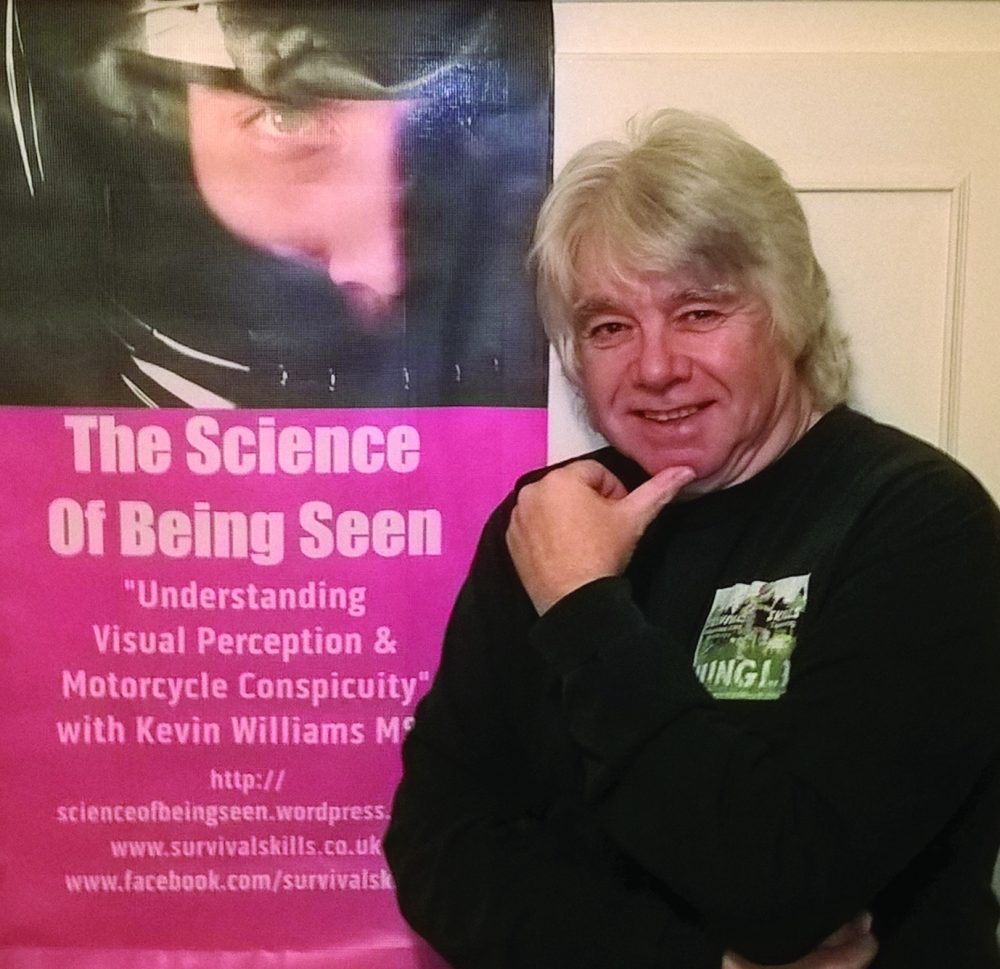
 

Kevin Williams / Survival Skills Rider Training www.survivalskills.co.uk

(c) K Williams 2020

The Science Of Being Seen – the book of the presentation £9.99 plus P&P and available now from: www.lulu.com

The ‘Science Of Being Seen’ is a presentation created in 2011 for Kent Fire and Rescue’s ‘Biker Down’ course by Kevin Williams. Biker Down is now offered by over half the nation’s FRSs as well as the UK military, and many deliver a version of SOBS. Kevin personally presents SOBS once a month for KFRS in Rochester. He toured New Zealand in February 2018 delivering SOBS on the nationwide Shiny Side Up Tour 2018 on behalf of the New Zealand Department of Transport.

Find out more here: https://scienceofbeingseen/wordpress.com

Bullets, Camels, Elephants & Tigers (Part 1)

Having spent a lazy summer swanning around the Cotswolds, John Stevenson was getting bored. Patrick White, who was recovering from a serious illness, was also bored, having not been on a bike for nine months. Both wanting to extend their biking horizons, we braved an adventure north – all the way to Birmingham. The destination was that bikers adventure park, The NEC Bike Show.

Without the use of maps, compass or satnav, we explored the show, narrowly avoiding bankruptcy at the likes of BMW, Norton, Ducati, Brough etc., until we found an oasis of calm and a very friendly welcome at the Indian Rides stand.

Narendra, the founder, and his wife Gopika asked us if we had ever thought of going to India. John replied “Yes, it is somewhere I have always wanted to go,” whilst Patrick, looking horrified, said “You’ve got to be joking!”

Fast forward to early February 2019. Patrick, having been encouraged, maybe bullied, by John agreed that – although it was pure madness – they should just do it. By the end of February having, in true Indian style, negotiated a good deal for the tour, flights were booked with British Airways and deposits paid. At this point it seemed like a good time to do some extensive research into what we were actually letting ourselves in for.

The Tour was to last 15 days, but as we considered ourselves to be “gentlemen of leisure”, we added a day on the front and several days on the back. When planning and booking we worked out a strict budget, but over the following months that gradually fell by the wayside. The months from the end of February to the departure were filled with obtaining visas; having lots of jabs; getting International driving licences; a long search for a map of Rajasthan; endless shopping trips and searches on eBay for suitable biking gear; enough first aid kit to equip a  small ambulance plus large quantities of Deet for the expected mosquitoes.

Then one day we found ourselves at Heathrow Terminal 5. Having checked in the luggage, we settled down at Costa in the departure lounge and said “Well there’s no turning back now!” The big positive was that we knew that we were going to have excellent biking weather.

10 hours after buying some ‘Scottish medicinal mouth wash’ in the Duty Free at Terminal 5, we looked out of the aircraft window to see New Delhi rushing up towards us out of the smog. A car from our hotel collected us from the airport and gave us our first taste of Indian driving and traffic. India, having been part of the British Empire, had all the familiar infrastructure: driving on the left, pavements, roundabouts, pedestrian crossings, traffic lights, English road signs, only you just ignore all that. The police just stand and watch the ensuing chaos.

After checking into our hotel we went for a climatisation walk – a circular tour of the area around the railway station. We were in awe of the volume and variety of traffic, which included cars, lorries, bicycles, scooters, motorbikes, ox carts, Tuk Tuks, cycle rickshaws, dogs, cattle, goats, pedestrians and handcarts. It all appeared totally chaotic. The deafening cacophony of horns and engines which continued 24/7 almost made you forget that the air was over 40°C and heavy with pollution.

Contrary to all the scaremongering, the smell was no worse than most other cities. To get a real flavour of Delhi we took a ride in a Tuk Tuk across New Dehli centre at rush hour – until you have experienced that you don’t know you are alive. We also rode the Metro, which was so modern, efficient and clean we thought we had been transported to another planet.

That evening we enjoyed our first ‘real’ Indian curry followed by a good night’s sleep. The next morning we were collected from our hotel by Indian Rides and whisked some 4 hours away in a mini bus to Mandawa and our hotel, The Mandawa Haveli. It was essentially a town centre manor house of historical and architectural interest, and we felt that we were now experiencing true India. Parked in the front courtyard were our trusty steeds for the next 15 days; 14 new Royal Enfield 500cc Bullets in British Racing Green. Wow, let the fun begin!

That evening over dinner and a few bottles of Kingfisher, we got to know the rest of the tour group which consisted of us, 4 other Brits (3 of whom were IAM members), 1 Dutchman, plus 3 French couples and of course Narendra, our tour leader. As well as this there was the support crew of 2 with their minibus for our luggage and a variety of Royal Enfield spare parts. These two guys we renamed Hudson and Jeeves as we could never remember their proper names and when we did remember we couldn’t pronounce them.

Now the serious riding began but first a safety briefing and bike check: Check 1 engine starts; Check 2 horn works; Check 3 – just ride! The first day of riding covered many aspects including ignoring everything we learnt back home, riding on road surfaces that were so bad that it proved England does not have any pot holes, just minor surface imperfections. We rode through rivers, deep gravel, sand and unmade roads, all while negotiating regular Indian traffic – which appeared to be complete chaos – plus avoiding cows, camels, pigs, dogs, oxen, monkeys, and of course, pedestrians, Tuk Tuks, rickshaws and thousands of scooters. In spite of all this, it was some of the best fun we have ever experienced on bikes and did wonders for our observation and filtering skills.

The Mandawa Haveli.

Hudson and Jeeves.

The following day we left Mandawa and headed for Bikaner, covering another good mix of road types and avoiding herds of camels. We were now really loving the Bullets, the big 500cc single, thumping away, exhaust burbling, plus the popping and banging on the overrun. We stopped off for a tour of the Fort of Junagarh then on to Bikaner, where we stayed in an ancient palace which now served as a 5 star hotel.

After a good breakfast of traditional Indian or European fare, we were back on our Bullets heading for the golden city of Jaisalmer, on the edge of the Thar desert. Dinner in the open roof-top restaurant watching the sun set on Jaisalmer Fort was spectacular. The fort looks like a giant sand castle rising from the sandy plains.

The next day started with a tour of the fort and the town, then more riding but this time out into the Thar Desert. After an hour or so our hotel for the night appeared as if like a mirage. It was a tented complex surrounded by huge sand dunes. Our next test was to access the site up a rather large and steep sand dune. Narendra filled us with confidence while we all waited at the bottom and watched him ride straight up as though it was a tarmac road. We then attempted to emulate him one by one, resulting in no one getting much further than halfway without the assistance of several locals pushing. Having proved we cannot ride bikes on sand dunes and any prospect of competing in the Dakar Rally completely dashed, we all transferred to camels.

That night we were entertained by local gipsy dancers and musicians, and slept under the stars only to discover, the following morning, that we were just as bad at riding back down the dunes.

We negotiated many roads that were covered in sand, some several centimetres deep, but the Bullets never let us down and we couldn’t believe how versatile our bikes were, coping with everything thrown at them and proving you don’t have to spend any more than about £4,000 to have a brand new bike that is great fun and full of character.

Later that day, arriving at our destination, Pokaran, we found our hotel to be a converted fort, complete with battlements and a large outdoor swimming pool. Could this get any better?

John Stevenson & Patrick White

First published in Slipstream April 2020

From Bullets to camels.

Unusual & Infrequent Maintenance

How many of you have ever actually looked at the section of your bike’s owner’s manual titled “Service schedule”? At best, you’ve maybe glanced at the long list, noted the intervals, and made a note to drop your bike off with your dealer or independent mechanic at the specified mileages. The problem with this hands-off approach is that you risk a lot of important stuff getting missed, and suffering the reliability and financial consequences later on.

Whether it’s listed in your manual or not, the official maintenance schedule for your particular model of motorcycle will be defined by your manufacturer. They will have dictated what needs to be done at what mileage and time intervals in order to ensure reliable operation of the machine, or at least to ensure a minimum of warranty claims. The obvious, common stuff will be things like checking and lubricating pivot points (levers, sidestands, foot pegs), checking that no nuts or bolts have vibrated loose, and changing the engine oil. This stuff is easy to do and doesn’t take long, so it’s relatively cheap and makes the customer feel like they’re looking after their bike. Without this work, you’d notice significant degradation in your end-user experience of the product, followed by serious, and easily observable technical faults, such as your engine exploding.

See, long-term reliability and performance isn’t always a priority for the original manufacturer. If you’re a good little customer, you’ll be swapping your bike for a new one every 24-36 months anyway, so any long-term issues won’t crop up under your ownership. If the second or third owner experiences problems, who cares? Those riders aren’t really their customers, so their experience isn’t as important.

Of course, this short-sighted view is why I’d never want to own a BMW or KTM out of warranty but might consider giving Honda, Yamaha, or Suzuki my new-bike money one day. And if no-one wants to buy your used bikes, then suddenly the PCP business model collapses, and your ‘subscribers’ can’t afford your expensive new bikes anymore. But making the maintenance schedule entirely comprehensive would likely hurt new-bike sales. Servicing costs are a significant consideration for many buyers, so Ducati has worked very hard to reduce the frequency with which their bikes need taking in for maintenance. Initial purchase costs can easily be dwarfed by running costs if you’re not careful.

After 33,000 miles, what was left of my V-Strom’s fork oil resembled muddy hot chocolate.

Ask an experienced mechanic what you should be doing regularly to keep your machine at peak performance and you’ll likely be listed a number of things that aren’t on any manufacturer’s maintenance schedule. For example, suspension. Triumph, credit where it’s due, instruct their dealers to change the fork oil as part of regular servicing. Fork oil degrades over time, affecting damping performance, but isn’t considered a service item at all by many manufacturers.

Of course, shock absorbers degrade at the same rate in the same way, and stock units on most bikes are usually not rebuildable. In order to return like-new performance, you’d have to replace the entire shock absorber every 16,000 miles or so. No manufacturer wants to put that on their maintenance schedule, as OEM shock absorbers are hellishly expensive. I once asked a BMW rep at a trade show what their solution was for people wanting to get the suspension on their R1200GS refreshed. With an entirely straight face, he told me that it would never come up because at 18,000 miles I’d naturally be trading the bike for a new one anyway.

Aftermarket shocks can be serviced every 16k miles; stock units can only be replaced.

After a few harsh winters, the running gear under your bike will be in dire need of some TLC.

Staying with suspension for a moment, most modern bikes have complex linkages designed to allow short-stroke shock absorbers to support a wide range of wheel movement. These linkages are usually slung low in the chassis, often placed directly in front of the rear wheel, and get absolutely pelted with rain and salt. What’s more, there’s frequently very little grease pumped into those bearings from new, and after just a few thousand miles of wet-weather use can often by at risk of seizing up and acting against the movement of the suspension.

Because of the torque being applied to these moving parts, it’s rare for a suspension system to seize solid – you simply get metal-on-metal grinding that quickly turns into expensive damage. In the meantime, you’ll experience added stiffness to the ride, but odds are it’ll be so gradual that you won’t notice until it’s too late. Dismantling these linkages can be a very involved job – on a Yamaha FJR1300 you even have to remove the exhaust system – making it very expensive in terms of labour hours.

In a dry climate, with a bike that’s only ridden in nice weather, you could probably go for years and not have a problem. But I’ve taken apart linkages on both my Yamaha T-Max and Suzuki V-Strom when they had relatively low mileages, only to find that I’d caught the problem just in time. One of the linkages on the T-Max was completely seized at less than three years old, and the bearings all showed tell-tale signs of rust. This premium scooter had a full dealer history when I bought it, but nowhere in the maintenance schedule are suspension linkages mentioned at all. But worst of all is when stuff is on the service schedule, but lazy mechanics don’t do it because it’s too much work. Depending on how honest your mechanic is, you might still be paying for the work, but I have strong evidence to suggest that my Triumph dealer never checked the valve clearances during my Street Triple’s 12,000-mile service, despite charging me for the work. “Everything was fine, nothing needed adjusting, that’s 3 hour’s labour please.” I can almost understand the logic; if you’ve checked dozens of engines and they’ve thus far been in-spec at the 12k mark, then it’s very tempting to assume that they’ll all be fine. But you can’t officially not do it, or the manufacturer will blame your dealership if there’s an engine failure under warranty. So you tick the box and move on to the next bike on your to-do list.

Steering head bearings are a similar story. Buried under fairing on many bikes, and requiring hours’ of work to get to even on unfaired models, checking, re-greasing and adjusting them must be a task that’s tempting to ignore. And how would the customer even know, one way or another? Steering head bearings can fail at any time, even if well maintained, and are considered a wear item. No warranty claims, no proof, no problem!

Getting to the steering head bearings is no mean feat, even on a naked bike…

The next problem you have is detailed service records, or the lack thereof. If you’re taking your bike back to the same main dealer, or a dealer with access to a shared records system, you might be OK. They’ll be able to look up what was done last visit and therefore know what is required this time, be it an annual service or something mileage-based. If you’re relying on a different dealer or a mechanic that simply doesn’t keep those kinds of detailed records, you’ve got a problem. You’ll have a stamp in the book showing when the last service was completed, but no details of what work was completed. So the mechanic will ask you what needs doing this time, and unless you’re like me and keep track of individual service items yourself, you’ll have no idea.

Is it time for the brake fluid to be changed? The fuel hoses to be swapped? Are you due a valve check or not? Some items are time-based, others on mileage alone, some a combination. Asking a mechanic to “service” your bike is like asking an artist to paint you a picture – you’re going to need to be a lot more specific. Asking for a “basic service” usually means changing the engine oil and filter, maybe an air filter, a check of the brakes, followed by a quick once-over to make sure nothing external is leaking or otherwise obviously broken. Do that same thing every year or every mileage interval and you’ll probably avoid catastrophic engine failure and maintain basic safety, but long-term reliability and performance will suffer, and you could be storing up some big, expensive repair bills for the future.

My approach is to meticulously document everything

Some independent dealers might list “bronze”, “silver”, and “gold” services, along with what each one entails. All will be generic, none will be model-specific, and even if you follow a sort of minor/major cadence there will be plenty of things that get missed from the official schedule – not to mention the unwritten list of other stuff that really should receive regular attention. The only thing you can do is educate yourself by talking to experts, asking hard questions of your mechanic, and keeping your own records and schedules. That way, you can be in control, can be sure that your bike is being properly maintained, and avoid some really nasty surprises further down the road.

Here are a couple of tips and best practices I’ve developed over the years:

  • Keep detailed service records of exactly what was done and when. Ask your mechanic or service writer for a full breakdown when you pay the bill.
  • If using an independent mechanic, do your homework and get hold of an itemised service schedule for your bike. If they are true professionals, they won’t mind looking at the previous work notes and official service schedule before talking to you about what they recommend needs doing based on your bike’s history.
  • Use forums and owner’s clubs to find out if there are any model-specific maintenance pieces that should really be added to the manufacturer’s list of service items. Discuss these items with your mechanic, with a view to seeking their advice – no mechanic wants to think that their experience is valued less than “wot I read on the internet”, so be diplomatic.
  • Find a mechanic you can trust and stick with them, making sure they understand that you’ll be using their services again. If they’re going to have to pick up the pieces of any corner-cutting, they’ll be less likely to cut those corners in the first place.
  • If you intend to keep the bike for the long-haul, let your mechanic know. The advice they would give to someone looking to keep a bike short-term might well differ from what they would tell someone who wants to still be relying on the same machine in 50,000 miles.
  • Have any particular maintenance tasks you think are frequently overlooked, or maybe a particularly clever way of logging everything? Send me a message and let me know!


Nick Tasker

First published in Slipstream April 2020

Science of Being Seen – Part 3

SMIDSY – there’s more than one driver error

Thanks to decades of ‘Think Bike’ style campaigns which in essence tell drivers to “look harder” or “look longer” for motorcycles it’s not surprising that most riders believe that the SMIDSY results from poor driving skills and specifically from “not looking properly”. This advice and these beliefs have arisen from ‘post-hoc’ analyses of crashes. That is, they tell us WHAT happened and we find that out by starting at the end point of the collision, and working backwards till we find the error. It’s pretty straightforward in the case of the SMIDSY; the driver didn’t see the bike.

But post-hoc analyses don’t tell us two things:

  • how OFTEN the crash occurs – in fact, with 30+ million active drivers and between 1 and 2 million active motorcyclists in the UK, serious collisions are remarkably rare – just over 2000 in total in 2017. The vast majority of drivers see the vast majority of bikes – we just notice the ones who don’t see us.
  • WHY the driver failed to see the bike – for that we need to start at the other end of the crash and ask why an everyday interaction went wrong.

Last time I talked about the ‘looked but COULD NOT SEE’ issue, where the motorcycle is simply not where it could be seen. But what about those events where reconstruction suggests that bike was actually in a place it could be seen?

In fact, there’s a chain of perceptual events to be completed between the driver looking and the bike being seen. The ‘Looked But Failed To See’ problem can result from a breakdown at any of the stages:

  • firstly, the driver has to look – if he / she doesn’t look, the driver will not see the motorcycle
  • secondly, the bike has to be where it can be seen when the driver looks – if not, the bike is not visible and the driver cannot see the motorcycle
  • thirdly, the driver has to look and perceive the motorcycle – if the motorcycle is not perceived, the driver will not see the motorcycle
  • fourthly – and this one is hot off the press, straight out of a paper published late in 2019 – the driver has to look, perceive the motorcycle and then retain that knowledge right through the manoeuvre – if the driver forgets that he or she saw the motorcycle, the manoeuvre will be performed as though the driver did not see the motorcycle
  • fifth and last, if the driver perceives the motorcycle, the driver has to assess speed and distance correctly – if the driver misjudges either, the result is likely to be a faulty decision to turn and an unsafe manoeuvre

The proportions of the different errors may surprise you.

‘Did not look’ falls into the smallest segment of the chart, and includes collisions where drivers are using mobile phones. An IAM report entitled ‘Licensed to skill: contributory factors in road accidents: Great Britain 2005 – 2009’ looked at over 700,000 items of official crash data from the UK and found that ‘driver using mobile phone’ was the cause of 0.8% of fatal crashes, and just 0.2% of all injury crashes. I should point out that these are crashes involving ALL vehicle types, and that given the huge increase in smartphone use the figures may be outdated, but the inference is that the crash rate between motorcycles and drivers using a phone is almost certainly much lower than most riders believe.

In fact, the three main factors are:

  • the driver looked but the bike COULD NOT be seen – between one-fifth and one-quarter of all collisions
  • the bike was visible, and the driver ‘Looked But FAILED to see’ – around one-third of all collisions *
  • the bike was seen and the driver ‘looked, saw but MISJUDGED speed and distance’ – around one-third of all collisions

(This total is likely to include the newly proposed ‘looked, saw but FORGOT error’).

From our perspective as riders, it’s important to understand that each error is different, with different causes and different possible solutions. Treating them all as a ‘driver didn’t look properly’ issue has held back our understanding of collisions between cars and motorcycles for over forty years. It’s time to move our understanding and our strategies for dealing with these crashes forward.


Kevin Williams / Survival Skills Rider Training www.survivalskills.co.uk

(c) K Williams 2020

The Science Of Being Seen – the book of the presentation £9.99 plus P&P and available now from: www.lulu.com

The ‘Science Of Being Seen’ is a presentation created in 2011 for Kent Fire and Rescue’s ‘Biker Down’ course by Kevin Williams. Biker Down is now offered by over half the nation’s FRSs as well as the UK military, and many deliver a version of SOBS. Kevin personally presents SOBS once a month for KFRS in Rochester. He toured New Zealand in February 2018 delivering SOBS on the nationwide Shiny Side Up Tour 2018 on behalf of the New Zealand Department of Transport.

Find out more here: https://scienceofbeingseen/wordpress.com

Science of Being Seen – Part 2


Looked but Could Not See

In the moments leading up to a SMIDSY, we can usually see the car. We can often see the driver. Ergo, we assume the driver should be able to see us ‘if he looks properly’. It’s the obvious, common-sense, conclusion.

It may be obvious. It may be common-sense… but it’s often wrong.

In fact, in over one-third of collisions involving a car and a two-wheeler, the bike was out of sight at some point of the run-up.

Now, before I go any further with my explanations, I want to make clear that explaining how and why drivers make mistakes is NOT ‘shifting the blame’ for the SMIDSY collision onto the motorcyclist.

The driver still has a responsibility to avoid making mistakes, and maybe you think the answer is that drivers should ‘look harder for bikes’ but it’s not as simple as it sounds. Have a think about what we all do when pulling out of a side turning – we’re looking left and right, back and forth, possibly watching ahead if we are at a crossroads, probably keeping an eye on cyclists and pedestrians too. Although we do this almost without effort once we’re through the learning stage, even motorcyclists pull out in front of other bikes.

As the ones far more likely to get hurt, what matters to us is seeing it coming and getting out of trouble if there’s the remotest chance. As I said in my first column for MAG years ago, ‘it takes Two to Tangle’; if the driver sets up the circumstances in which a collision CAN occur, we still have to RIDE INTO IT for it to happen. Mid-emergency, blame is irrelevant. We can leave the lawyers to sort that out later.

So let’s start by understanding just how a motorcycle can vanish from sight.

A typical motorcycle is one-third of the width of a car and can easily be hidden, particularly on busy city streets. Maybe other vehicles block the drivers view, particularly if we are filtering or moving alongside parked vehicles. We can vanish behind a tree, a telephone box, even people standing on a street corner.

Sometimes the bike is obscured by the car itself. The framework supporting the windscreen – the A pillars – are significantly thicker on modern vehicles. Those in my partner’s car are about the size of my palm. Stand in front of your motorcycle, hold your hand up in front of your face and see just how close you can get and not see your own motorcycle. The distance should alarm you. So if the driver looks in our direction and the view is blocked by the A pillar, the driver won’t know we’re there.

So now angles are important. Imagine approaching a car already waiting to turn at a junction. If the car’s at right angles to us, then the driver can look out the side window. Or if the car is facing us, waiting to turn into the side road, the driver’s looking out the windscreen.

But what if the side road is at an angle, or the driver has angled the vehicle? At the right (wrong?) angle, the A pillar can partially block the view down the road. And from our palm experiement, we know how close we can get and still be invisible. The B pillar supporting the doors can play the same trick when glancing back over the shoulder.

What if both vehicles are moving? Then another, more complex, problem known to sailors as the ‘constant bearing’ problem can arise.

Here’s what happens. If two vessels are sailing on a collision course, then there’s no movement across the background – the bearing between them stays constant. The same can happen if a bike and a car are both moving towards a junction. Since the angle stays the same, there’s no movement across the background to help the driver detect the motorcycle in the first place. But if their relative positions put the bike in the blind spot created by the A pillar, then it will remain invisible almost to the moment of collision.

This seems to explain many roundabout collisions and near-misses. Most of us approach a roundabout hoping to keep moving, so we look, don’t see anything, and drive straight onto the roundabout. That’s when we discover that there’s been another vehicle in the blind area the entire time.

I started off by saying we don’t have to ride into these collsions. A big plus of riding a motorcycle is that we usually have a better view than a driver. It’s rare we have zero view of the car that’s about to pose a threat.

We need to work out the driver’s likely line-of-sight. If we can see the front of a car (but not the driver) then our bike isn’t where the driver can see it. If we can see that the A pillar is sitting directly in the driver’s line-of-sight, then we can anticipate he can’t see us.

And then we do something proactive to avoid the ‘looked but failed to see’ error making mincemeat of us. We can slow down, change position, sound the horn and be ready to take evasive action.

To say that too many riders fail to take these simple precautions and consequently get caught out isn’t ‘blaming the rider’ but it’s hard not to think that our response in an emergency needs to be better than ending up in a heap repeating the tired old complaint ‘the driver didn’t look properly’.

We’ve been saying that for one hundred years and it’s not solved the problem yet.

Kevin Williams / Survival Skills Rider Training www.survivalskills.co.uk

© K Williams 2020

The Science Of Being Seen – the book of the presentation £9.99 plus P&P and available now from: www.lulu.com


The ‘Science Of Being Seen’ is a presentation created in 2011 for Kent Fire and Rescue’s ‘Biker Down’ course by Kevin Williams.

Biker Down is now offered by over half the nation’s FRSs as well as the UK military, and many deliver a version of SOBS.

Kevin personally presents SOBS once a month for KFRS in Rochester.

He toured New Zealand in February 2018 delivering SOBS on the nationwide Shiny Side Up Tour 2018 on behalf of the New Zealand Department of Transport.

Find out more here: https://scienceofbeingseen.wordpress.com

Is Motorcycle Journalism Broken?

A family relative recently advised me that they would be cancelling their subscription to a mainstream motorcycle magazine, commenting that they found my own reviews more useful and interesting than those written by apparently more experienced and certainly more professional motorcycle journalists. He complained that the reviews were all overly positive, with no real-world detail or relevance to himself as a motorcyclist.

Naturally, I was extremely flattered but advised him that he should temper his criticism somewhat given that, in many ways, I had a much easier job than writers who needed to earn a living doing this stuff. Let’s not forget that I write for both my blog and for Slipstream as a hobby, as a critically-minded enthusiast of all things two-wheeled. Then again, I too have issues with motorcycle journalism as it is delivered elsewhere – it’s one of the reasons I started writing about bikes in the first place. After all, if you want something done right, you’ve got to do it yourself.

So let’s examine some of the claims and see if they’re just baseless rumours, or if there’s some fire behind the smoke.
Magazines are paid-off by manufacturers!

I’ve heard from sources in the industry that this has happened in the past. It may persist in some quarters today, though editors I’ve heard from hotly deny it. My suspicion is that any coercion was and remains far more indirect, as motorcycle magazines are generally dependent on three things to survive:

a) Magazine sales
b) Press bikes
c) Advertising revenue

Online sources rarely have access to direct sales or subscriptions, with most content being delivered for free, but also have significantly reduced distribution costs. Printing and shipping magazines around the country isn’t cheap! Web media also have access to a far wider – often global – audience, although language barriers still restrict readership. There have certainly been instances when advertisers have threatened to pull advertisement spending unless the product is reviewed favourably, and editors have had to make some very difficult commercial decisions.

I’m certainly going to continue being suspicious of glowing reviews of products that are advertised on the same page(s) of a publication that is making money advertising said products. Then again, sometimes stuff is just awesome, and an accompanying advertisement is merely a coincidence. I would like to think that my own record speaks for itself, and I can certainly promise that I would sooner refrain from reviewing a product at all than write an artificially biased piece. Any advertisers wishing to promote their clients or products in Slipstream are welcome to get in touch but should be advised that favourable coverage must be earned, rather than bought.

Press Bikes are another issue. Magazines, both online and print, rely on free loans of the motorcycles and products that they write about – buying an example of every new item would be prohibitively expensive and uneconomically viable, given their current business model. There are some exceptions – me included – who stick to writing about bikes and products they’ve purchased or borrowed from dealers, limiting our scope but freeing ourselves from our dependence on the continuing goodwill of their providers. I’m aware of at least one publication that can no longer get access to Yamaha products, for example, after they wrote one too many scathing words about the company’s motorcycles.

Working in the Marketing/PR industry myself, I have to say that such childish responses seem counter-productive. Far from cowing the journalists in question, it’s simply guaranteed that their negative appraisal of the company’s products can never be reassessed in light of new developments. The journalist in question is still writing gleefully about how Yamaha sulkily took their toys and went home, and aren’t being given the chance to ride newer bikes they might enjoy and therefore write about more positively. You can’t hide anything on the internet, so a negative review simply helps put the positive ones into context and improves their perceived legitimacy.

Unfortunately, I suspect that there are a few journalists (and certainly plenty of influencers) who are at least partially cowed by these implied (or even explicit) threats and choose to tone down any criticism, attempting to balance their editorial integrity with their desire for press fleet access. You can learn to read between the lines on such pieces, but it certainly cheapens their value and limits their usefulness to the informed consumer.

My reviews depend exclusively on loan bikes from dealers across the country, and I’ve occasionally travelled significant distances for a few hours on a rare bike I wanted to write about. I also tend not to bother riding or reviewing bikes I don’t expect to enjoy, meaning that my more scathing pieces are written out of disappointment rather than schadenfreude. That being said, I’m sure there are one or two manufacturers who have blacklisted me in advance, just in case I do ever get in touch

Journalists are out of touch with owners!

As mentioned earlier, few – if any – motorcycle journalists have paid with their own money for the bikes they are reviewing. If they had, we’d have to worry about a different kind of bias creeping in. In the same way that few parents will admit that their own children are anything less than perfect angels, it can take a long time for someone to admit that their new bike has any faults whatsoever. And in truth, the reality is that modern motorcycles are all pretty good.
I may only ride each bike I review for a couple of hours, and there’s certainly a skill to quickly evaluating all aspects of a motorcycle that I’ve had to develop. Journalists with access to press fleets may have a bike for a few days or even a couple of weeks, and some publications occasionally run a long-term bike for months and thousands of miles. The longer someone spends with a bike, the wider the variety of circumstances and environments in which they use it, the more likely they are to expose any flaws in the design. In my case, even a positive review is intended to encourage a test ride rather than a blind purchase, and I always try to be clear on when I am speaking from direct experience and when I am merely speculating based on limited data.

Unbeholden to advertisers, I can deliver an unvarnished report (eg: not a fan of this Road King)

But even a long-term loan isn’t the same as handing over your own credit card. That is why the test-ride is so important. Even a professional journalist who tries to speak objectively is unlikely to ever be considering a bike they review for a personal
purchase. Motorcycle Journalism doesn’t pay particularly well, and with a constant conveyor belt of new bikes to ride, rarely have they the means or the need to buy a brand-new motorcycle for themselves. Some journalists are better than others, of course, but I challenge any of them to say, hand on heart, that they are as careful and critical of their analysis when their verdict will have no impact on them personally or financially. Every motorcycle I review for Slipstream is a bike I seriously considered buying, and long-time readers will note that my archives are littered with proof that I am occasionally sufficiently impressed to open my wallet.
I am convinced that this disconnect between purchasers and principle public mouthpieces is one of the reasons we’ve seen the average transaction price of motorcycles creep up over the last couple of decades. It’s no surprise that every BMW motorcycle delivered to reviewers is the fully-equipped top-of-the-range version. As a result, it’s equally unsurprising that the lucky journalists who get to ride these technological wonders are almost universally impressed by the experience. Personally, I’m far more impressed when a manufacturer can deliver a great experience on the cheap – it takes far more skill than simply throwing money at the problem.
I once saw MCN unfavourably compare a £10,000 V-Strom 1000 to a brace of £15,000 alternatives. Not once was the cost differential mentioned as a factor, nor some sort of weighting system used during the final scoring. That’s a bit like telling me a million-pound mansion is more comfortable than a £100 tent; quelle surprise! Yes, PCP has hidden this cost differential for many people, but that’s no excuse for ignoring the price entirely.

Judging by the sales numbers, far more of us are riding older bikes than brand new ones.

But even a long-term loan isn’t the same as handing over your own credit card. That is why the test-ride is so important. Even a professional journalist who tries to speak objectively is unlikely to ever be considering a bike they review for a personal
purchase. Motorcycle Journalism doesn’t pay particularly well, and with a constant conveyor belt of new bikes to ride, rarely have they the means or the need to buy a brand-new motorcycle for themselves. Some journalists are better than others, of course, but I challenge any of them to say, hand on heart, that they are as careful and critical of their analysis when their verdict will have no impact on them personally or financially. Every motorcycle I review for Slipstream is a bike I seriously considered buying, and long-time readers will note that my archives are littered with proof that I am occasionally sufficiently impressed to open my wallet.

I am convinced that this disconnect between purchasers and principle public mouthpieces is one of the reasons we’ve seen the average transaction price of motorcycles creep up over the last couple of decades. It’s no surprise that every BMW motorcycle delivered to reviewers is the fully-equipped top-of-the-range version. As a result, it’s equally unsurprising that the lucky journalists who get to ride these technological wonders are almost universally impressed by the experience. Personally, I’m far more impressed when a manufacturer can deliver a great experience on the cheap – it takes far more skill than simply throwing money at the problem.

I once saw MCN unfavourably compare a £10,000 V-Strom 1000 to a brace of £15,000 alternatives. Not once was the cost differential mentioned as a factor, nor some sort of weighting system used during the final scoring. That’s a bit like telling me a million-pound mansion is more comfortable than a £100 tent; quelle surprise! Yes, PCP has hidden this cost differential for many people, but that’s no excuse for ignoring the price entirely.

Motorcycles are still very diverse, so these generalist magazines have many different journalists on the books, each one with their own preferences and biases, each predisposed to look favourably upon certain brands or types of motorcycle. They also tend to be more familiar with the bikes they personally enjoy, and it therefore makes sense that a magazine editor would send their sports bike junkie to review the new Kawasaki ZX10R, rather than the weatherworn touring enthusiast. This means that each review is written by the journalist most likely to enjoy each bike, and least likely to question the core tenets of its philosophy.

A Kawasaki H2SX would likely be labelled as overweight and slow to turn by someone who preferred dedicated track bikes, and a relaxed touring enthusiast would flay it for its appalling fuel economy and missing top box. And while it might be amusing to read such reviews, it wouldn’t really provide any useful information to anyone. Of course, anyone who hasn’t figured out what sort of bikes they like won’t glean any useful data from a slew of universally positive reviews either. Match the right journalist to the bike and you’ll learn that every bike has good brakes, handles well, gets acceptable fuel economy and is sufficiently comfortable for longer rides. Everything is relative, unfortunately, and what’s comfy or economical from one person’s perspective might be considered shockingly poor from another.

I wear my biases openly, usually opening my articles with statements explaining what I was looking for in each case. I try to detail the parameters I consider good for each aspect and make sure to explain why I do or don’t like something about a particular motorcycle. I’m predisposed to favour less expensive, less powerful bikes, and value practicality, reliability and longevity over outright performance. I’m suspicious of technology for technology’s sake, and my particular physiology means I don’t find sports bikes comfortable, so I’ll probably never bother reviewing one – you already know it’s not going to be a positive write-up.

One big difference, however, is that I am aware of my biases, and can use that information to improve my objectivity. Even if I don’t like a bike, or rather, decide that it’s not fit for my particular purpose, I’ll always do my best to speculate about the purposes for which it might be suited. My hope is that this will help my readers draw their own conclusions and inform their own decisions. I can give friends and family members more personal advice because I know what their particular biases and preferences are, and can more accurately gauge which bikes I think they would enjoy or would fulfil their needs.

I’m afraid I don’t know you. You’ll have to make up your own mind.


A Different Type of Riding (Part 5: Putting it to the test)

Turns out an oversized scooter makes an excellent two-up touring bike.

While I ride some motorcycles purely out of a sense of curiosity, newcomers to this site may not realise that, in many cases, I’m simply documenting the process by which I search for my next bike. I usually have very specific requirements, and I’m always very, very picky.

In this case, I had a very specific objective. To achieve it, I first tried out a Honda Forza 300, then a Harley-Davidson Sport Glide, before finding what I was looking for in a Yamaha T-Max 530. That meant that it was time to put my money where my mouth was and bring home a very lightly-used 2-year-old matte-black ‘DX’ variant of my very own. Buying used always carries risks, and I assumed I was relatively safe given that Yamaha regularly tops reliability surveys. And with just 2,300 miles on the odometer there weren’t a lot of opportunities for the previous owner to have abused the bike before I took ownership.

Sadly, the honeymoon period lasted just 24 hours before an electrical fault prevented the bike from starting after I rolled it out of the garage the very next morning. As you might imagine, I was fairly aggravated, but a private sale of a just-out-of-warranty vehicle left me with no recourse. Without a wiring diagram it quickly became apparent that I was stuck, and none being publicly available for such a new bike I gave in and paid my local Yamaha dealer to take it away.

Six hours of labour later the technicians finally traced the broken wire buried under the fairing and I was back in business, albeit with my wallet somewhat lighter. Still, their exhaustive search meant that any other potential gremlins have clearly been driven off, as my new T-Max has been faultless in the 4,000 miles since – many of which were under fairly extreme conditions.

My intention was to use the T-Max for a two-up low-speed 3,000-mile tour of the Italian and Austrian Alps, which my girlfriend and I set off for as August drew to a close. Luggage proved to be more of a challenge than expected, with the official Yamaha top box inexplicably on indefinite back-order, and the aftermarket racks too ugly for me to seriously contemplate. I was able to track down the smaller of the two options from a German dealer and made do by moving some day-to-day items to a ‘Tunnel Bag’, a sort of scooter tank bag that wedges between your legs. I took the under-seat storage, she claimed the top box, and we packed light.

Engine performance was sufficient for the intended task, with the DX-exclusive throttle modes proving more useful than expected. ‘T’ is very relaxed, exacerbating the already rubber-band-like throttle response of the constantly-variable transmission. Perfect for rolling on and off the power while trundling around, but also responsible for making slow-speed manoeuvres even more difficult than usual. In contrast, ‘S’ mode is considerably sharper than the only engine mode on the standard T-Max I reviewed, and it was quite a shock the first time I tried it out.

The engine reacts instantly, and the CVT’s design ensures that peak power and torque are delivered to the rear wheel at all times. With a relatively light curb weight of 215kg – the same as my V-Strom 650 – the T-Max shoots forwards immediately, the rate of acceleration defying its 45bhp peak power figure. Coupled with the surprisingly supple and controlled suspension, I was able to keep up with far more powerful motorcycles when blasting around solo. Two-up the power deficit becomes more apparent, with engine response far more sluggish and a noticeably reduced top speed.

Buying used means that the previous owner pays the 30% depreciation.

Yamaha claim 100mph is possible, but with the electronically-adjustable windshield at maximum and a top-box and pillion adding extra weight and drag this is clearly a fantasy. I set the electronic cruise control to a GPS-verified 130km/h as we blasted down the French autoroutes, but with the bike loaded this way the computer was unable to maintain those speeds during some of the steeper sections to the east of the country. Still, this extreme stress-test does mean that the kevlar-rubber belt transmission is clearly up to the task.

… but a private sale leaves you with zero recourse if something goes wrong.

Suspension proved itself to be just as impressive two-up and loaded with luggage as it had when riding solo. That being said I was disappointed to discover that even maxing out the preload on the rear shock could not maintain the chassis attitude, sagging a few degrees under our combined 130kg. On darker days and in tunnels I was regularly flashed by oncoming drivers convinced I had left my high-beams on, and the maximum 45-degree lean angles were noticably reduced. The centrestand touches down first on the T-Max, and with very little give it would be very easy to lift the bike off the ground on sharper bends. I think a stronger spring or new shock may be in the T-Max’s future.

Brakes are another area that proved adequate for the task at hand, even if they aren’t up to enthusiastic use when fully-loaded. With the centre of gravity so low in the vehicle, there’s not a great deal of weight transfer, limiting total braking before the ABS cuts in. Braking felt perfectly safe and stable in most realistic circumstances, but the feedback from the chassis, suspension and brakes advises against hooligan behaviour. If you’re a quick rider, and like to ride as fast two-up as you do solo, then this might be the bike for you.Fuel economy seems enormously variable. Spirited, mixed solo riding returns around 55-60mpg, and relaxed two-up touring sits in the 60-70mpg range. The full-speed autoroute trip drained the 15-litre tank in just over 100 miles, meaning that we were filling up once an hour and just scraping 40mpg. Later experiments at slightly reduced cruising speeds saw economy climb into the low 50’s, proving that no engine is truly efficient when running at its absolute design limits.

Comfort and stability were fantastic. The electric screen allowed me to dial out wind noise under the vast majority of conditions and the seats were comfortable for hours and hours of riding for both rider and pillion. I would prefer the handlebars be set further back, but then I do have notoriously short arms, and at 5’8” I was easily able to stretch out my legs on the spacious footboards. The wide seat meant that I had to settle for tiptoes on either side at a stop, but putting a single foot down flat is perfectly possible with the other on the boards. The weight is held low in the chassis, so balancing when stationary is much easier than it would be for a similarly-weighted adventure bike.

Oil changed, suspension adjusted, luggage packed and ready to go!

There are only two “modes”, but unlike many bikes they’re both different and useful.

Handling wise you’re limited by the slightly odd-feeling front-end. The low centre of gravity means limited weight transfer, so the T-Max handles a little bit like a telelever-equipped BMW; you just have to learn to trust it. That being said, turn-in is sharp and light, with the smaller 15” wheels providing less gyroscopic resistance than the 17-19” rims most motorcyclists are used to. Ground clearance only seems to be an issue if overloaded or riding excessively enthusiastically, and in ‘S’ mode the engine is responsive enough to allow you to maintain positive throttle through bends. Conversely, ‘T’ mode adds enough lag to discourage faster lines through corners, and I don’t recommend attempting hairpins or other low-speed manoeuvres with the throttle set this way.

It’s worth noting that the T-Max’s automatic clutch disengages at around 12mph on a closed throttle, resulting in a sudden loss of engine braking – very disconcerting if you’re following slower traffic through a downhill hairpin. I recommend trailing the rear brake all the way through such bends with the throttle partly open to maintain control. While it’s definitely easier to execute accurate manoeuvres with a clutch, you can certainly learn to work around the foibles.

The advantages are that you never have to change gear, never wear out your left hand in traffic, and are never going to find yourself in the wrong gear on an uphill hairpin. Instead, you can focus on your Roadcraft, maintaining the right lines while enjoying the stunning scenery. Whether rolling through sleepy Italian towns or dicing through Alpine passes with sportsbikes and adventure bikes, the T-Max never missed a beat, and the only times I wished for more power were when overtaking faster-moving traffic.

More relaxed touring returned acceptable, if not hugely impressive numbers.

Back home I’ve filtered down the motorway and into central London with ease, collected groceries using the cavernous underseat storage, and genuinely enjoyed a few twisty back-road blasts. An adventure bike is still a better all-round motorcycle, and for many riders a big scooter might be a step too far if they enjoy enthusiastic riding on solo trips. Even on days when my girlfriend and I broke from the rest of the group and did our own thing, we never once found ourselves wishing we’d brought something bigger, faster or more expensive. What’s more, I’ve since taken the T-Max out on some local loops and can confirm that I had no less fun than when riding the same roads on my proper bikes.What won’t come as a surprise to BMW or Harley-Davidson riders is the sheer joy at not having to lubricate a drive chain at the end of a day’s ride, nor having to scrub oily residue off the rear wheel and surrounding fairings at every wash. The belt drive certainly has its disadvantages; if it ever needs replacing, the part alone is more than £300. But Yamaha does not quote a replacement mileage, merely an inspection interval, and I’ve spoken to Harley-Davidson owners who are still on their original belt at 75,000 miles. Pulleys weigh more than sprockets, and the whole arrangement saps power over a traditional chain. If you get unlucky and pick up a piece of gravel it’ll punch a hole right through it, but all things considered, it’s a compromise I’m happy to make.

The release button on the glovebox door became very sticky after a couple thousand miles and needed lubricating with silicone oil, and the 2-amp fuse on the 12v socket popped when I tried to top up one of my tyres using my compressor. The toolkit is extremely lightweight, containing only a screwdriver and a couple of Allen keys. Notably missing is the hex-key driver necessary to access the battery compartment, which would spell disaster if you managed to flatten the battery while away from home. You can’t bump-start a vehicle with an automatic clutch.

No chain to oil and so far almost 7,000 miles with no adjustments needed.

Not an inch of wasted space; I’m not looking forward to the valve clearance check…

I’d argue that servicing is both expensive and unnecessarily frequent, with an oil change every 3,000 miles, more substantial checks every 6,000 and even more work at the 12,000-mile mark, which also includes replacement of the internal CVT-belt. Labour charges add up quickly with so much bodywork to remove, and Yamaha’s prices for parts and consumables are fearsome. On the other hand, oil changes are easy, with Yamaha providing full instructions in the owner’s manual, and resetting the service reminder can be done simply through the dashboard.

I was able to figure everything out in the end, and in truth it’s simply a very compact motorcycle squeezed under some unconventional bodywork. Given how few of these are sold in the UK, it’s quite likely that the only difference between you and your local Yamaha mechanics are that they don’t have to pay to access the service manual. I may cave in when the valve check is due, as there’s not a lot of space to work with, but I have until the 24,000-mile service to make up my mind about that.

The tyres probably have another 2,000-3,000 miles in them, but uneven wear has affected turn-in slightly. A new set of Michelin Pilot Road 4’s are waiting in the garage, the newer version in the series not yet available in the T-Max’s smaller 15” wheel sizes. I’m also tempted to try a more aggressive pad compound, or braided hoses, for the front brakes and would like a more adjustable rear shock. But I have to remember that I didn’t buy this bike for high-speed hijinks, and that any upgrades need to be entirely focused on the mission for which it was purchased.

And on that score, the T-Max is an absolute triumph. Yes, it’s down on power compared to what most fully-qualified motorcyclists are used to, and no, the seating position isn’t for everyone. At the end of the day, you have to be honest with yourself about which features and specifications you’re insisting on out of habit or misplaced pride, and perhaps consider that there are alternatives to conventional wisdom, because it turns out that you don’t need a 1.3-litre 150-horsepower motorcycle to go climb mountains with your partner; a 530cc scooter works just fine.

Nick Tasker
First published in Slipstream February 2020

Science of Being Seen – Part 1

Unless you’ve been under a rock, you’ve probably heard of ‘Biker Down’. It’s an accident scene management and first aid course delivered to motorcyclists by many UK fire services. It’s been adopted by the military too.

There’s also a third pro-active safety module on Biker Down. Most teams run a presentation called the ‘Science Of Being Seen’.

You may not know where it came from.

I’m the author, Kevin Williams of Survival Skills Rider Training. I created the Science Of Being Seen (SOBS) in early 2012 for Kent Fire and Rescue, the originators of Biker Down. Later that year, we won a Prince Michael of Kent International Road Safety Award, plus an insurance industry award in 2013. Most Biker Down teams deliver a modified version of my SOBS presentation. I deliver SOBS monthly for KFRS, as well as clubs and groups around the south of England.

How did I come to put SOBS together? I’ll fill you in. Leaving London University with a science degree that wasn’t finding a job, I spent sixteen years and half-a-million miles paying the bills by delivering parcels in London. The job funded me through a Masters degree but eventually I changed career (if not mode of transport) in 1995 and trained as a basic instructor.

Although I continued as a DAS instructor until 2006, I also launched my advanced training school, Survival Skills, in 1997. I subsequently added a BTEC in post-test training and an NVQ in distance learning, and I’ve continued in post-test instruction ever since.

I’ve written for MAG for almost twenty years and my work’s been published in several motorcycle magazines plus the Telegraph. I’ve worked with a number of organisations on projects to do with rider safety, including Bucks County Council and Somerset Road Safety Partnership, and last year I acted as consultant to the Transport Research Laboratory.

I spent February 2018 in New Zealand as ‘keynote speaker’ (sounds important, doesn’t it?) on the Shiny Side Up Tour, for the NZ Department of Transport. SOBS was delivered at a dozen different venues on North and South Islands. I was lucky enough to be invited back in February 2019 and gave even more talks.

So what is SOBS all about? Let’s start with a bit of background. I cut my despatching teeth in the era when every rider ‘knew’ blind Volvo drivers who “don’t look properly” caused the ‘Sorry Mate I Didn’t See You’ SMIDSY crash and killed bikers. An old buddy of mine called Dave Brown – now a top political cartoonist – drew a short-lived cartoon series called ‘Planet Ovlov’ for one of the motorcycle magazines. Why Ovlov? Turn the letters around. My early days as a courier seemed to confirm that. I had a few near-misses and one low-speed bump. “Sorry Mate…” etc etc.

Around the same time, we were first told to use hi-vis clothing and ride with headlights on (a choice most of us no longer have). We were told that these ‘conspicuity aids’ would make us more visible, and drivers could see us coming. It sounded good in theory. London’s mid-70’s ‘Ride Bright’ campaign was probably a world first. Yet the more I rode, the more it seemed to me that staying out of trouble was down to me. I realised that more often than not, collisions between motorcycles and other vehicles at junctions were avoidable.

In 1995 when I started working as a trainer, I was supposed to promote hi-vis and use lights to new riders. Remember, my background is in science. One thing that science teaches us is never to accept something on trust alone. My courier experience started me wondering if conspicuity aids actually worked or if there was something wrong with the ‘be bright, be seen’ advice.

My first investigations into what are now known as ‘Looked But Failed To See’ collisions fortunately coincided with university research institutes opening up their libraries to the internet. A quick look at comparative accident statistics for before / after the ‘Ride Bright’ campaigns suggested nothing much had changed – junction collisions still topped the list and drivers still weren’t spotting bikes. And riders still sailed into these collisions. Ever since I started bike training, I’ve warned riders not to place any great trust in conspicuity aids but to be ready to take evasive action. Way back in my very first MAG column in 2002, I wrote:

“It’s easy to point the finger of blame at car drivers but it’s worth remembering “it takes Two to Tangle” – one vehicle operator to make the initial mistake, but the second (all too often a rider) to sail blindly into the trap.”

Fast forward to 2012, when I started to put SOBS together… still no change in accident locations. Junction collisions STILL top the list. But by now, there were hundreds of studies investigating car/bike collisions! They date from the 60s to 2019. Some are primitive lab exercises using photos or videos asking simplistic questions like “which bike is more visible – the white one or the black one?”. Others are more complex off- or on-road behavioural studies. The latest are highly sophisticated studies which may use a high fidelity simulator or even track real-time behaviour in a genuine driving environment. Crucially, the latest avoid priming the subject by telling them what the experiment is actually looking for.

These studies aren’t only from the UK, Europe, North America, nor even the Western world. I’ve seen studies from Israel, Australia and New Zealand, as well as developing countries in Asia.

And here’s something very interesting. Wherever you look, motorcyclists have much the same collisions with turning vehicles. The crashes happen regardless of standards of training and driving, and regardless of road rules and deterrents. That implies human factors at work.

Even more interestingly, training seems to play little part in our ability to avoid these collisions. The implication is that training that focuses on skills alone is inadequate, and what’s needed is more insight when applying our skills. In other words, to avoid being caught out by someone else’s mistake, we need to understand what, where, why and how things go wrong.

That’s what SOBS will be looking at in the next few issues of the magazine.

Kevin Williams / Survival Skills Rider Training www.survivalskills.co.uk

© K Williams 2020

The Science Of Being Seen – the book of the presentation £9.99 plus P&P and available now from: www.lulu.com
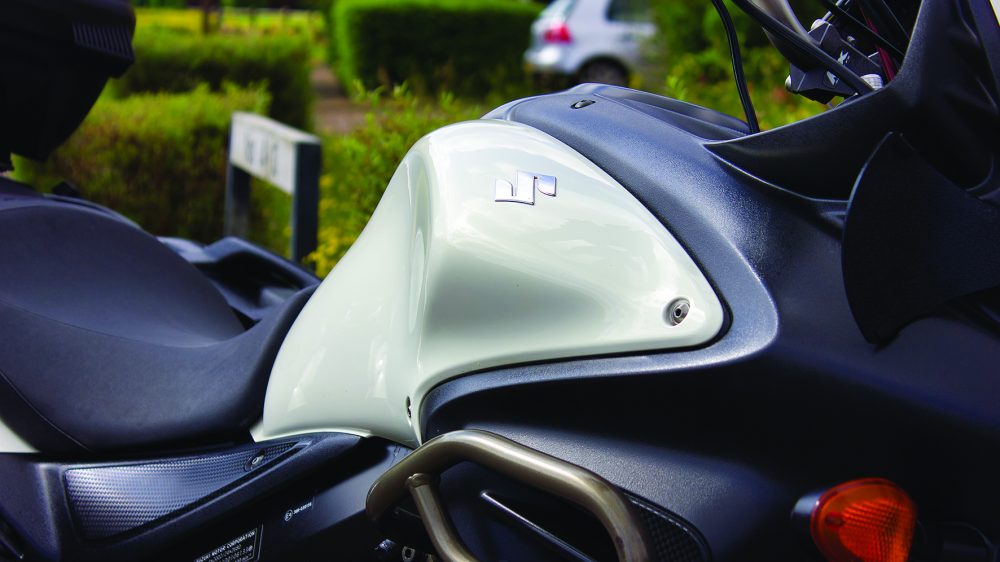
Ups and Downs in the Picos de Europa

On the recommendation of Neil Kerr and others, and with some trepidation, we entered our 1934 Lion 600 outfit for this year’s Colombres Rally in October. How would we manage those mountain roads in the company of much more current machinery?

Early on the Saturday morning we rode from our B&B on Hayling Island to the Portsmouth ferry.  All went well until, about half way between Santander and Colombres on Sunday afternoon we unexpectedly ran out of  petrol. A (fortunately downhill) freewheel to a garage we had just passed was quickly followed by the discovery that the banjo at the end of the float chamber arm was in 2 pieces.  The flatbed that eventually turned up looked as if it needed as much roadside assistance as we did but it got us to our hotel where we were overwhelmed with help from the organisers and other participants.  However it soon became apparent that we would have to arrange for a new float chamber to be shipped out before we could motor again. The blessing was that if this had happened 50 miles earlier we would not have got on the boat and if 50 miles later we would have been in the mountains.
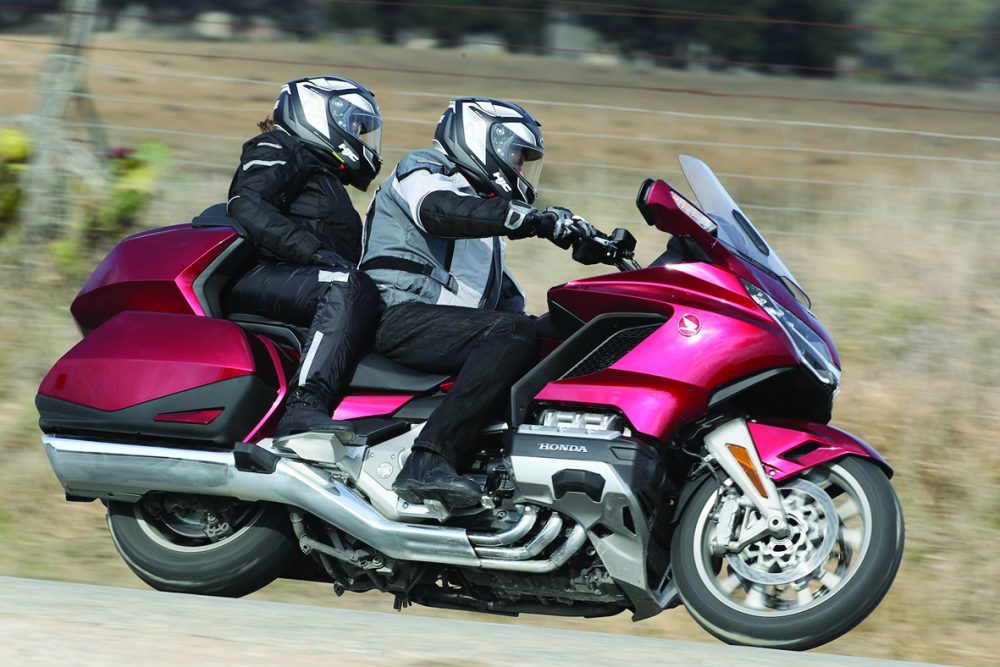
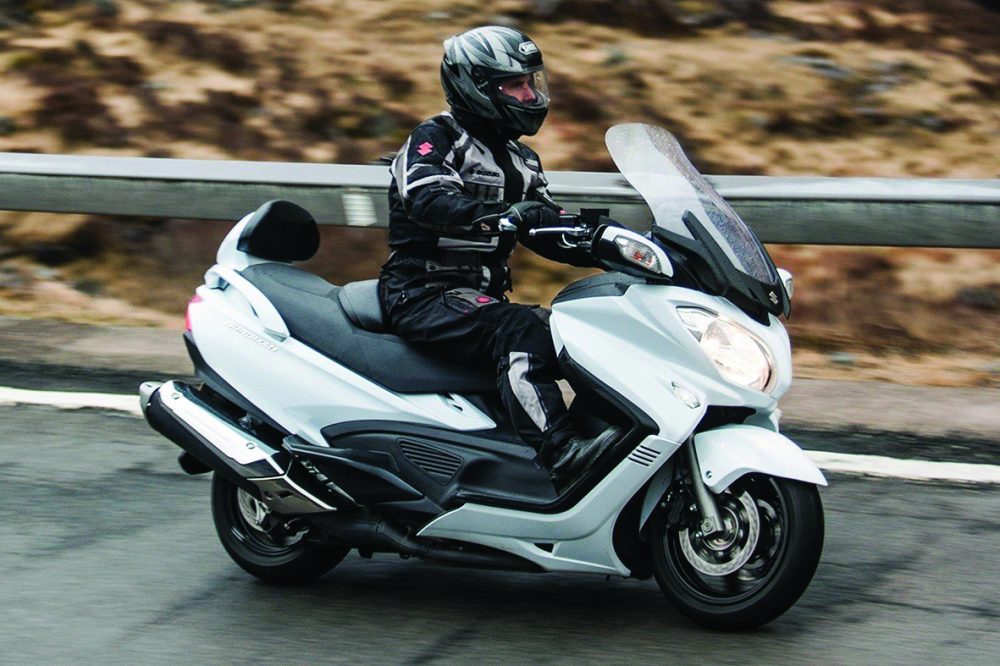
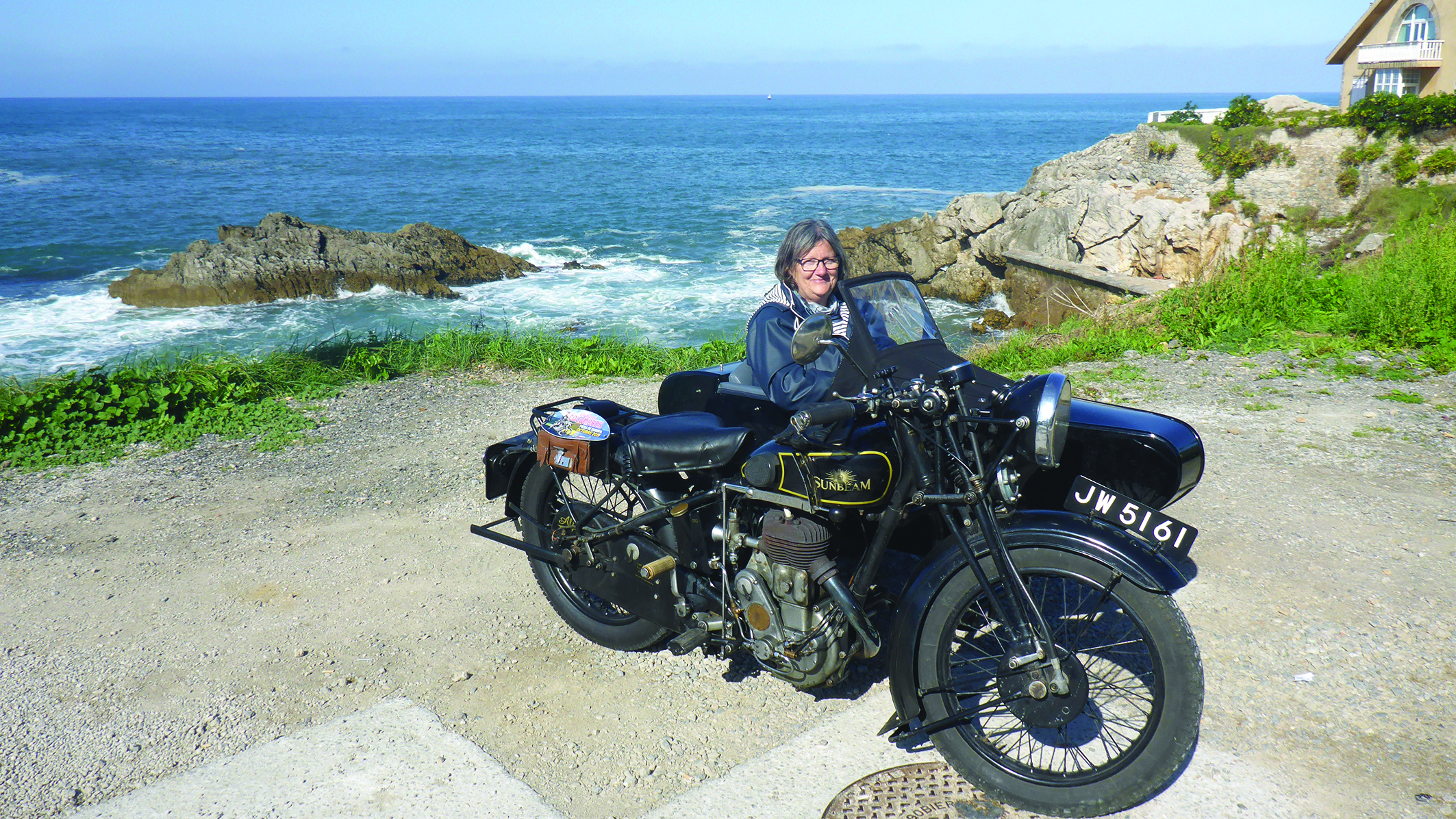
Monday was spent on the phone  to those nice people in Salisbury and the bowl promised by Tuesday evening. To my great surprise I was offered the loan of a 500cc four cylinder 1970s Benelli by the chairman of Moto Club Indianos for the Tuesday ride. We were staying at his hotel (also on Neil’s advice) and he had already been very helpful. The bowl had arrived by the time I returned on the Tuesday but it had the wrong fuel pipe union. Once more, fellow participants, including those who had brought vans full of tools and spares, came to the rescue. It is amazing what can be achieved with Araldite and a hair dryer. The blessing in disguise was that with the new float chamber the full-throttle performance was even more reliable than before, and we were in for plenty of that.

For the rest of the week we enjoyed wonderful rides along the spectacular coast and in the even more spectacular mountains. The Sunbeam behaved perfectly, pulling well in fourth gear on all but the very steepest bits of road at speeds between 20 and 40 MPH. The only heart-in-mouth moments were on tight downhill right-hand bends, where use of the front brake required extreme caution with the sidecar.  Lunch stops were in beautiful locations where tables had been set up, grills lit, and drinks laid on. Our longest day, Thursday, was 150 miles on roads from sea level to 4,500 ft, with a giant paella feast in Colombres in the evening. We copped out of the 300 mile mountain challenge on the Friday and went sightseeing in the historic centre of Sintillana.
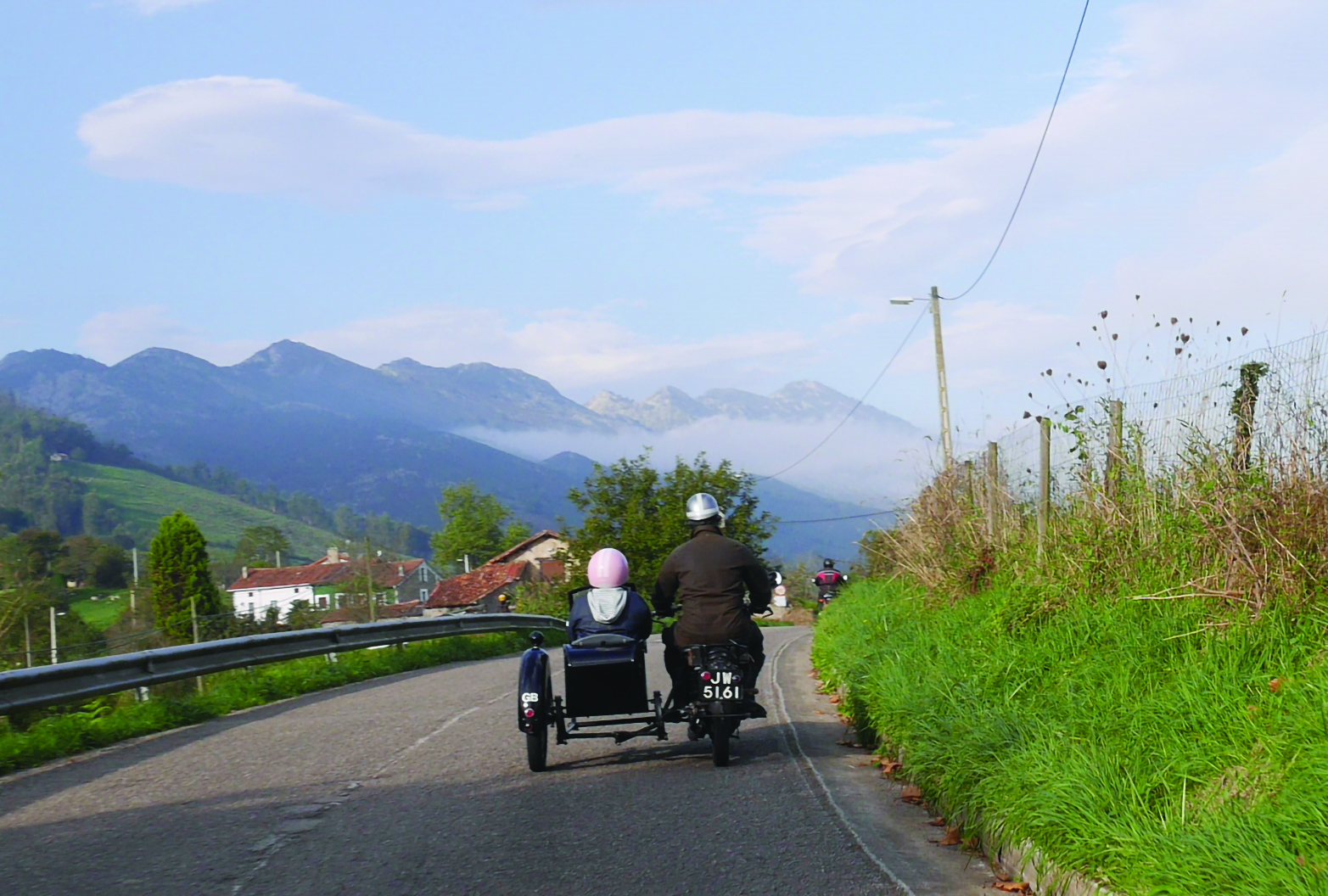
On the Saturday all participating machines returned from a shorter run and were parked around the main square, with food and drink stalls, and the rest of the town was solid with parked motorcycles for the sprint hillclimb event along the Bustio to Colombres road. Because of ferry problems we had to return a day early but the Sunday run was in the direction of Santander so we simply went on after the usual splendid lunch stop.

Coming off the ferry after dark on the Monday night the electrics started to play up so we abandoned the bike in a pub car park and got a taxi to our B&B. Once we had recovered from that undignified ending we concluded that the week had been a wonderful experience, with good company and wonderful scenery and roads, and that the bike had for most of the week performed above our expectations. Apart from one or two vintage bikes that showed up for the final weekend we were on the oldest machine on the rally, the only one with a hand gear-change and the only outfit. This was the 8th Colombres Rally in its present form and earlier events did, we were told, have more pre-war entries.

We are considering doing this event again some time so if you are tempted, do get in touch.

For a short film go to FaceBook and search [MC Indianos sidecar]

Ken Jeddere-Fisher

Triumph Factory Visitor Experience

Triumph has been around since 1902. In its heyday the company was one of the world’s most successful motorcycle brands, but following sustained periods of low of investment and the arrival of Japanese competition in the 70s, the business collapsed in 1983. John Bloor, a property developer who had attended the auction to buy the land on which the old factory sat, decided instead to buy the name and rebuild the company.

The new Triumph ‘Hinckley’ range was launched in 1992 and the Phoenix was reborn.

They now make around 65,000 machines a year, and expect to produce their millionth motorcycle this year.

My visit started early with full wet-weather gear to get to Beaconsfield services in the pouring rain for an 8:30 briefing by Nigel Winstanley, who had organised the visit and was also trying his hand at being a run leader for the first time. His own KTM was off the road, so he had borrowed a replacement bike. With torrential rain forecast, a last-minute change of route was also in order. Given all these challenges it was perhaps surprising that the only thing to go wrong on the day was that Nigel couldn’t figure out how to get the tank bag off his loan bike to fill it up. Fortunately one of our group suggested he look for the key inside the tank bag.

The weather gods were looking down on us as the rest of the journey stayed dry. We had a very pleasant stop for breakfast at Reg’s Café in Banbury, a nice biker-friendly place with good food. We all arrived at Hinckley by 1pm in good time for our factory tour.

The visitor centre is an impressive new facility, opened in 2017.

Next to the café is a well-presented exhibition on two levels illustrating the history and technology of Triumph Motorcycles up to the present day.

Our guide Robert gave us the full 2 hour tour. It can be done in 90 minutes, but we asked far too many questions. The factory was not operating at the time, but it was obvious that they had set up with visitors in mind. There were video presentations in all the key areas, and other static displays, typically showing examples of the manufacturing process that key components go through.

Triumph is now a global business with factories in Thailand and final assembly plants in India and Brazil. Thailand is where they have their diecasting plant and injection moulding factory, as well as final assembly of selected models such as the new Rocket 3 and the Bonneville range. The Hinckley plant produces around 15,000 machines annually, mainly Tiger 1200s, Tiger Sports and Speed Triples. In order to avoid high local import tariffs, the factories in Brazil and India assemble finished bikes from kits of parts shipped from the UK.

The Triumph Rocket 3R

Robert explained that they build most bikes to order, with a mixed model line depending on demand. The only time they make a large batch of the same bike is when they build launch stock to introduce a new model.

Much of the Hinckley factory is dedicated to machining engine casings and crankshafts, plus the finish grinding of camshafts and cranks. We got a strong impression of how important consistent quality is in the manufacturing process. They take samples of crankshafts after they have been cleaned and washed. They pass the cleaning fluids through a fine filter and measure the amount of dirt particles trapped. Robert reckoned that a well-maintained Triumph engine is good for 250,000 miles, with many customers who have achieved this.

There was a large screened-off research and development section where they develop new machines, with around 400 people employed in R&D. Regular employees are not normally allowed inside, and they only get glimpses of new machines as they are taken out on test rides. The dedicated road-testing team may look to have the dream job, but they ride out in all weathers, doing several hundred miles a day. It would soon lose its attraction to all but the most ardent rider. It typically takes Triumph three years to develop a new model from scratch.

At the end of the tour we were shown an area where bikes were prepared for journalists to test.  There were around 20 new Rocket 3s ready for the world’s press to try in November. Although supplied with tyres pre-scrubbed in by Mira, the journalists clearly take every chance to explore their limits, and one pre-production bike had already been back in the workshop for repair after one tester slid it down the road.

If you’re interested in modern production methods, or are just into Triumph motorcycles, you’ll find the factory tour a fascinating experience, a real study of precision manufacturing and global logistics.

My thanks to Andrew Whiteman for his help with the article.

Nigel Winstanley

First published in Slipstream January 2020

Five Go Mad in Spain

Aragon MotoGP 2019 Tour

About a year ago a few biker friends and I were kicking around ideas for a European tour for 2019. My mates had done a few before, such as the MotoGPs at Assen, Catalunya and Misano. I started riding again in 2015 after a long break and had never done a ‘proper’ continental tour. We had toured the Lake District, Wales, the 2018 Isle of Man TT, the 2019 NW200 as a group, but I’d not tried riding on the ‘wrong’ side of the road yet, or on proper mountain roads (no offence to Wales!) For the 2019 tour, 5 of us settled on the Aragon MotoGP (myself, Rod, Stephen, Leigh and Paul). I had passed my advance test with TVAM in June 2019 but my friends are not advanced riders.

The first major ride on 17th September was getting to the ferry bound for Santander. We are all local to Portsmouth (1 hour away) but the ferry company made a late change to depart from Plymouth instead. Undeterred, I planned a reasonably scenic route, away from most motorways, for 3 of us riding down together which also gave me the chance to programme my new Garmin SatNav with waypoints. This all worked well until we couldn’t find somewhere to park and eat lunch in Dorchester. We eventually found a Morrison’s a few miles further on.

The tricky part came when we returned to the bikes and realised we were tight for time in catching the ferry, with nearly 100 miles to go and less than two hours ‘til last check-in. I pushed the pace on my ZZR1400 to make sure we didn’t suffer that embarrassment.

We met companion number 4 on the ferry. He had picked up a hired Africa Twin for the trip, after we persuaded him that taking his recently-restored 40-year-old Laverda might give rise to breakdowns and small amounts of mechanical chaos/oily puddles each morning.

I had placed a sticker on my right-hand mirror to remind me which lane to be in when I got to Spain. I emerged from Plymouth Sainsbury’s petrol station towards oncoming traffic. Not my finest hour.

After a merry evening over a few drinks on the ferry plus a bit of Croque Monsieur and Paella action, we had two cabins to try and get a good night’s sleep before the first full day’s riding in Spain.

Paul, the 5th and final member of the team, was waiting for us at Santander Port, having ridden 200+ miles from his UK home to Paris for a meeting, then a further 650 miles from Paris to Santander. Paul could have bailed out when work got in the way, but he was crazy enough to stick with the tour. What a lad! (And serves you right for retiring and then going back to work.)

Can’t stop smiling. What a road!

I led the group to the first hotel about 90 miles from the Santander ferry port. About 3 miles from the hotel, SatNav directed me off the motorway onto a much smaller road and about a mile later, diverted me back onto the motorway. WTF? Rod (who doesn’t have a SatNav) said “What was the point of coming off the motorway? It was a waste of time!” I was tired and stressed and replied, “I was following the SatNav, and I don’t f***ing live around here!”

The following few days involved a pattern of breakfast; checkout; load up the bikes and ride for a few hours; stop somewhere for lunch; then ride again until getting to the next hotel. Parking was often a challenge but once found we decanted the bikes; checked-in, showed (bliss); changed and headed out to dinner.

What wasn’t a blur of routine was just how fantastic the roads were. The tarmac surfaces felt like riding on a racetrack; there were very few cars; and the scenery was exquisite. Some of the rides were so good that we would stop for photos and rabbit on about certain bends or stretches of road. One mountain section was so damn good that when we got to the top we agreed to ride back down so we could do it all again.

Riding that big ZZR was quite a challenge for me on mountain descents where the mass and momentum was very different to riding my Aprilia Tuono Factory. Fully laden with a big chuffer like me on it, the ZZR weighed in at close to 900lb (or nearly 400 kilos). I had a purple patch where I followed the 2 BMWs in our group up a mountain pass and stayed with them for 15 minutes or so. It was exhilarating, but then it hit me when we found a short straight that I was exhausted from the concentration, the speedy smoothness over what might have been 100’s corners and the physical effort of leaning the bike left and right, over and over. But what an unforgettable 15 minutes that was!

Tito Rabat meets his heroes!

The Doctor looking cool on the grid-walk.

For race day, we rode for 2 hours in pitch black and rainy conditions, arriving at the Motorland Aragon circuit at 8:00am. We met with our host, Rubén Xaus (a retired racer nicknamed ‘Spider-Man’). He took us into the Avintia garage to meet the riders, Tito Rabat and Karel Abraham, take a look at the bikes and see what happens in the garage with bike set-ups, tyres, brakes etc. The personal highlight was two of us were given MotoGP Grid Walk passes. Being five grown-ups, we decided on who got the passes by playing, ‘Rock, paper, scissors’

I’m not easily starstruck but standing next to my hero Valentino Rossi as he got ready to race was just the best thing. Seeing all those familiar riders such as Marquez, Dovioso, Crutchlow, Rins, Vinales etc. was just brilliant. The brolly girls were beautiful but I did ask a couple to move a bit so I could get the entire bike and rider in shot (what a geek!). I walked so far down the grid I even spotted Jorge Lorenzo. Sorry, that was cruel!

So close!

At this point I want to say a massive thank you to my mate Paul who organised the race day VIP experience. I won’t forget it and neither will my mates. He also planned all the routes and booked the hotels. He and Stephen were the day-to-day route gurus when the SatNavs wouldn’t play ball all the time.

The ride back to Bilbao for the ferry home to Portsmouth was the only part where we missed a great set of roads. From Pamplona to Bilbao, the guys knew a lovely mountain road, only we never found it and ended up on some big A roads instead. After a cracking dinner in Bilbao, we knew that the tour was effectively over.

The next 24 hours was spent on the ferry to Portsmouth and a parting of ways, where we were already preoccupied with leaving in 5 directions. It was raining for the whole hour home, and the roads were clogged with cars and lorries, the road surfaces were poor, and I realised how spoiled we had been with our week on peerless Spanish roads. Hasta luego España!

Many flies lost their lives on this trip!

What did I learn from my first continental tour?

  1. I had packed well and took as little as I could get away with. I only needed my clear visor though as I never used the tinted one.
  2. I hate my Garmin SatNav. Even with pre-loaded waypoints set up a week beforehand and the routing style programmed to avoid motorways it drags me onto less good roads. It seems that a MyRouteApp SatNav course is needed to better understand the kit. Switching to Google Maps on our phones was better when looking for a hotel in a town or city.
  3. My Bluetooth earpiece was erratic. It spoke beautifully until we stopped for petrol or a pee, then it wouldn’t reconnect, even if I re-  booted both bits of kit. It was like an unruly kid that defied reason.
  4. My ZZR can ride like a dream in corners, but it takes a lot of effort at speed, and I enjoyed the scenery more at lower speeds. But crushing continents in a straight line is a breeze on it; what a smooth, powerful and comfortable bike it is. I covered 1,444 miles on the trip and could have ridden many more.
  5. The roads in Spain are fabulous. I cannot believe how good they were in terms of surface quality, lack of holes, beautiful bends. Leigh humorously speculated that the roads had been designed by bikers.
  6. Putting a sticker on my right-hand mirror was a great reminder of which side to be on. Apart from one incident by a Spanish gorge when I rode into the left lane, scaring three cars and myself to death.
  7. I’m a stickler for ‘all the gear, all the time’, which for me included an air bag vest. But it did get damned hot if we dropped below 50kph. Waiting in a hot lobby area to check-in after a day’s ride meant turning into a red-faced sweaty mess.
  8. I can see why so many bikers take on a European or Worldwide tour. It was addictive and fantastic.  Intense, but relaxing…nothing gets on your mind apart from enjoyment when you are riding.
  9. When I get tired towards the end of the tour, I’m liable to snap at one or two of my friends over tipping conventions. You know who you are.

The four bikers of the apocalypse.

What were we riding?

  • I (Brian) was on a Kawasaki ZZR1400 Performance Sport
  • Paul and Stephen on BMX S1000XR Adventure bikes
  • Rod on a Ducati Diavel
  • Leigh on a hired Honda Africa Twin

The routes we covered included:

Day 1 & 2 in the UK:

  • A ride to Plymouth from Hampshire
  • 200 miles and 4 hours riding
  • 24-hour ferry crossing from Plymouth to Santander

Day 2 in Spain:

  • Santander ferry to our first hotel in Cangas de Onís, Asturias (all motorway – dreary but necessary) plus 20 minutes to find the hotel even though SatNav said we had arrived.
  • 90 miles and 120 minutes riding.

Day 3 in Spain. Cangas de Onis to Riano:

  • Riding through the Picos Mountains and National Park. An epic day following a rambling route from Cangas de Onis to Riano, via Santa Maria de Valdeon, Puentenansa, Cervera de Pisuerga and Triollo.
  • 201 miles and 7 hours of riding

Day 4 in Spain:

  • Riano to Vitorio Gasteiz, via Cervera de Pisuerga, Reinosa, Huespeda and Quintana Martin Galindez
  • 198 miles and 5 hours of riding

Day 5 in Spain:

  • Vitoria Gasteiz to Zaragoza, via Corres, El Rasillo de Cameros and Agreda
  • 224 miles and 6 hours of riding

Day 6 in Spain:

  • Zaragoza to Motorland Aragon MotoGP circuit. And after the race, Aragon circuit to Graus
  • 172 miles and 4 hours of riding

Day 7 in Spain:

  • Graus to Bilbao, via El Pont du Suert, Jaca, Pamplona and San Sebastien
  • 315 miles and 8 hours of riding

Day 8:

  • Bilbao Ferry to Portsmouth
  • 24-hour ferry and a 1-hour ride home (50 miles) in pouring rain.


Brian Benson