From The Saddle (March 2019)

The record temperatures this February encouraged a lot of bikes out on to the road. At H Café on Sunday there were many bikes that appeared to have spent the previous months carefully cocooned in garages, having been lovingly cleaned before being put away. I imagine that many riders spent an hour or two cleaning and checking their bikes before a Sunday run in the warm, dry and sunny weather. Everything looked shiny, bright and ready for action.

Some of the riders, though, looked decidedly rusty. Contrasting with the polish that had been applied to their bikes, the lack of polish in their riding was clear. It struck me that we’re generally very good at making sure our bikes are ready to ride, but less good at making sure that we are. The IAM SAFE checklist that Andy Slater discussed in a previous issue is a good way to check before each ride, but it’s also important to recognise where our skills may have slipped when, for example, we haven’t been riding as much as normal due to poor weather. So please take the time to build up your riding skills when you’ve been off the bike for a while and make sure that your riding is well polished – not just your bike.

Keeping skills up is also a key theme for our Observer Day being held on 2nd March. Almost all our Observers and Trainee Observers are coming along to a day of workshops and discussions, prepared by the Training Team, to keep their knowledge and skills up to date. The day is a classroom-based day, and together with our Observer Weekend in July (which is focused around riding), is designed to keep our Observer skills honed around the four key areas of being an effective Observer:

  • Creating a learning environment
  • Knowing your stuff
  • Relating riding issues to the System
  • Riding to the IAM RoadSmart Advanced Standard (as a minimum)

    I am grateful that so many of our Observers are keen to continue to improve their knowledge and
    skills since these form an important element of the training and development for Associates and Full Members and enable us to develop truly ‘thinking riders’ that view Advanced Riding as an ongoing skill development.

    If you’re interested in becoming an Observer then please come along to one of the introductory discus- sions with the Training Team at 10:00am at the St. Crispin’s meeting, or drop an email to observerinter- est@tvam.org

    Safe riding

From The Chair (February 2019)

Well it was January’s St Crispin’s and nearly 100 members had gathered in the lecture theatre for the Club’s AGM. For so many to give up their Sunday lunch for sandwiches and slides is either a sign of a revolution brewing or testimony to the support the Club has from members right across the board. Thankfully it was the latter. The AGM is when the Committee reports back on what happened last year and what’s planned for the coming one. For the first time Paul our Treasurer presented not just the accounts from last year but the budget we’ve drawn up for the coming year. At the end of last year we had very healthy cash reserves but this year we’re planning on spending slightly more than forecast income which will slightly reduce these.

It was a pleasure to recognise those members who have been contributing to the Club, often behind the scenes. Alan Mossman and Wendy Dance for social run leading and back marking were each awarded a day with Rapid Training as was Greg Ward for his IT support and for running the Club’s membership data- base for the past 18 years. Mimi Carter-Jonas was thanked for her three years on the Committee responsible for Events, which she will continue to assist with. Sarah Chandler was also thanked for her service as Green Team Leader, only stepping down just before Christmas due to a change in work circumstances. As probably expected, all those standing for roles on the Committee were elected including Alan Hudson to represent the Green Team as the new Green Team Leader and Phil Donovan who takes over for Events and Promotions.

I presented some objectives we have for the coming year for the Club which include continuing our role as a road safety charity actively promoting the RideUP scheme for young riders and strengthening our links with regional Fire & Rescue services, County Councils and BikeSafe.

Given we can no longer claim Gift Aid for Associates (who make up about 25% of the Club’s membership) we will be asking all Full Members who qualify to sign up for Gift Aid. There’s no need to do anything as we will be approaching members for whom we don’t have a declaration.

This year we hope to develop an active off-road/Adventure riding activity and I know people are already working on organising events. This will bring a new avenue for many members, some already have off- road bikes and have experience of green lane riding which I hope they will share with the rest of us. Not sure I’ll be taking my S1000XR off-road though, I think I’ll need something lighter and smaller.

We will also be investing in providing opportunities for Full Members to develop their riding skills on- road. Chris has just announced that the Enhanced Advanced Rides (EARs) have been re-launched. I’d encourage anyone who passed their test over 3 years ago and hasn’t been out for an Observed ride since to consider doing one of these. All our Observers have to do a health check and an Aardvark with Rapid Training in that timeframe because our riding style and skills change gradually over time and an EAR is an opportunity to re-set those and have some fun.

The AGM slides are available to view in the website library in the Meeting Minutes/AGM 2019 folder.

Finally, Spring is on its way….Yes it is… and now is the time to think about destinations that could be visited during the season ahead. There will be more social runs than ever in Slipstream but how about organising a run for a few mechanical motor head Club mates to maybe the Beaulieu Motor Museum, Museum of Army Flying, or Haynes International Museum? Then there’s the MotorGP at Silverstone. Could we have a Club run to a day there?

Keep warm in the saddle.

Yamaha Tracer 900GT

Do expectations always deliver? And just what is the true potential of the new Yamaha Tracer 900GT? Keith Yallop reports on his bike purchase of May 2018. After over 9,000 miles he asks, “Is this the ultimate jack-of-all-trades?”

I have been biking for many decades having ridden about 1/2 million miles – or to the moon and back – on over 50 different machines of various sizes and capabilities.. My last few bikes have all been high-performance sport tourers with the emphasis on ‘sports’. I do quite a lot of touring in this country and across Europe with my riding buddy, Paul Ruden. We quite often do over 500 miles a day. In 2017 we did a European trip with me on my Kawasaki Z1000SX, which is a great bike, but the riding position was starting to take its toll on my ageing joints. At the end of a day’s ride I was glad to get off it. I came to the conclusion that my biking requirements needed some major reassessment.

So over Christmas 2017 I drew up a list of what I wanted from my motorcycling, taking into account that I was entering into my twilight years and my ageing joints were not as flexible as they used to be. High on my list was comfort, ease of handling, light-weight, narrow (to aid filtering), panniers which were not too large and could be easily removed. Low on the list was dropped bars, big cc, massive horsepower and MotoGP acceleration. Don’t get me wrong, I appreciate a bike with low down punch but over 100mph top speed was definitely moving off my radar and comfort was becoming a priority.

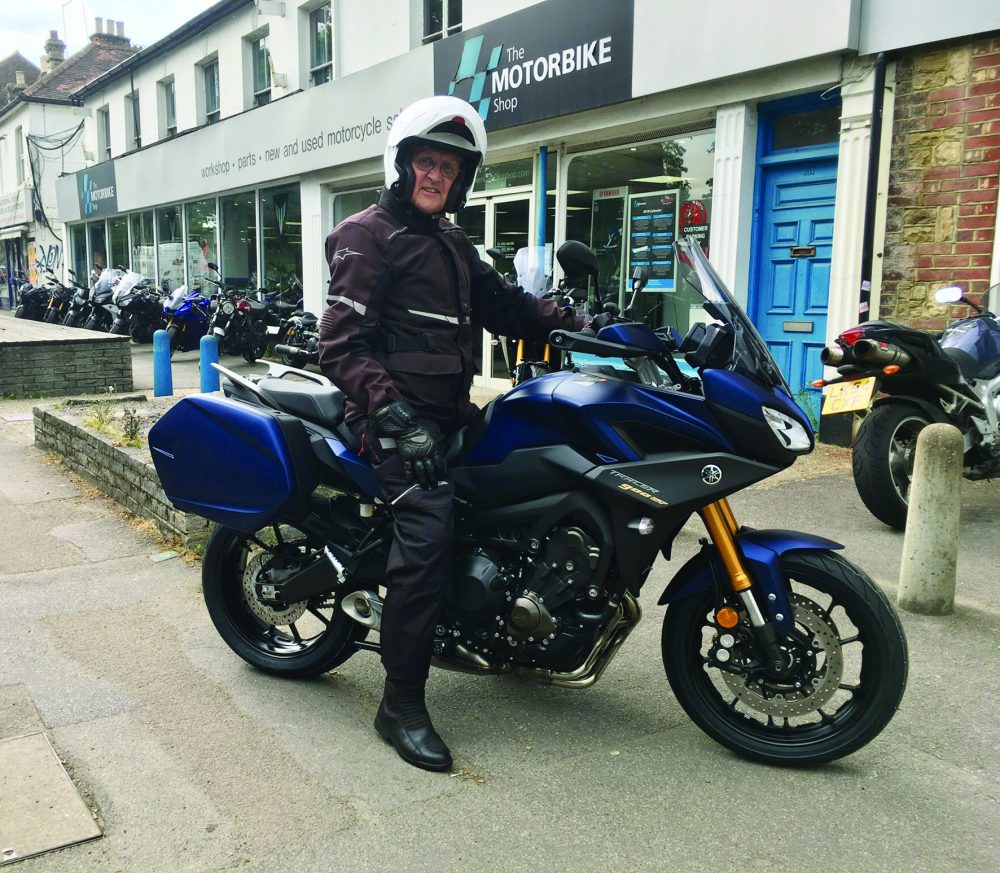
So what fitted these requirements? I started to look at a range of bikes all in the upright adventure touring position. During December 2017/January 2018 I visited BMW, Triumph, Honda, Ducati, Suzuki, Kawasaki and Yamaha. All the dealers offered great sports tourers, all with good points and some not so good. However at The Motorbike Shop in Farnborough I was invited to take out a Yamaha MT-09 Tracer. This bike was not on my list but I thought why not give it a try? After an extended 50 mile ride I felt that this machine and I could have a long and happy relationship. It all seemed to gel for me, this was probably helped by the fact that I have owned a number of Yamahas.

The throttle response was very lively, especially when in sports (A) mode, where with its short wheelbase it would easily lift its front wheel if you left traffic lights too energetically. On my return to the shop I was informed that a brand new model called the Tracer 900GT would be launched in early summer 2018. It would have an extended swing arm to reduce front wheel lift and make the bike more stable with panniers fitted. It would have a host of extras as standard, including panniers, touring screen, narrower bars, better seat, quick-shifter, updated suspension, cruise control and the list went on. It would be sub £11k. They offered me an excellent part-exchange price for my Z1000SX so I made an instant decision to place an order, one I hoped I would not regret.

I spent a nervous 5 months wondering if I had made the right decision and found myself asking if it was going to be anywhere near as much fun as the demo MT-09 on which I had ridden. Or had the practical additions to the GT changed this new model for the worse?

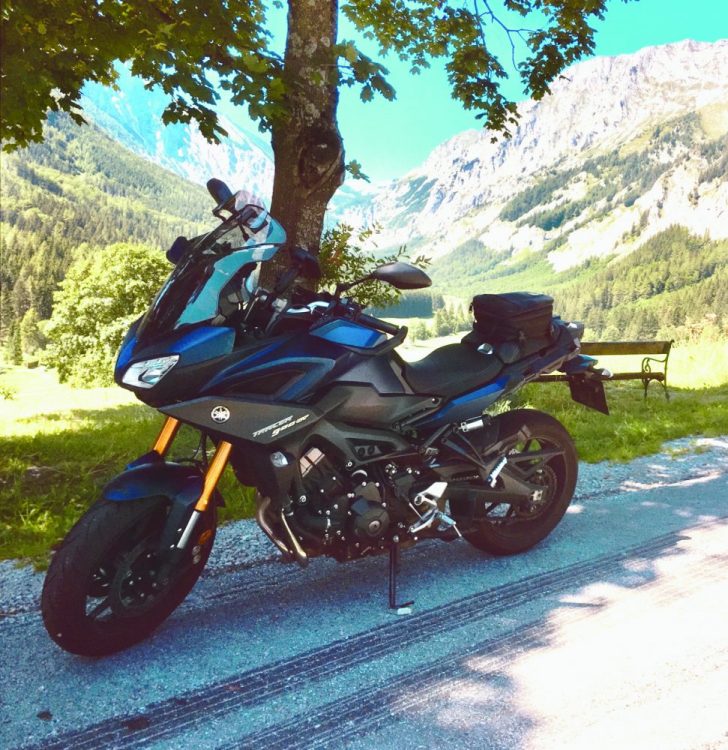
On the 21st of May I was the first rider in the UK to take delivery of the Tracer 900GT, or so I was told. The first thing that struck me was just how impressive the bike feels. It has the same grand presence as an adventure bike, but obviously with the road-focused bias. Sitting on the machine allows for a good view over the traffic ahead and the large screen appears to provide good protection (more on that later).

The bike feels tall with an 850mm seat height, but despite this I’m still able to flat-foot pretty easily when sat on it (I’m 5’ 11”). For those who might be a little more vertically challenged this could be more of a problem, however there is a lowering kit available.

It’s all well and good babbling on about the GT’s finer details but unless it rides well on the roads and operates well in real situations then it doesn’t mean diddly squat. So how does it ride?

Well the suspension was not one of the best points of the MT-09 based models of old. I was therefore pleased to discover that the revised suspension immediately puts to rest any previous questions over the earlier model. The suspension has been uprated using Kayaba units featuring dual springs and adjustability of both high and low speed compression damping, as well as preload and rebound damping. The rear shock preload is easily changed thanks to a side-mounted adjuster, perfect for those who are looking to travel with a pillion and/or lots of luggage. Yamaha have obviously been listening carefully to their customers, which is certainly refreshing in the motorcycle industry. Through corners it is probably one of the most ‘flickable’ bikes I have had the pleasure to ride.

Yamaha have also gone to town on reprogramming the MT-09 ECU mapping. Renowned for being a little snatchy on the power, the old map has been updated to give a much smoother delivery and also make the bike much more manageable when sat at a higher revs.

After riding over 9,000 miles on the bike in this country and across Europe, I must say it is a very pleasurable bike to be sat on for long distance cruising. It is very responsive and agile even though it weighs in at 227kg fully kitted out with panniers and fuel. Combining the excellent chassis with the brilliant 847cc triple power unit makes for an engaging ride that doesn’t leave me feeling disappointed or achy.

It would be pretty easy to think of these rather significant updates being the end of the story, but it is in fact just the beginning. Yamaha have seemingly thrown most of their accessories catalogue at the GT to make it into a machine that you could pick up tomorrow and set straight off on a European tour.

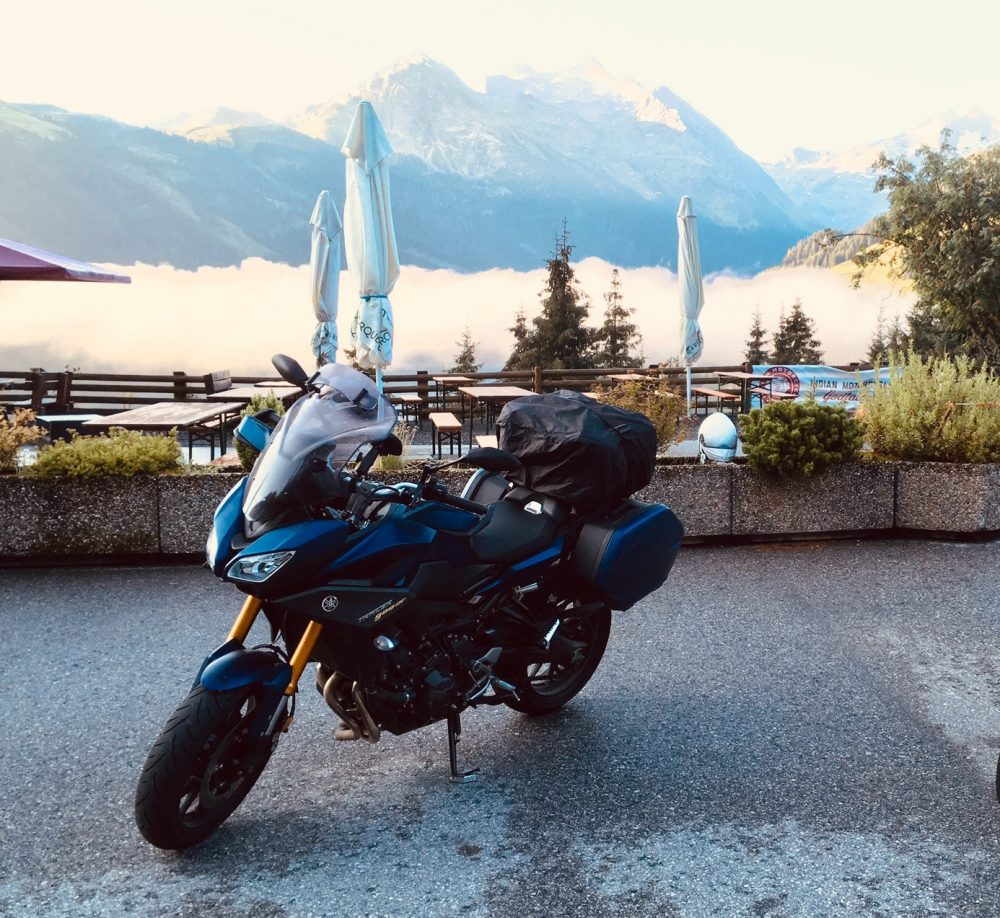
The most notable of the accessories is of course the hard luggage, which offers a mediocre 44-litres of storage. As the silencer is tucked away under the engine this allows both panniers to be of equal size. However the panniers will not take a full-face helmet. I have modified a soft bag of similar capacity to clip onto the rear seat thereby giving me close on 90-litres total luggage for touring. I replace this large bag with a smaller bag of 15 litres for weekends away. A plus point is that the paniers are very easy to remove using the ignition key and there is no scaffolding left behind.

Alongside the panniers the GT also comes with a centre stand, hand guards and heated grips where all 3 settings can be programmed individually to allow 10 different heat choices for each setting (30 in total), this makes winter riding a far less disconcerting prospect.

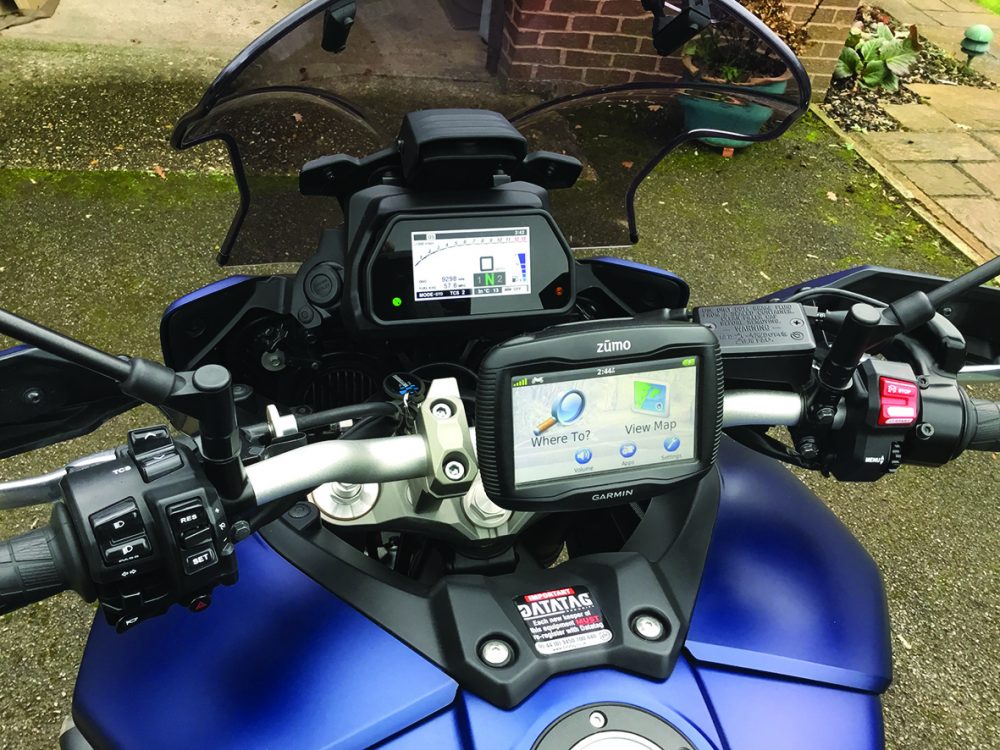
The rest of the electronics package is also very impressive with three selectable engine modes and traction control settings. There’s also cruise control, which definitely makes long range touring much more pleasurable. The coloured TFT instrument panel is from the R1 dash and although it is a bit on the small size it can be programmed with just about any information you would like the bike to give you, including gear indicator.

Impressively, the Tracer 900GT also comes with a slipper clutch down and quick-shifter up. The quick-shifter certainly makes for a smooth and simple affair when kicking up through the gearbox, it’s very easy to get used to clutchless upshifting. However I have to say that I still often prefer to use the old way and change gear with the clutch. But the choice is yours.

With panniers removed the bike is fairly light at 205kg and with the ECU programmed to give low down torque it is no slouch. For those of you who are interested in the tech figures, the bike has a triple cylinder 847cc engine producing 115bhp at the crank, has a top speed of 140mph, does 0-60 in 2.7 seconds and quarter mile in 10.6 seconds. But what about stopping? Well the rear brake is ok but not super efficient, the front brakes come from the R1 and are very positive having ample stopping power with very little effort even when the bike’s fully loaded.

However it is not all honey and roses – I do have a few gripes. The first is with the original tyres. The Tracer 900GT came with Dunlop Sportsmax D222 as standard and I was not at all impressed with them. I think Yamaha must have got a bulk cheap deal from Dunlop! Driving hard out of bends the back end seemed to be a little skittish and lively which took me back to my old days of scrambling. It also seemed to grab at every crack or seam in the tarmac. Not quite what I wanted on my new touring bike. So at sub 2,000 miles I visited Mel and he advised fitting a pair of Bridgestone Battlax T31’s. The difference in handling was amazing, the skittish feel had gone and the line grabbing was vastly reduced. What a difference a good tyre can make!

Secondly, I don’t personally like the fuel gauge. It only starts reducing after you’ve dropped to lower than half of the tank’s 18 litre capacity, then it shoots down and hangs around for a long time at 1/8 of a tank. It’s not a big deal and to most of you it won’t make any big difference at all, it’s just what I prefer. So I have set the TFT screen to show how much fuel I am consuming. When it gets near 4 gallons (18 litres) I know I need to look for a petrol station pretty quickly. The fuel consumption indicator is showing 55mpg and on tours I have managed to push a full tank to over 200 miles, the warning light comes on at around 185 miles. That makes it one of the most economical bikes I have owned, other than a BSA Bantam and a Triumph Tiger Cub!

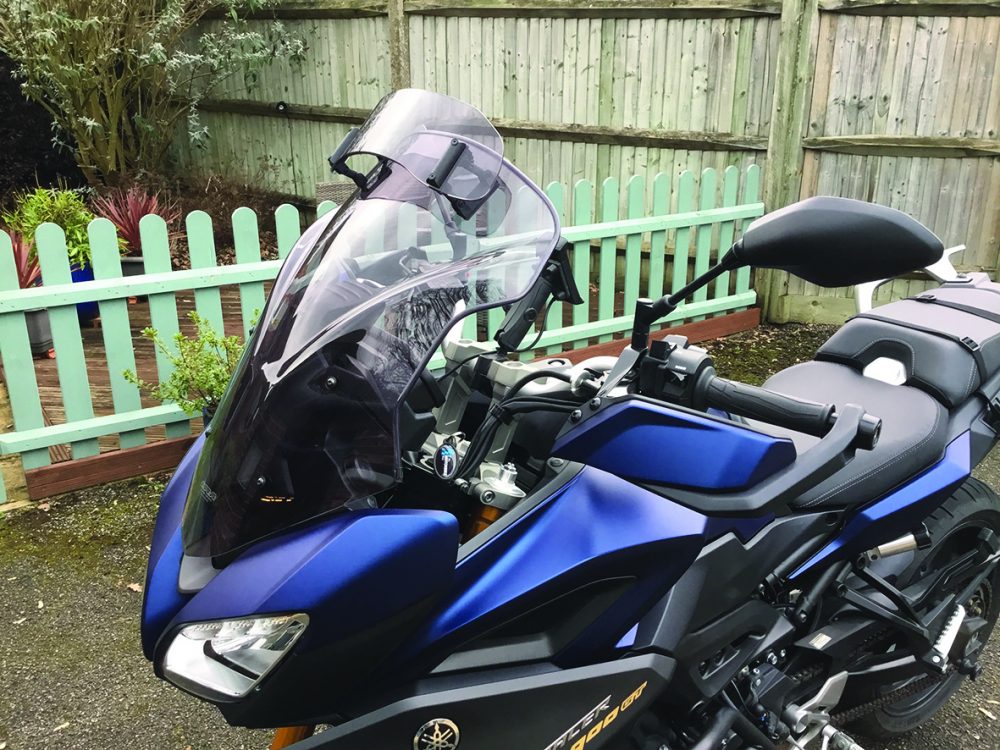
My other major gripe is the screen. I seem to be in good company with this moan as nearly all magazine and online testers say the same. At higher speeds the wind coming around the screen is noisy and seems to buffer me around, especially on motorways travelling behind vehicles. Before my tour to Europe I purchased an MRA touring screen with an aerofoil on top and that has made a lot of difference. The screen is manually pinch and adjust with one hand which was useful in Alps when we came out of a tunnel straight into a tremendous rainstorm. Yamaha do offer their own larger touring screen but it costs a lot more and I am not sure how good it is.

Another minor moan is that you cannot fully put your toes on the foot pegs without hitting your heels on the pillion foot-peg mounts. However I have learnt to come off my toes and use the balls of my feet, seems to work just fine and is probably a little more comfortable.

My final moan is the position of the ignition key. If the handlebars are straight ahead then it is difficult to get your hand in, if they are turned to the right it’s impossible to reach. So steering needs to be turned left to get to the key. Why could they not mount the key in a more accessible position?

I have to be honest though, what I’m most impressed with is the price. While on paper the £10,649 price tag may seem like quite a lot, what you get for the money is nothing short of incredible value. I could not find another comparable motorcycle in this price bracket that even comes close to the specification of the GT as standard and it really makes this motorcycle very hard to fault.

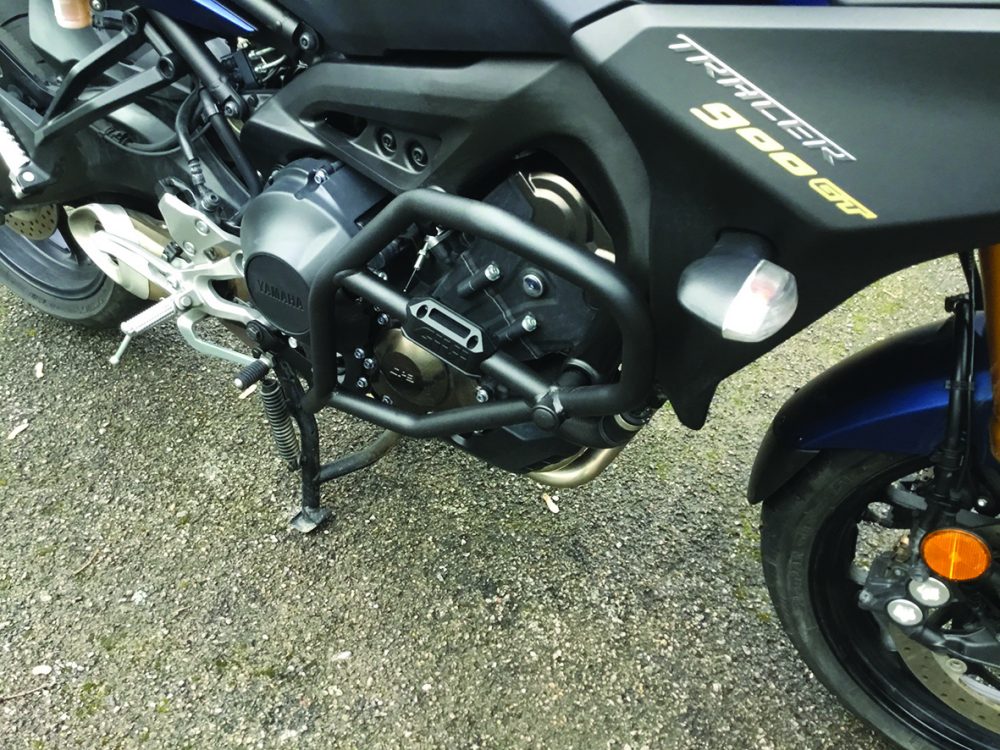
So what extras have I deemed necessary apart from the MRA screen (£108)? Well I have fitted a radiator guard (£40) along with a front mudguard extender (£22). I have also fitted twin horns (£15), a Yamaha larger side-stand foot (£48), a pair of R&G bar ends (£23) and Givi engine crash bars (£126) – just in case I feel the need to gently lay the bike down.

So did the Tracer 900GT tick all my boxes from my Christmas 2017 ‘nice to have’ list? I think it has and probably more. I believe the hard fact about the Tracer 900GT is that you’ll grin like a Cheshire cat whenever you ride it, despite the weather, season or journey. Cold or hot, rain or shine, commuting or charging; the GT will be everything you could ever need and be lots of fun whilst doing it. It’s definitely a bike that has been designed to be a little easier to live with and, importantly, you don’t need to remortgage the house to buy it. The Tracer 900GT is definitely going to appeal to those who want just one bike that will comfortably do a bit of everything and do it well. And finally, to quote MCN, ‘a seriously good bike at a seriously great price’.

Keith Yallop

First published in Slipstream March 2019

A Different Type of Riding (Part 1)

It may come as no surprise to many of you that not everyone wants to ride everywhere as fast as possible. It certainly puzzled me for quite some time.

My entire riding career has been spent in the pursuit of optimising, improving and developing both my skills and the tools I use in an effort to become an ever safer, smoother and faster motorcyclist. I approach everything I do in this manner, always seeking to improve on previous efforts, iterating on designs and techniques in a rewarding, yet ultimately futile attempt to achieve perfection. It’s probably something to do with growing up in Germany.

When my rudimentary skills proved too limited, I joined TVAM. When my bikes held me back, I upgraded and modified them to increase their performance envelopes. I daresay my V-Strom 650 is the most over-developed example in the world, and I’d like to think I could keep up with most of you just fine through any alpine pass of your choice. But I’ve also come to the realisation that for many motorcyclists this might just be missing the point.

Where I find satisfaction and enjoyment from a series of perfectly-executed mountain hairpins, my parents are quite content to trundle along in the middle of their lane, gazing around at the surrounding scenery, often at a considerable amount below the posted limit. When returning from our last trip they enthused at length about the villages, towns and countryside monuments they had seen on our travels. I mostly recalled a series of apexes amongst a green blur in my peripheral vision. Everyone had a great time, in their own fashion.

For a number of years we toured together, with myself and often my brother waiting at junctions and the top of passes for parents, aunts and uncles to catch up. But as time has gone by the performance delta has increased; myself and my bikes have become faster, while they have preferred to dawdle at a decreasing pace. Last year the frustration this caused became too much and we resolved to no longer ride together, parting ways each morning and meeting again at the evening’s hotel to eat, drink and swap stories.

While this initially appeared to be an ideal arrangement, the truth is that in practice it strongly resembles two parallel vacations. We aren’t really on holiday together and there would be precious little difference should the two trips happen in series, rather than parallel. From my perspective nothing would change if they swapped out their bikes for a minivan; either way, we weren’t really touring together anymore.

And so a new solution is needed. Encouraging my family to join their respective IAM-affiliated clubs and learn to keep up has been unsuccessful, because they’re not actually interested in getting any quicker. They have the skills, forged over decades of riding, but aren’t interested in using them to cross countries at speed. And if they won’t go faster, and if I want to get back to riding as a family, then I’m going to have to slow down.

That sounds easy; just use less throttle, right? Except that it’s not. Everyone has their own stride, their own pace – walking down the street with someone who’s gait is considerably shorter than your own offers a similarly frustrating experience. You speed up and slow down, see-sawing back and forth as you attempt to force your own pace to match theirs and, while this is of course possible with considerable restraint, on many motorcycles it can make for uncomfortable and even painful riding.

Both of my own bikes are built to go fast. They’re fun to ride quickly, satisfying tools designed for the purpose of covering distance at speed, regardless of how twisty the route. But sat upright at half their usual speed they are uncomfortable to ride, with engines, brakes and suspension that are ill-suited for this unfamiliar task. With their smaller engines, they demand higher revs for smooth operation, which does not make for a peaceful ride at lower speeds. This results in bikes that are fun when ridden hard, but supremely dull and unmemorable when reigned in for a gentle cruise.

Which is a very long-winded way of saying that I need a new bike! Not a replacement for either of my existing steeds – each serves a very particular purpose and fills a considerable niche of my motorcycling world. There’s still a large gap where a proper dirt-bike should be (watch this space…!) but for now it’s time to fill the newly-created slot designated “Family Touring Bike”.

This means I will be shopping for a motorcycle using radically different requirements than I have ever considered in the past. Horsepower isn’t important. Cornering ability is secondary. As a touring mount items such as hard luggage, wind protection and a 200-mile tank range are minimums, but experience has also taught me to value compliant suspension, low maintenance engineering and seats and handlebar configurations that are all-day comfortable.

New to the list is a feet-forward riding position. Despite my best efforts with foot-peg relocation, my knees still ache after long days on the V-Strom, never mind my Street Triple. That discounts your usual suspects – most tourers have your knees at a 90-degree angle at most and I am really aiming for much more than that. Highway pegs are one suggestion, but as the name suggests they don’t work terribly well on winding roads where the rear brake and gearshift might be required at any moment.

But more than anything, whatever I choose absolutely, positively must be enjoyable – rather than frustrating – to ride at low speeds. It’s time to go shopping…

Nick Tasker

First published in Slipstream March 2019