An eclectic collection of Slipstream contributors’ motorcycling adventures: new-bike road tests, technical articles, opinion pieces, humourous travel anecdotes and more.
In 2009 Nathan Millward spent nine months riding a Honda CT110 all the way from Sydney, Australia to London, England. This ridiculous adventure is documented in book form, and Nathan now runs guided tours of North Devon from his new base at Dorothy’s Speed Shop in Ifracombe, named after the diminutive little Honda that carried him all the way home from Australia. Nathan’s “A2 Adventure Test Days” present a unique opportunity to test seven different motorcycles from his collection while exploring the rugged beauty and muddy lanes of Exmoor national park.
After a good night’s sleep we were introduced to Nathan and his menagerie. The day would be largely road-based, as most UK green-laning adventures usually are, but a couple of muddy and rutted lanes would be laid on to allow us to test the bikes in more slippery circumstances. This was ideal, as here in the UK a bike that can’t handle a bit of greasy, wet tarmac in between the muddy bits simply won’t work for most people.
First up was something rather interesting: Honda’s not-officially-available-in-the-UK CT125, the successor to Nathan’s own legendary CT110. Essentially a reworked version of the relatively new Honda Cub 125, it was launched to great acclaim and rapturous reception in both Asia and North America last year. Exceptionally light-weight with an engaging semi-automatic four-speed gearbox, massive luggage rack and even a snorkel for river crossings, the CT seemed absolutely perfect as a low-speed trail crawler. With both feet flat on the ground, the complete opposite of the traditional sky-high seat height of most off-road motorcycles, the little Malaysian grey-import Honda was sure to inspire great confidence in slippery conditions.
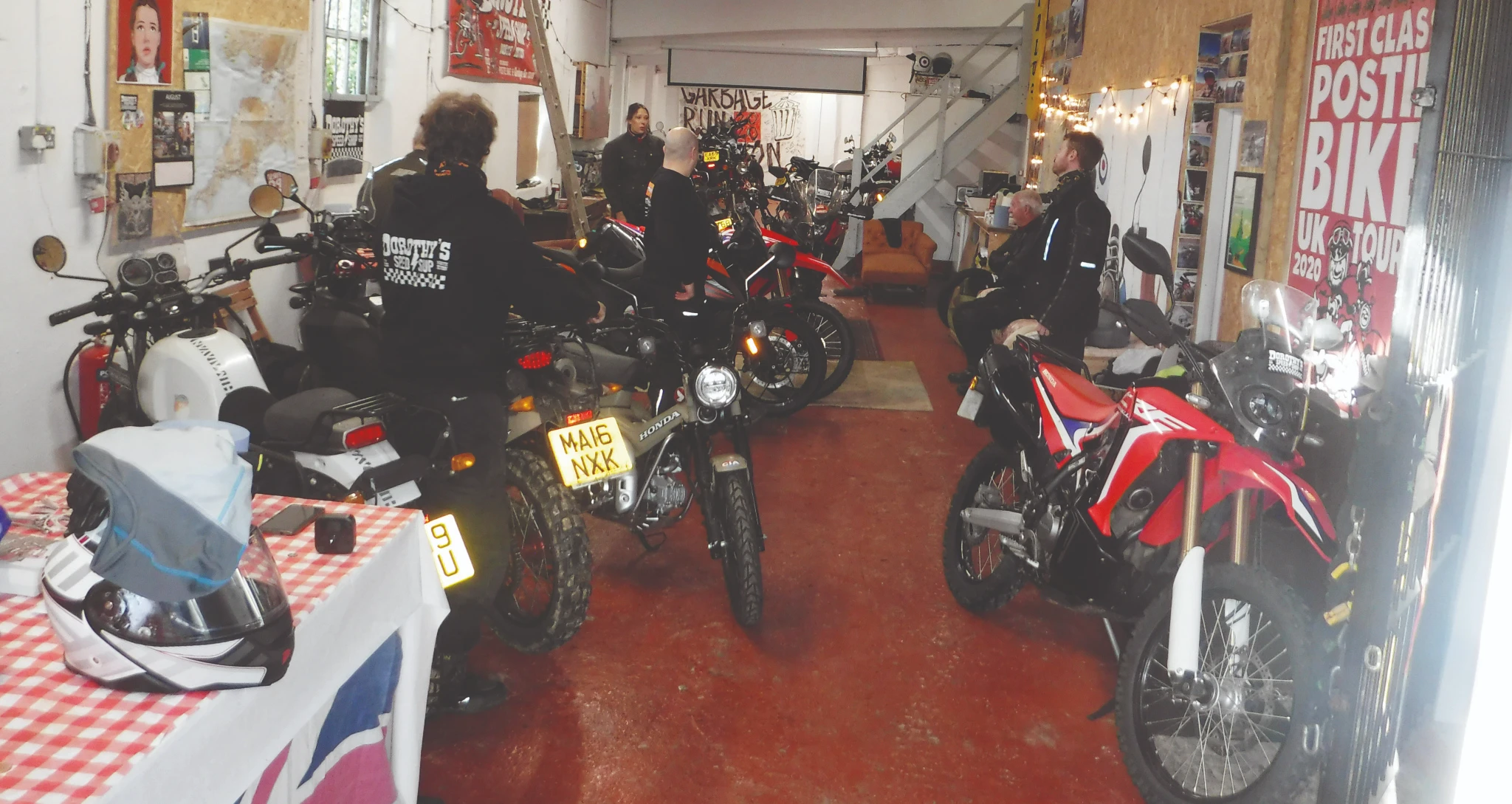
Nathan’s ‘Garbage Runs’ were popular before lockdown; here’s hoping they return!
The little Honda they won’t sell you. Behind it the CRF Rally – lighter, more powerful, and not much more expensive than the old 250.
Also joining us from the Japanese manufacturer were a pair of their best-selling enduro motorcycles, so-classed because of their balance between off-road function and on-road capability. The Honda CRF250 Rally and CRF300 Rally both gain a little weight compared to their stripped-down ‘L’ variants, but also feature larger fuel tanks, wider seats and a useful front fairing and windshield to make longer trips in inclement weather more palatable. The newer 300cc version supplanted its less powerful predecessor just a year ago, gaining even more fuel capacity while somehow weighing a useful 4 kilograms less.
The reason the 250 Rally was of interest to most of our party was because Nathan had fitted his example with lowered suspension, theoretically making it a less intimidating machine to approach for those of shorter stature.
KTM joined the A2 adventure party a couple of years ago by wrapping its 390cc Duke/RC engine in a slightly more adventure-y chassis and bodywork. That said, the classically off-road focused Austrians have inexplicably opted for road-based wheels, tyres and suspension to a bike that weighed far more than any serious off-roader would ever tolerate (around 172kg at the kerb). It was clearly a fashion-first machine, rather than a serious all-road contender in the vein of its larger 790/890 Adventure lines.
Worlds away in design terms, but manufactured in the same country as the Indian-made KTM was my old nemesis, the Royal Enfield Himalayan. I reviewed this bike when it first launched to much fanfare and enthusiasm from the world’s motorcycling press. The promise was strong: low-tech mechanicals and minimal gadgets paired with off-road-spec wheels and tyres. The reasonable 15 litre fuel-tank even sported a set of front-mounted pannier rails capable of carrying additional luggage in addition to the rear racks, all of which should have made for a genuine do-anything and go-anywhere bike.
Instead, both bikes featured in my review suffered serious mechanical failures and I was unable to look upon the model favourably. It would be interesting to see if Nathan could change my mind.
Under-specced, overweight, but apparently capable.
An interesting addition was another Honda: the commuter-spec CB500X. The 500cc parallel-twin was the only multi-cylinder engine in the group and was also by far the heaviest. But here Honda’s modest intent had been subverted by an expensive Rally Raid kit, replacing the cast wheels and basic suspension with entirely new hardware designed for serious off-road work. Despite this, weight would be the enemy here, the chunky CB500X tipping the scales at a portly 195kg.
Rounding out our selection was our host’s own CCM GP450, a 450cc single-cylinder adventure bike made by the UK-based Clews Competition Machines. Discontinued a few years ago when the supply of Rotax/BMW engines dried up, my brother still treasures his, its combination of truly light weight and 20-litre fuel capacity making it an astonishingly-capable on- and off-road machine. It’s a bike with no real equal on the market today.
Our full-day ride was less than 80 miles, but it felt like far more. Everyone had ample opportunity to sample every bike as often as they liked, with stops every 20 minutes to allow for us all to swap thoughts and keys. My personal predilection for small-engined motorcycles meant that I immediately gravitated towards the semi-automatic CT125 and spent the majority of my first stint learning how to rev-match my gear changes on the widely-spaced four-speed ‘box. Despite its small size it featured a wide, comfortable seat and well-placed handlebars. The throttle was smooth, take-up from the automatic clutch was faultless, and once I’d got used to the sketchy-feeling knobbly tyres, it was an awful lot of fun.
Still very cheap, and still cheaply made.
At the end of the day, it was the bike that two of us voted as our favourite, with its utterly charming aesthetic and genuinely entertaining ride, but alas Honda UK has confirmed that it has no plans to officially offer the bike in the UK. Both myself and my friend agreed that you could probably have almost as much fun on an MSX125 as, despite the aesthetic, the CT is very much a road bike. It became very wayward in mud especially, and deep ruts and potholes quickly exhausted the limited suspension travel and ground clearance. The four-speed gearbox and low-powered air-cooled engine meant that none of us managed to break 55mph at any point during the day, and the soft suspension and twitchy handling meant that it felt very unstable at those speeds. Getting one imported isn’t difficult, but at time of writing imported versions were a difficult-to-swallow £4,500.
Two bikes none of us rated highly as genuine trail bike propositions were the KTM 390 Adventure and the Honda CB500X. Both are much larger, heavier bikes with 19″ rather than 21″ front wheels, and both engines are clearly designed for road rather than dirt. The Honda sounds great with its 270-degree firing interval and honestly felt a lot like a less powerful V-Strom 650 to ride. The Rally Raid suspension was fantastic on tarmac, doing an excellent job of providing both feel and control, and the riding position works relatively well for both seating and standing positions, helped by the chunky off-road foot pegs.
The KTM sings at revs and carves bends confidently on its road-biased tyres, though the cheap ByBre brakes are wooden and lack feel. The engine shudders and bucks if you let the revs drop, no doubt a side-effect of the aggressive tuning necessary to get a full 47bhp out of just 390cc of displacement. The KTM also suffered an intermittent electric fault throughout the day, occasionally leaving the hazard lights stuck on for no discernible reason.
The CCM GP450 divided opinion. The more experienced off-road riders thought it was great, though hot-starting issues and a flickering rear tail-light meant that even Nathan admitted it wasn’t a bike he’d want to take too far from home. I found it genuinely frightening off-road, its aggressive steering geometry making it handle much more like a road bike both on and off the tarmac. This might be a necessity with a full 50bhp and genuine 80mph capability, but also meant that the front wheel was far more willing to follow ruts and be knocked aside by stones than some of the other bikes. It wasn’t the most welcoming machine for a relative off-road novice.
Receiving both universal derision and acclaim were the Honda CRF250/300 Rally twins. The critical factor was the lowered suspension on the 250, which wallowed and swayed on the road, sitting low like a cruiser. Off-road performance wasn’t affected as much, but it made for an uncomfortable on-road experience. The 300 however, was voted the bike that the group would be most likely to actually buy with their own money.
Expensively modified by Rally Raid, could the CB500X overcome its inbuilt tarmac bias?
It made the off-road sections easy while handling as well as any knobbly-tyre-equipped motorcycle can on wet, leaf-strewn tarmac. The updated dashboard is great, and boasted a believable 100mpg average fuel consumption throughout the day. The ultra-soft suspension meant that the bike compressed down to a comfortable seat height as soon as it was tipped off the sidestand, and the switchable ABS system provided everyone with the confidence to make the most of the surprisingly-powerful front brakes. 8,000-mile service intervals mean that long-distance adventures don’t need to be interrupted by oil changes, never mind top-end rebuilds. It’s all very, very Honda.
But honestly, that wasn’t much of a surprise. The wildcard, and the one that surprised us all the most, was the slightly rough-and-ready Royal Enfield Himalayan. The digital components of the dashboard were unreadable due to condensation behind the glass and the front brake is so bad that many of the group genuinely thought it was broken.
India has a very humid climate, so I really can’t understand how the condensation issue hasn’t been spotted and resolved. And the brakes make absolutely no sense. The rear braking system, lower-spec on paper, somehow has bite and power aplenty. I can only assume that either a different pad material (wood? Hard plastic?) has been used on the front, or that the front master cylinder is completely the wrong ratio.
As before, a close look at the welds and materials confirms that this is a cheap bike in every sense of the word, but not cheap enough when a CRF300L isn’t that much more expensive. The Royal Enfield also much heavier, the steel frame low-tech components adding up quickly, and just half the power of the similarly-sized KTM engine. That being said, it plugs along just fine, the gear change is smooth and the clutch light. It handles more like a road bike than the CRF300 does, and in a startling turn of events was actually superior on the muddy green lanes we tested it on. Some quirk of the geometry meant that it refused to be led by ruts or rocks, staying on-course and following the rider’s inputs doggedly no matter what.
The rear wheel never tried to come around on the mud, and while deeper potholes and bumps are best avoided due to the relatively meagre ground clearance this also means that paddling over rougher terrain will be eminently doable. Nathan has ridden one all the way across the USA with nothing but a steering head bearing failure (apparently another very common fault) and was happy to vouch for its touring performance provided you stay off the faster highways.
Startlingly clever but sold poorly, and common mechanical and electrical issues dent appeal.
Let me be clear: I could never buy a Himalayan brand new; the build quality and obvious design flaws would be unforgivable to me, regardless of the price. But as a used proposition? Now that’s another story. Were I to find a two-year-old example for say, half the price, the warranty having resolved the initial issues, I might be a lot more forgiving. I could fix the brakes, install some good tyres, throw on a duffel bag and hit the trails without a care in the world.
Find a used one, Hammerite the rust and point it at the nearest muddy lane.
And that, honestly, is where the story should end. A fantastic time was had by all, and we all made it back home warm and dry with not so much as a snapped clutch lever. But follow the thread of light-weight adventure motorcycles far enough and you eventually catch yourself eyeing electric mountain bikes. But that’s a story for another time…
I had booked this cottage during lockdown, planning on joining a walking holiday around the North Devon coast, but once I got back on the bike, I forgot about walking and that was it. My imagination was re-fired and we were off on a girlie bike trip!
DAY ONE – FRIDAY
Friday ride down. Through Highclere, country roads, avoiding main arteries and traffic. Leisurely coffee at Honey Street Mill Cafe. My first time there and not my last. Lovely crafts, candles, scents, tie dyes….from which I had to be extracted.
We skipped Cheddar Gorge as time was going on and we wanted to avoid the Bank Holiday traffic, along the A39, through the Quantocks, onto the coast road, through Watchet, lovely Blue Anchor bay….miles of golden sandy beach, and quite deserted. Strange for a sunny August Bank Holiday in Devon. Perhaps they’ve all gone to Wales?
Then a little light entertainment approaching Porlock Hill. I am relieved Salli had not told me we were ascending this hill. I believe our friendship would have ended right there as I would have bolted in the other direction and probably gone to Wales.
I vaguely knew about Porlock Hill from friends in the club. Legendary, apparently, a rite of passage. Then I forgot about it. We were going to be tourists on this trip. Amiable amblings around Devon and Cornwall. A holiday after all. Ummm…..
Negotiated tarmac parking – phew!
So I was on it before I knew it. ‘Gradient 1 in 4’ the signpost read, in red. ‘Caravans advised to use toll road’ it said. So, of course, we were going over it. Trustingly, I followed. Actually it was ok to start with, I just kept a steady low and even speed in 1st gear and didn’t stop. It reminded me of a steep minor road on my Irish trip in 2015 (reported on these very pages), once you are on it you are kind of committed.
I remember thinking, oooh wouldn’t want to do that in the rain and in traffic… and was feeling quite smug. But we weren’t done, it turned out. Another hill reared its ugly head and this had traffic so I had to stop. This was when I discovered I had wooden arms and my right hand was kind of locked on the front brake. As I slowly released it, the front wheel started to rise, as is normal. The only problem was that my wheel just kept rising….and rising…. almost perpendicular, it felt. So then I started praying or maybe swearing, I am not entirely sure. I tried the back brake but didn’t entirely trust it on such a steep gradient, I felt a tad unstable. So I just revved up, engaged and away! Hurray!
Numerous other Porlocks on minor roads after that, very hilly here – and gravel and potholes. Deserted, unnamed roads where only bikers and cars lost with satnavs go.
Final arrival at the cottage. Idyllic, though again tested by gravel. Fortunately we negotiated some tarmac parking for the week. Online grocery delivery. Bright idea that and a hot dinner. End of day one and collapse into bed.
DAY 2 – SATURDAY
Easy day. Swam in morning. Lovely pool at the cottage. Peaceful with wonderful country views out of every window.
We went into Ilfracombe to see Damien Hurst’s Verity. Tourist element. Box ticked. Not my thing really. It’s a seaside town and was hot, rammed with holidaymakers, potbellied semi-naked bodies and the usual seaside knick knacks. Glad to leave. So that is where everyone was spending the Bank Holiday! We returned to the calm and tranquillity of the cottage.
The Eden Project
DAY 3 – SUNDAY
Eden Project 80 miles there and 80 miles back. We left early with a lovely ride down the Atlantic Highway coast road. Again the roads were clear. Lovely sweeping bends and good road surface. The day was sunny and hot. Once parked up we crammed our gear into the useful but undersized lockers for bikers and walked around the park in shorts and t-shirts.
Although the Eden Project doesn’t extend over a huge area, I still managed to walk 6 miles that day. Very well set out. Beautiful biomes – Mediterranean and tropical rainforest, then a walk around the outdoor gardens showing climatic plantings, with zip-wire dare-devils screaming as they passed over our heads. Highly amusing.
Note: Devon has lots of hills and bends, with steeper gradients than Wales, or parts of Scotland I have ridden (if those appeal ask Salli for her routes).
DAY 4 – MONDAY – EXMOOR
Bank holiday Monday. The plan was to go to Tarr Steps with the clapper bridge, 3,000 years old…. anyway we couldn’t find it so there went the history slot. Over the week, we kept coming across signposts to Tarr Steps but it was always 5 miles away…. Exmoor was dark and foreboding. Riding up and down hills with multiple cattle grids, the overcast cloud adding to the mystique of the forest roads and the moorland… roads carved through ancient forests….like Snowdonia or Game of Thrones country.
DAY 5 – TUESDAY – DARTMOOR
Princetown gaol dark and striking. Bovey Tracey. Connector roads. Hilly holes. Steep. Twisty. Spoilt in Wales. Hard to see here, vegetation obscuring vision. Getting better at uphill starts on sharp bends. Yippee!
A lot of cafes were closed, including the one at Widecombe in the Moor, where Salli had planned lunch, so we found a community kiosk with enormous pasties which defeated my tour leader.
Editor admits defeat!
Appledore
Appledore
DAY 6 – WEDNESDAY – COASTAL CRUISING
Appledore… as lovely as it sounds.. coffee and crafts… on down the Atlantic Highway… Torridge. Then onto Boscastle where we lingered a while. Reminiscent of tv serials and a youth-hostelling trip in the early 90s. Still lovely. Then onto Tintagel, full of commercialised myth and legend… we did not stop. Bodmin and Jamaica Inn were too far today so we returned to the cottage. Lovely to have a single base rather than a different one every night, it makes a difference.
Boscastle
Jam or cream first?
Our trip was a thoroughly good mix of fun, adventure, gravel, nadgery green roads, hilly, tight turns, golden sands, and gravel, gravel and more gravel…. we are spoilt in Wales! But we were lucky with the roads too – a useful passing place would always present itself in sight of an oncoming tractor. Thank you Salli for these marvellous routes, just wonderful – 1,200 miles across Devon and Cornwall, pasties, clotted cream teas, ice cream… bliss! When are we going back?
Catherine Russell
on a KTM Duke 790, following Editor/Tour leader Salli G on her Triumph Trident 660
The run was initially planned with Chris as the solo Observer, but we had the bonus of an extra Observer, the one and only Si Rawlins, so the Associate at the back of the trio (who usually gets a bit of a break from being observed) was still observed during the day… eeek… no pressure!
We headed east away from Llandrindod Wells in the direction of Llanfihangel-nant-Melan, then south towards Llanelwedd and on to Bronllys, through the town of Brecon (no Beacons, unfortunately), we then headed north through Llandefaelog Fach, Capel Dyffryn Honddu to a view-point over the valley. The view would have been lovely, but we were pretty high up and partly in the clouds. We then had a little coffee stop in Llanwrtyd Wells and a chat about the positioning and Safety, Stability & View. Back on the bikes and headed south west towards Llanwrda, north west towards Cwmann and then north east via Llanddewi-Brefi (made famous in Little Britain as it was the home of Daffyd Thomas – the only gay in the village), through Pontrhydfendigaid towards Devils Bridge, followed by a lunch stop at The Red Kite Cafe. After lunch, we headed back along the A44 through Eisteddfa Gurig, Tyn-y-cwm and picked up the A470 in Llangurig and headed north towards the Clywedog Reservoir and beyond along the B4518 with a couple of really steep hills to a viewpoint looking at Snowdonia (a bit cloudy in the distance, but still breathtaking). A coffee shop stop in Llanidloes for a bit of a rest before heading back to the hotel.
So what did I get from this ride?
Invaluable feedback from Chris & Si throughout the day. Thank you guys, it really was a fantastic day
The Welsh roads were glorious, smooth and had very little traffic
Wales uses far too many consonants and too few vowels (great for Scrabble)
I’m glad we didn’t go to Anglesey as Llanfairpwllgwyngyllgogerychwyrndrobwllllantysiliogogogoch would be a sod to put in the sat nav
If you see the next 7Ws trip advertised…
GET YOUR NAME ON THE LIST. You will NOT regret it.
Brian Walmsley
“My cornering has improved. Met some lovely new people, and managed to find enough fuel to get home.”
Steve Gilmour
“I wanted to start by thanking everyone who was involved in the planning and execution of the 7Ws for making it such a success. I had a great time, learned a lot, and judging by the number of smiles on display, so did everyone else. I didn’t get a chance to thank Sean for his excellent talk on safety and gear usage on Friday, but it left me with a Welsh baritone inner monologue for the rest of the weekend which I’m convinced made me a smoother rider!”
Tom Peck
“Big thanks to everybody for a magical weekend.”
Graham Boret
“HUGE thanks to Ness, Andy and the team for organising another fantastic 7Ws. We are so grateful for all the long hours that you put into making the weekend go so smoothly. Also thanks to the Observers, TObs, Run Leaders and Back Markers who gave their time to make it even more enjoyable. Can’t wait for the next one!”
Rhona & Danny Ferry
“The 7Ws was enjoyable in so many ways, but made all the more special by sharing a Starburst with Ilhan Oner (Associate) & Dave Parsons (Observer). We had a fantastic ride and seeing Ilhan improve and gain confidence as the day progressed was so satisfying for all of us. He then went on to win the wooden spoon for the most improved rider!”
Jeremy Davies (TOb)
Thanks to all the photographers who sent in pics. We would need a few issues to show them all but I have tried to include at least one or two from each of them. Thank you especially to Tom Peck, appointed official 7Ws photographer for capturing so much over the weekend.
Robin Crane, Dave Parsons, Graham Boret, Tom Peck, Kathy Wright, Jo Gunton, Gaz, Andy Smith, Carl Flint, Simon Mack, Louise Dickinson
This was the first of two TVAM exclusive trail riding weekends in mid-Wales with Steph Jeavon’s off-road school “Moto Junkies” and organised by Phil Donovan. When I saw this event on Groups.io all the places were already taken – disappointing as I was keen to try out Moto Junkies new Honda CRF300L bikes; Dave Thorpe of Dave Thorpe Honda had recommended the bike as capable of dealing with most trails along the tarmac ride to the trail head. A call to Phil put me on the reserve list and happily for me, a place came available.
The selected starting point was only a few miles from the Welsh border. Five of us set off from Moto Severn Services near the M48 bridge at 9am Friday for a full day’s ride with Phil leading and selecting the best roads from memory, with a bit of help from an actual paper map. Eventually, after a good day’s riding exploring some great Welsh roads, we found a line of parked bikes outside the hotel near Welshpool and joined the other five TVAM’ers in our group who were already drinking beer in the evening sun.
After a lovely meal and good evening, Steph and her team joined us for a drink and briefing! By 10am Saturday morning we were all splendidly kitted out in new full body armour and dirt bike clothing and were introduced to the bikes: Honda CFR300Ls and Royal Enfield Himalayans. So we set off for a morning in the training field. Our tutor explained the necessary principles and techniques of loose-surface riding which naturally we quickly mastered and were soon sure-footedly speeding around the wet grass in the hilly field. Following an early lunch we confidently headed out to conquer the trails.
Our confidence grew as we flew along in advanced style – but then the road width dwindled to a track and the tarmac turned to wet mud, progress slackened to walking pace and then to no pace at all. The cause of the stoppage was a slight left-hand bend with a muddy puddle on the exit; we had slipped up (and over) at the first turn.
After quite an extended delay and lots of help from our training team to keep the sliding bikes upright, we reached the end of the rather short off-road section. Our group expressed concern that we seemed to have been dropped in at the deep end!
Tony our instructor looked slightly perplexed; not so – this was the easiest track in the area! We agreed to head for less-challenging routes and the day unfolded into an excellent ride, partly on narrow tarmac lanes and partly on loose surfaces.
With the sun shining and now welcoming the novel challenges, this became a fresh adventure and a new skill set, from which we could all benefit and to some degree integrate into our road riding. Sunday saw our confidence and competence grow with all manner of off-camber, steep and loose surfaces conquered.
As with all TVAM trips, a good part of the fun was created by the group, meeting new faces and turning old acquaintances into friendships. Steph and the Moto Junkies team made the experience great fun, provided a good structured learning environment and tailored the weekend to suit our talents. All of us agreed we had a great time and would be back again next year for round two!
I joined TVAM as an Associate just before the first Covid lockdown kicked in. Having been riding for more than 13 years, I had only recently realised what ‘proper’ riding really was. Last year I reconnected with some old biker friends who were already part of the IAM. Listening to their stories and having observed their, what was now a much-changed and developed riding style, I decided to look into where I could also progress my own skills. This for me was a huge wake-up call, I decided to explore the avenue into the journey of becoming a better and safer road rider.
I woke up nice and early one Sunday morning and headed to my first St. Crispin’s meet. Here I came across a huge number of friendly and like-minded people, everyone I spoke to was absolutely on the same level and I made a lot of new friends. Soon after I went for a thoroughly enjoyable observed ride by a lovely chap who goes by the name of Keith Miller. Keith provided me with invaluable feedback and tips, so needless to say, I was drawn into it all even more. A few days afterwards I noticed that there was an Advanced Bike Control course taking place, so without any hesitation, I quickly enrolled. The idea of learning new skills on an open runway in a controlled environment was just too good to dismiss and boy was I right!
I arrived promptly at 8.15am at RAF Odiham to be greeted by the TVAM ABC team who went through the format of the day as well as scrutineering all of our bikes ensuring that brakes, chains and tyres were acceptable. We rode into the airbase in a pack formation, very well organised with lead and tail end vehicles. Following introductions and our first briefing, we set out to the runway to get the day going. I will not go through all of the exercises here, however, I will say that everything was perfectly planned and the content was absolutely spot on. The way that it was all delivered including the physics explaining the why and how were explained made it so easy to digest and understand. Then some of the Observers would demonstrate each exercise prior to everyone doing the same.
If I had to pick, I would say that I really enjoyed and benefitted the most from the slow riding bike control and high-speed braking sessions. To put things in perspective, “How often do we practice things such as emergency stops?” These types of exercises could save our lives one day. Furthermore, not knowing the correct technique to carry out these manoeuvres could easily result in getting yourself in an even worse state than you are already in. Having the ability to carry everything out with expert direction in an off-road controlled environment was priceless. I for one went home with a huge grin on my face and found the day to be an excellent use of time. I wouldn’t hesitate to recommend the course to anyone.
Lastly, I’d personally like to thank the following people from the ABC who delivered the course on the day : Chris Caswell – who did a splendid job of carrying out all the briefings and directed the majority of the exercises. Graham Jones – did an excellent job organising the day in advance, including some last-minute Covid curveballs, which were dealt with very promptly and professionally. Ian Bessant, Alan Thomas, Bimal Maharjan, Bob Doe, Malcolm Smith, Peter Browne, Robin Crane and Steve Mason.
I certainly learnt a lot, now it’s the time for me to practice what I picked up and apply it to my road riding, hopefully resulting in a greater margin of safety going forward. Thank you so much to all the ABC team, this course is priceless. My advice would be to get yourself booked on the next one as soon as it’s offered. Best wishes
Sunny KhalsaA very grateful and contented Associate! October 2021
ELEMENTS OF THE COURSE
The venue was RAF Odiham and the occasion was one of four each year when the OMCC, Odiham Motorcycle Club, have access to one of the runways. Seems like there were two, this was a bonus, we were on Runway North – East and on runway West – East were OMCC. OMCC were literally tearing up their appointed runway at incredible speeds. We we also going to be red lining it down the tarmac!
Anyway these were the elements of the course on tarmac in the morning: • Slow speed bike control – bringing the bike to a stop from low speed & riding off • Slow riding – where to look on left and right turns including clutch and throttle control • Cone slalom • Cone slalom with more input from the rider required • Object avoidance – higher level of rider input in making decisions
Comments: The use of both feet as first contact with the road on stopping and turning circles with eyes set on intended direction, as the bike will follow. Cone slalom needed concentration on right amount of throttle with no clutch “feathering”.
Object avoidance was our chance to put into play our ability to make a split second decision to turn right or left and was tremendous fun (very brave Observers putting themselves on the line).
Elements of the course in the afternoon: • Rear brake application • Front brake application – the purpose of both is to show what happens when you grab the brake in an emergency situation • Dissipating energy from higher speed using the progressive application of the front brake only
Comments: The interplay between on board ABS and simulating its effects, of rapid pulsing of the rear brake, to avoid locking up, lots of rear clattering!
Front brake heavy use, (as little practiced in road conditions) was a real eye-opener to the power of the front discs to bring the machine to a stop in as short a distance as possible, hairy but personally speaking very eye-opening. The brake pads will need a check now!
Part Seven – Close and I’m having the cigar anyway!
I can’t believe that 3 months have gone by. Apologies for the lack of an article in the last 2 editions. Firstly, I was waiting for the tinware to come back, and then, I was ill with the plague – or a ‘viral infection’ as the doctor told me (the run-to condition when doctors haven’t got a clue what’s wrong with you – apologies to the doctors out there). It wasn’t Covid, but it was definitely some form of absolutely debilitating man-flu/plague/wrath of the Gods that had me flopped on the sofa for 2 weeks. This didn’t give me enough to write about in July and then the August edition was already full.
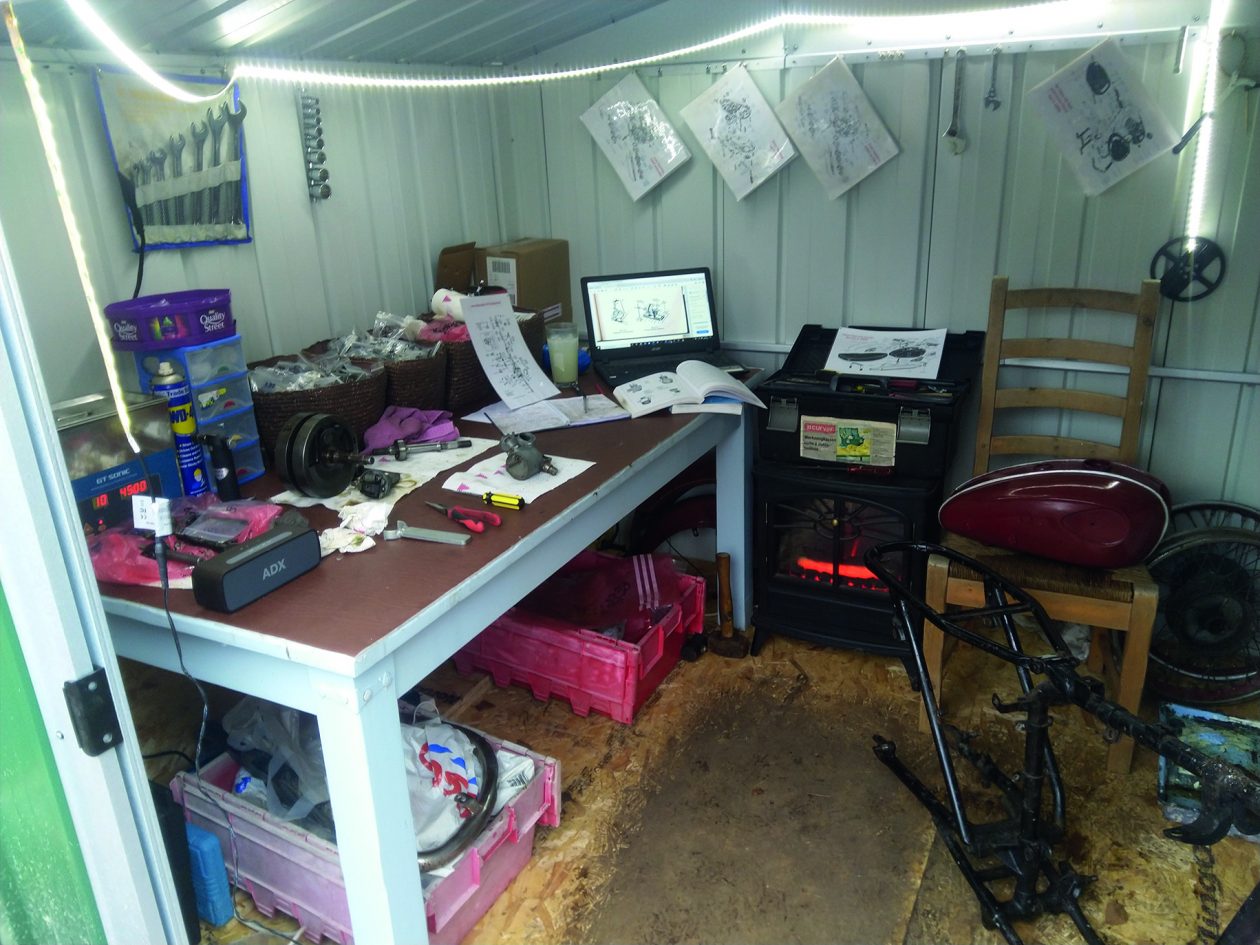
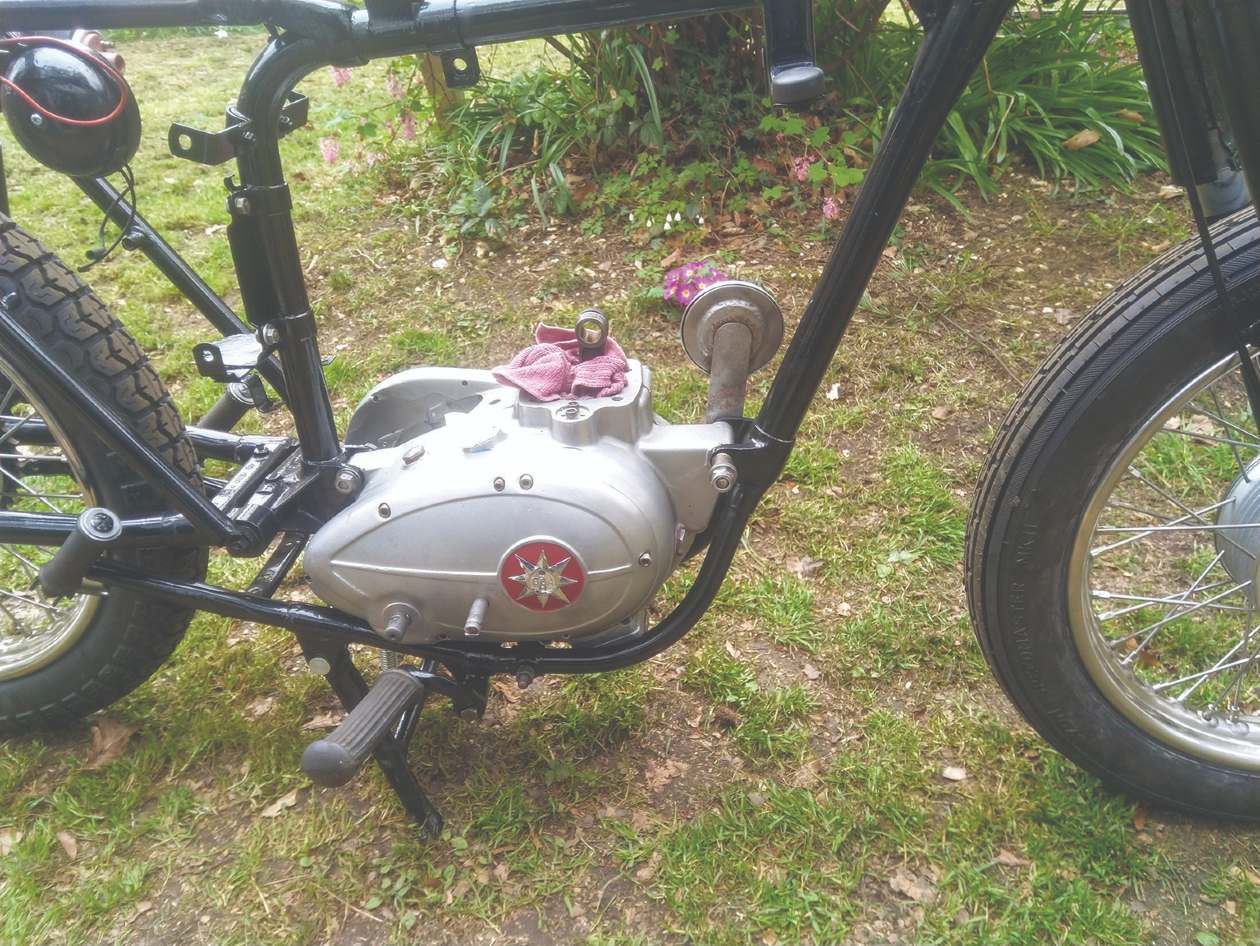
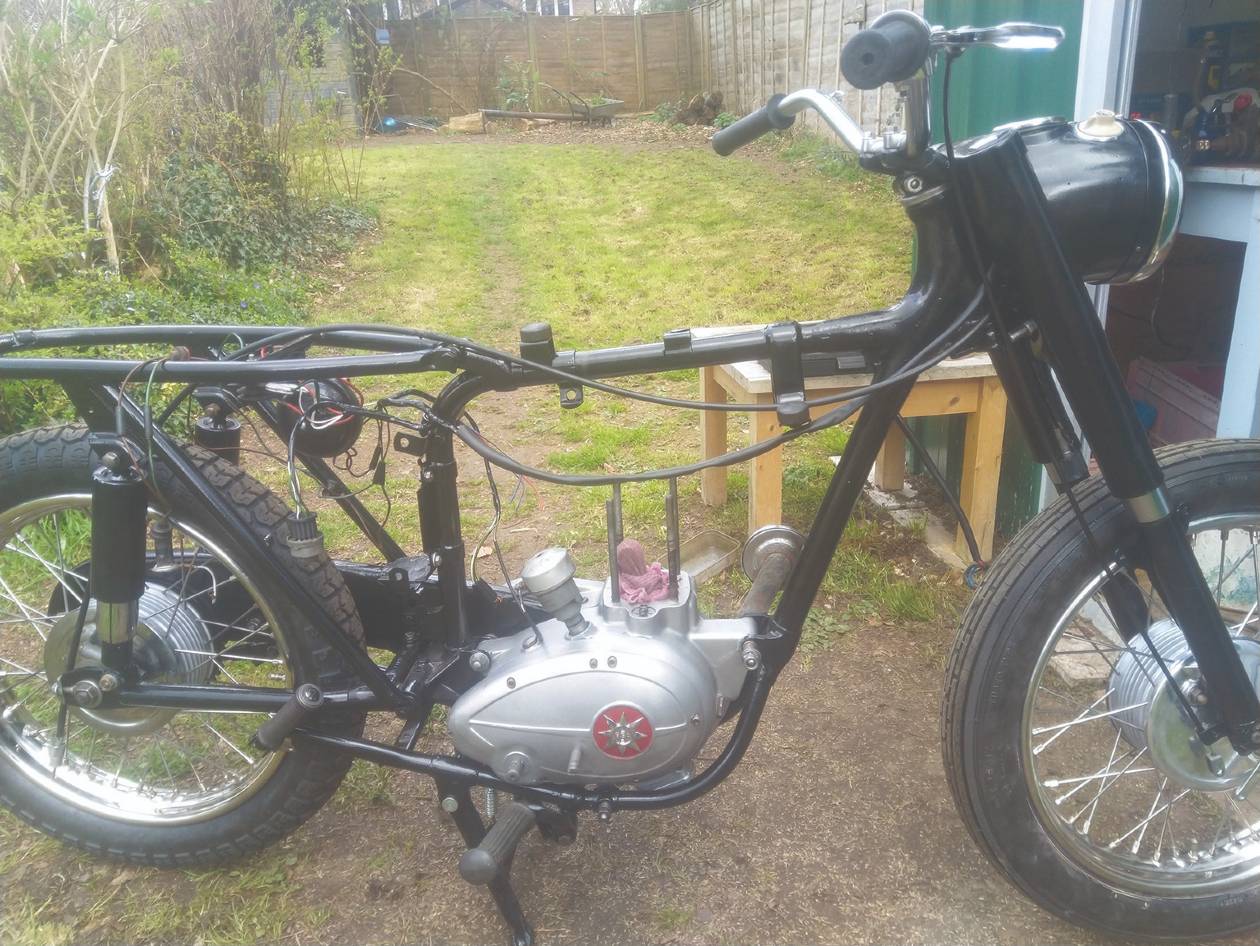
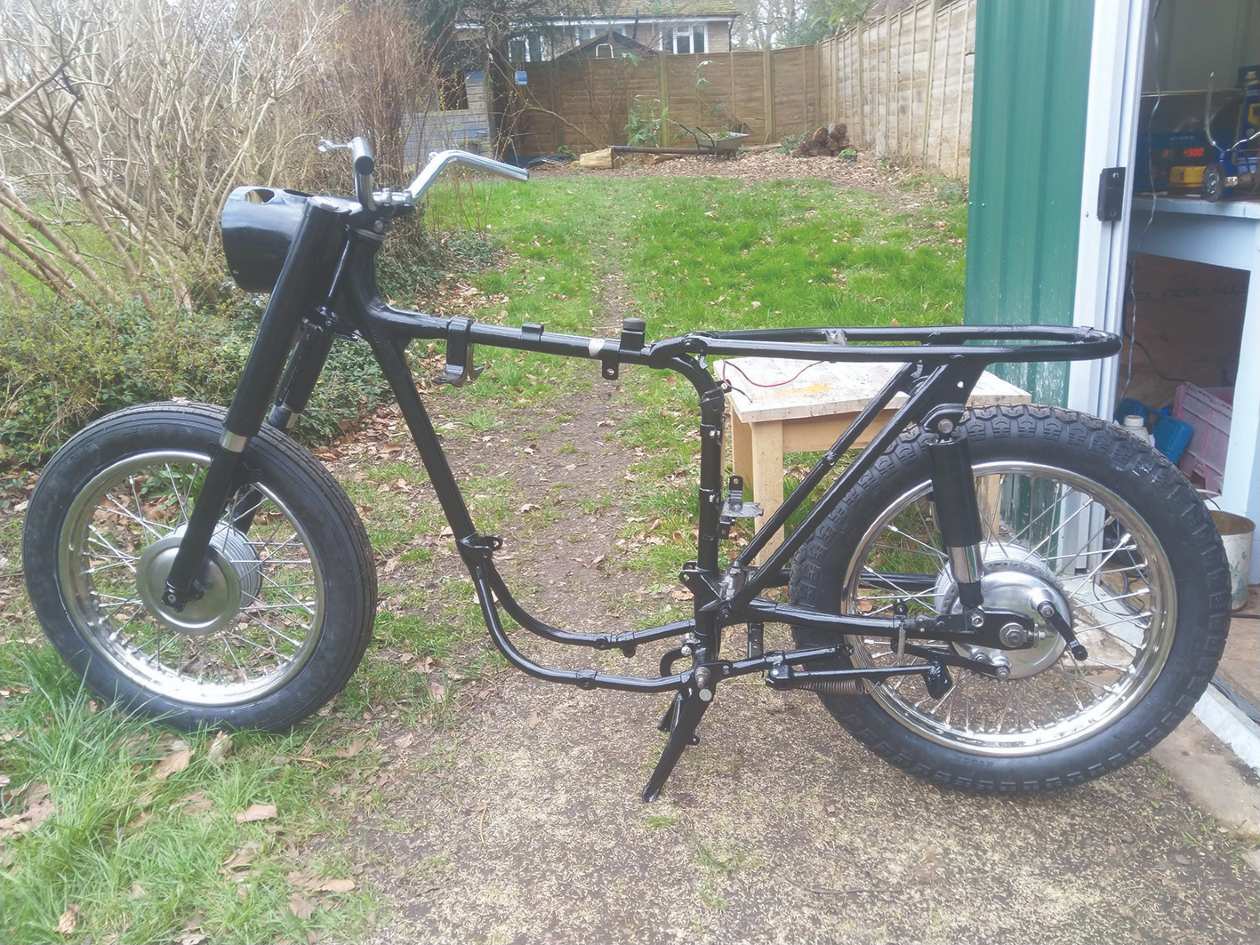
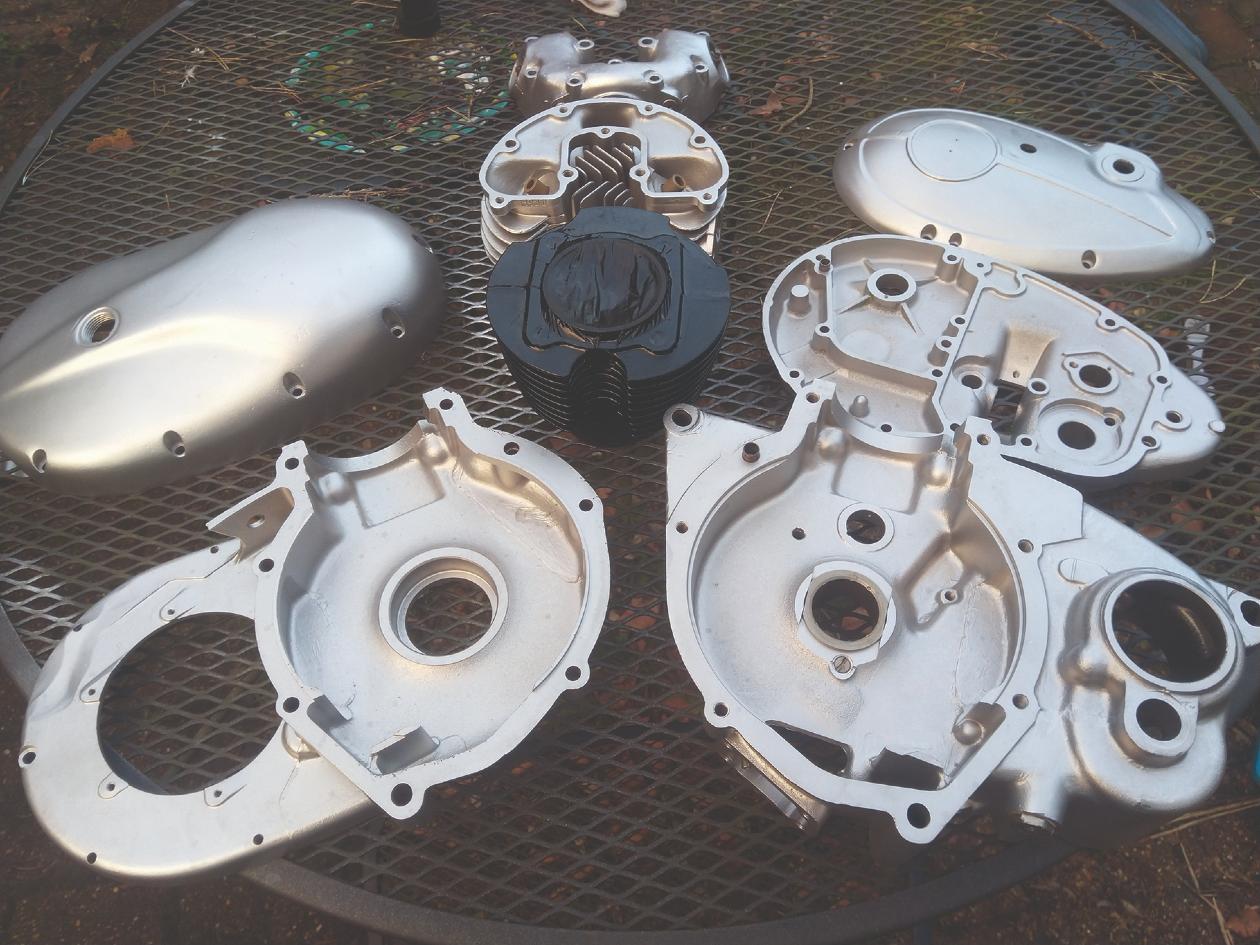
So, let’s catch up. The engine was back in the frame and I was waiting for the tinware to come back from Mike at Triple C. I had bits I could do whilst waiting for the tinware, but not much. Assuming there weren’t too many tasks that I had to take apart and re-do, that is.
The engine was nearly complete. I needed to do the valve clearances, the piston rods, the distributor and the carburettor. On the assumption that the valve clearances are correct, they were remarkably easy to do. The piston rods? I have heard of people buying an endoscope to do these before, and I can understand why. I don’t have one and it took about three hours of loosening the rockerbox, swearing, moving things around, swearing, resetting the rockerbox and trying again before it was eventually correct. People reading these articles must think my language is terrible. I can assure you it isn’t. Working on a classic bike just makes you swear! The two go together like Kirk and Spock.
The end can and the battery were ordered. Thinking of the electrics made me look closely at the point where the three wires from the stator connect to the loom. I was not convinced I had connected the three of them correctly. Research and advice soon yielded the information that these needed to be connected in a very specific and complicated (for me) way. And, yes, you’ve guessed it. The only way to check this was to take the primary chaincase cover off and remove the stator. I refer you to the penultimate sentence of the previous paragraph!
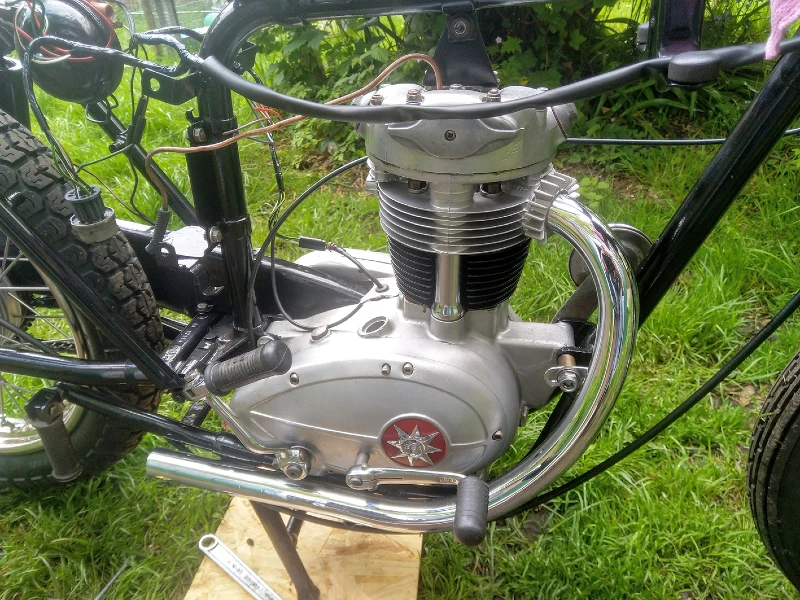
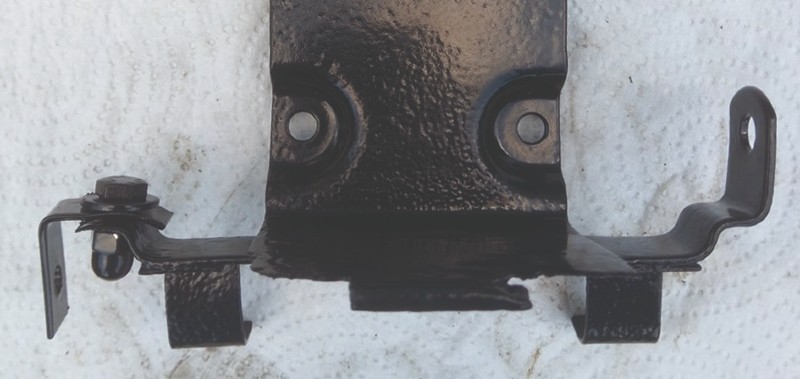
Exhaust downpipe
Anyway, it was a good job I had thought of this as upon removing the primary chaincase I discovered that I had it wired incorrectly. I proceeded to wire things up correctly, and a much better job was made of the soldering I’m pleased to report.
On to the distributor. Something else that I knew absolutely nothing about. I had no idea what it was even for. Research and advice from Mr. R time. I stripped the distributor and decided that the only thing that was needed was new advance springs which reduced costs significantly. They were bought and the distributor assembled. I’ll find out if I was correct when I try and start the bike.
On to setting the timing. I played around, getting a feel for it and the science behind this. I understand the basics of it now and got it to a place where I thought it was correct. Again, we’d find out when the engine was started.
I tightened up the Allen bolt to hold the distributor in the selected position……and the thread on the distributor clamp gave way! Nooooooo. This clamp is buried in the depths of the engine. The thread on it had been fine when I put it in place two or three months ago. This was panic inducing – potentially a major setback on up to three months’ worth of work. I hit the internet and my advice gurus to find out if there was a way around this. Unfortunately not, I needed to buy a new distributor clamp and replace the existing one in the middle of the engine. That was enough for that day. I’d had enough. I packed up, and went and sulked inside!
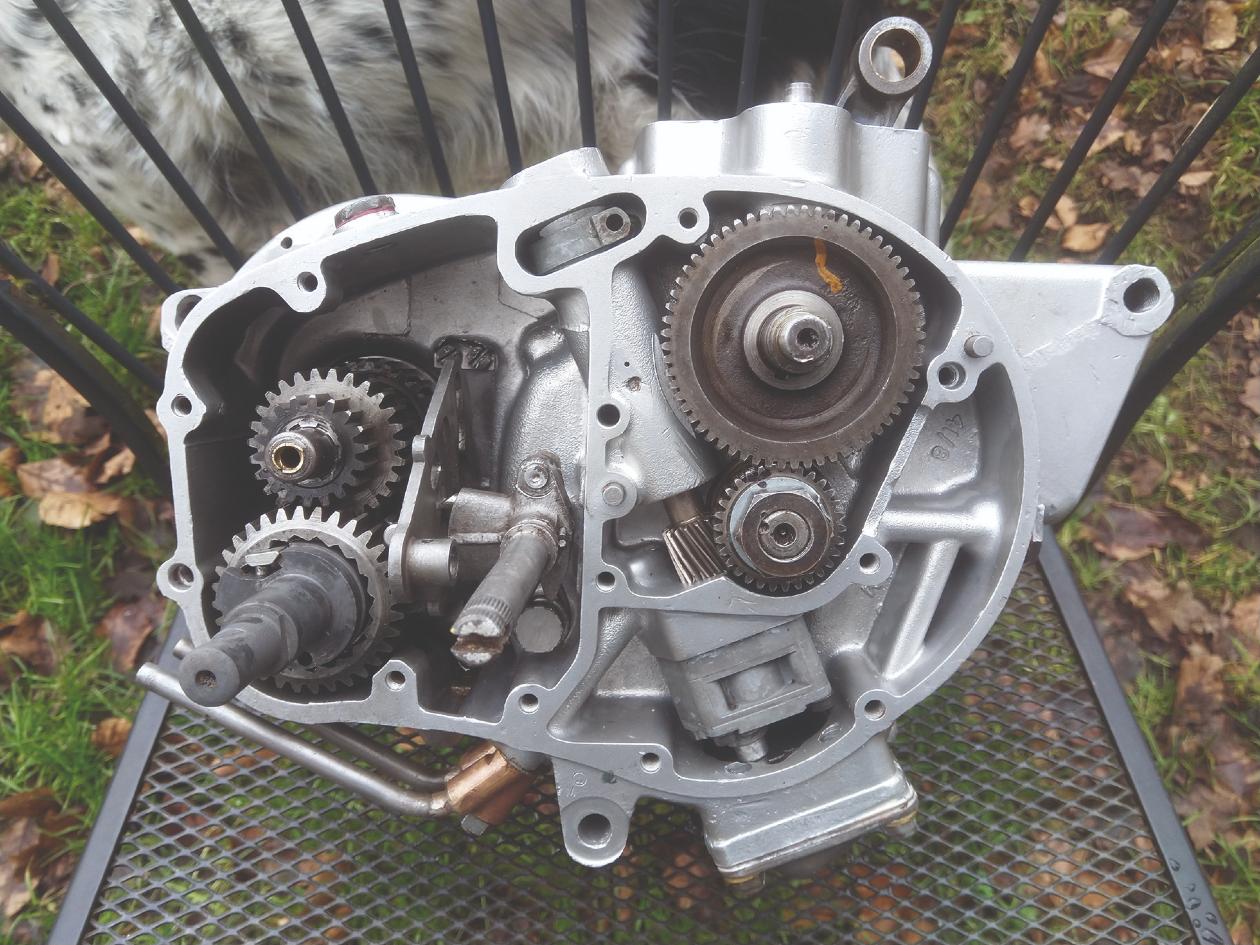
I had discovered another of the wonders of BSA design. The clamp that holds the distributor in position is in the depths of the engine next to the gears (an early part of the assembly), yet the retaining screw goes in through the outer timing cover – one of the last pieces to go in place. This makes distributor adjustments easy but causes problems if the clamp fails. As I said, I’d even checked the clamp before putting it in place, but obviously not thoroughly enough. So, to replace it I had to take off the newly-installed exhaust system, the pegs, the gear shift and kickstart pedals, remove the outer cover, dismantle the kickstart and gear change mechanisms, and remove the inner cover. Removing the inner cover obviously meant that one of my nemeses – the gearbox – came apart as well. I even had to loosen the engine in its frame mounts. There were very nearly tears at this point. To do all that assembly work on the engine had taken me weeks and weeks. I had to take apart 1/3 of the engine to get at that one part. Surely this could have been designed better?
On the positive side of things though, what had previously taken me weeks took me an afternoon this time. It brought home to me how much I’ve learned and what a difference it makes when you actually know something about what you are doing.
Of course, things couldn’t go completely smoothly though. That would be too easy. Upon re-re-re-re-re-assembly another thread went on the bottom engine mount and the kickstart cotter pin broke. Both fortunately external parts. I got the relevant parts from Dave (Mr. R) and quickly had the bike back to where it had been, but with an installed (and hopefully correctly adjusted) distributor.
Restored oil tank
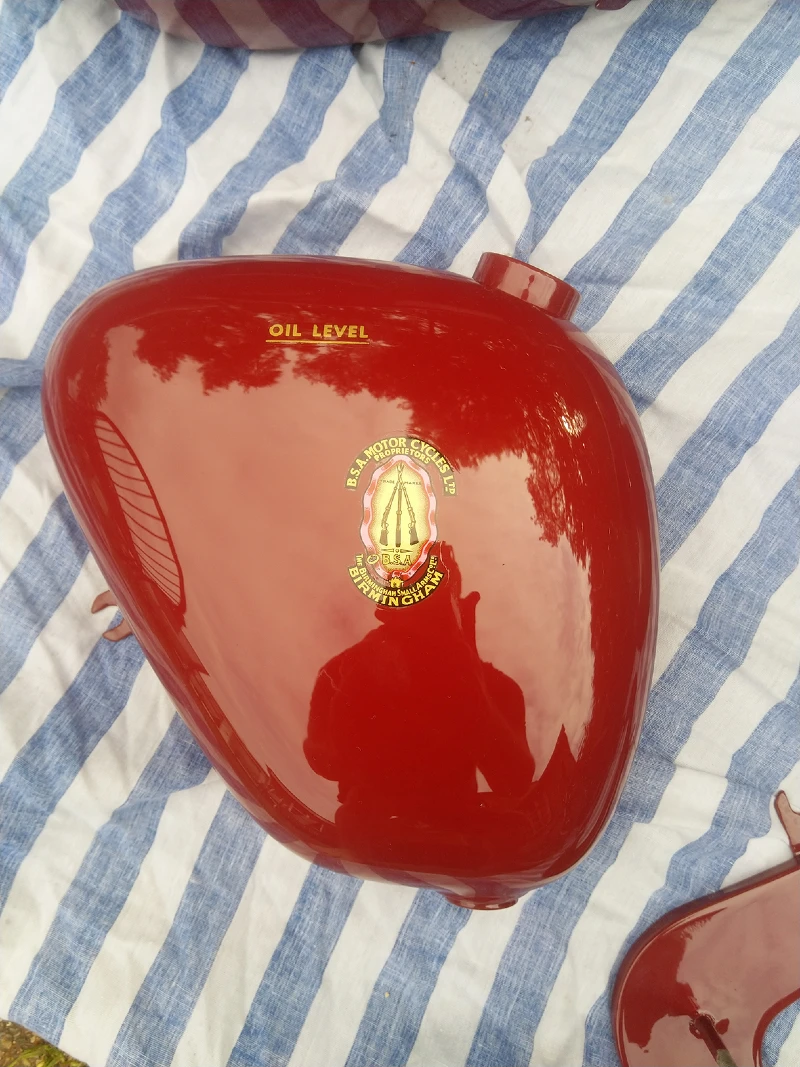
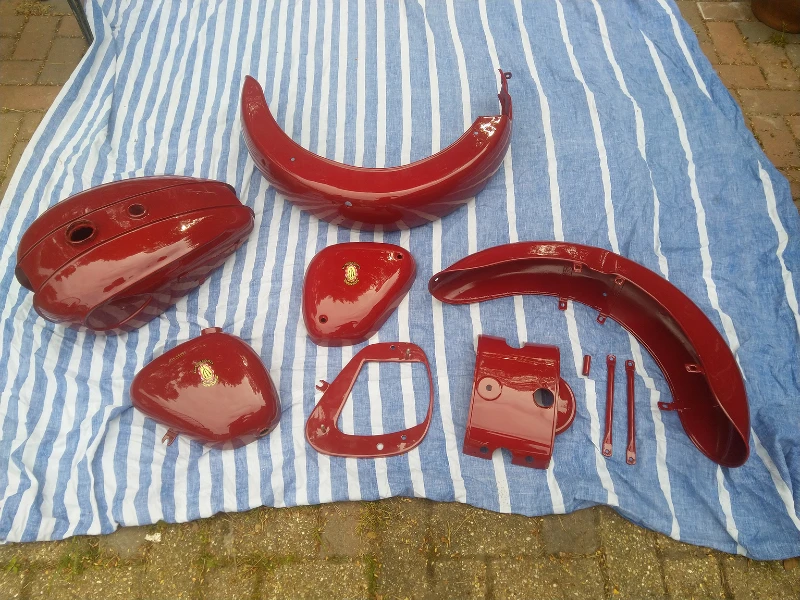
Restored tinware
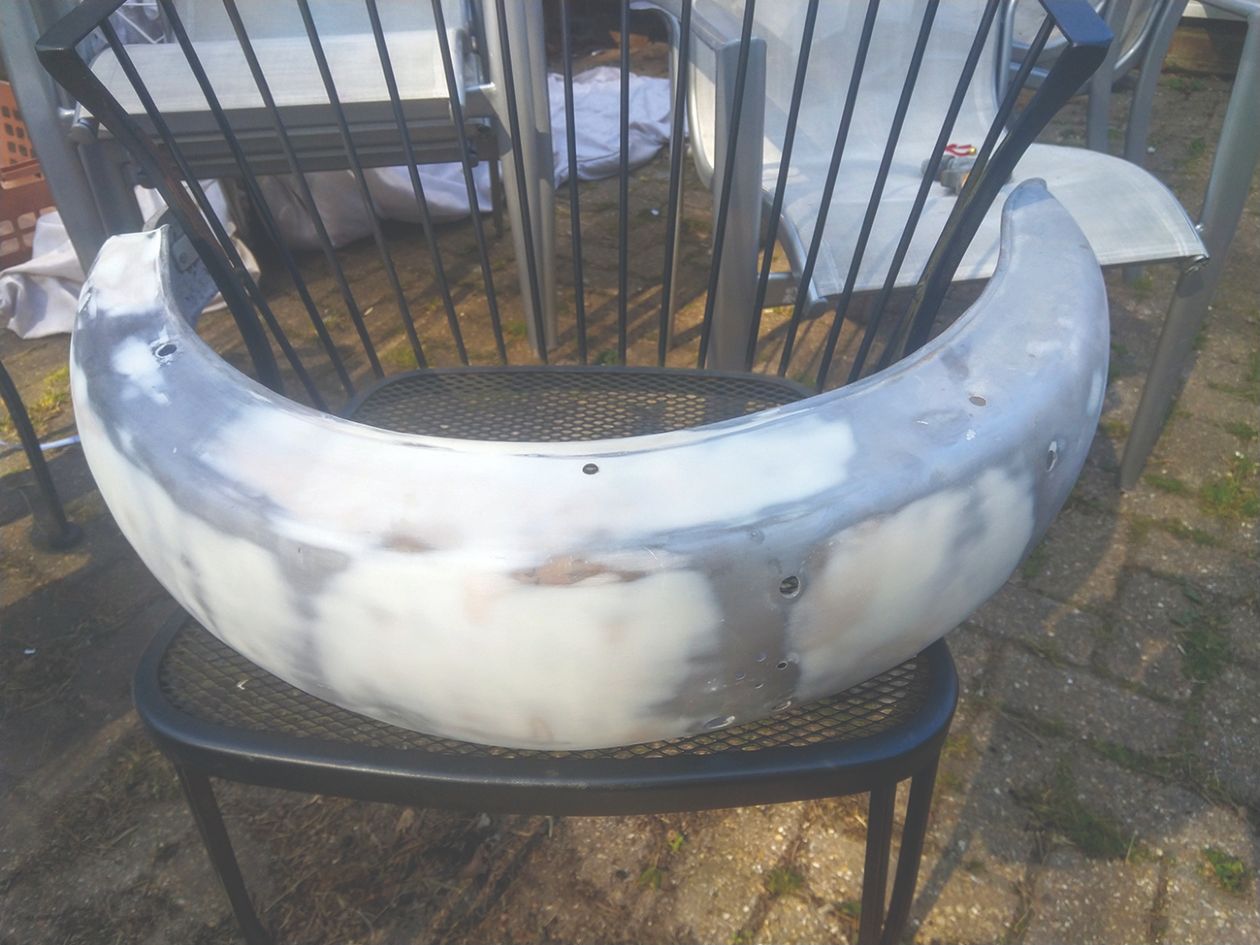
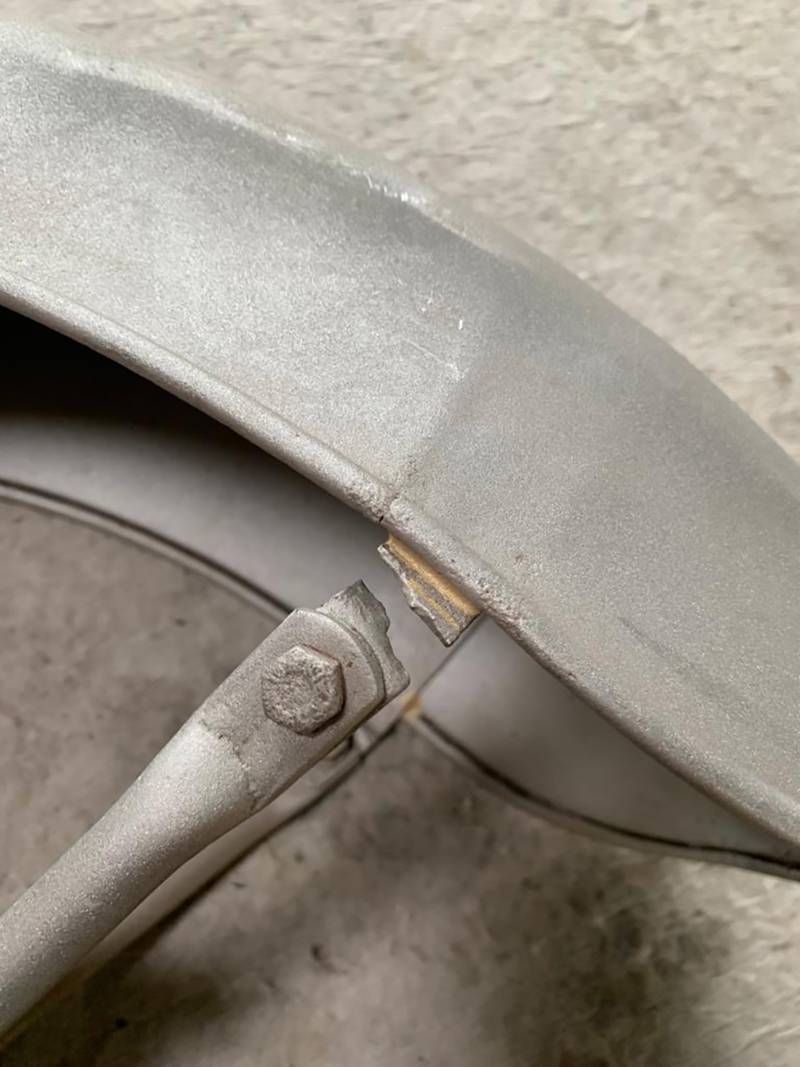
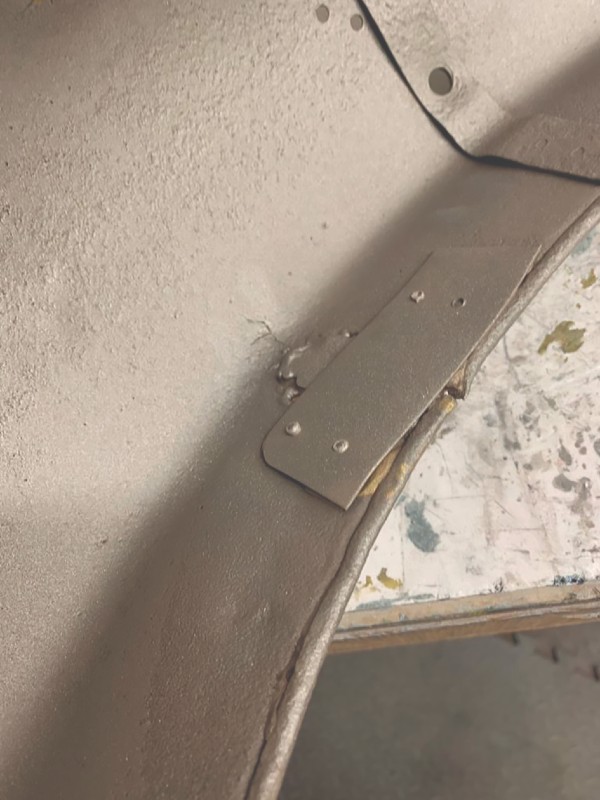
Finally, a long-anticipated day arrived – I got the tinware back from Mike at Triple C, and, to put it bluntly, it looked stunning. What an amazing job he did. The parts look absolutely gorgeous without even being attached to the rest of the bike. I was going to have to be really, really careful putting these on the bike. The last thing I wanted was a scratch.
I could now start putting these parts on, but before I did I wanted to dismantle and inspect the carburettor. To that end I took half a day to read about and carefully examine all the individual components. I’m glad I took the time to do the reading as I needed some new parts that I wouldn’t have got without the research, like a float bowl cover. A previous owner had over tightened this cover and distorted it. This would have most likely have led to a fuel leak in the future, not something you want really! Carburettor parts were ordered as well as numberplates. I also ordered something that would probably be very useful in the future, something that we couldn’t find when collecting the bike – keys!
While waiting for these parts I assembled the petrol tank and the rear lighting / numberplate holder on the rear mudguard. And, again, marvelled at how fantastic the tinware looked.
The numberplates arrived and were put on to their relevant mudguards (being an old fart I refuse to call them fenders!). I then quickly had the centre panel and the rear mudguard on the bike. The carburettor parts arrived, and the carb was assembled and attached to the bike in its initial setup. This will need to be altered later as modern fuels are different to the ones used at the time the instructions were written.
The next parts were the final ones and I was starting to get excited as the end of the restoration was in sight. Or was it fear at the thought of trying to start the bike after all this time, effort and learning (and swearing).
That was by-the-by though, as at this point I came down with a severe case of the plague, and lay moaning and groaning on the sofa for 10 days without the slightest bit of sympathy. What a heartless family I have! All I got were quips about man-flu and being a wimp.
Restored oil tank in situ
Seat on
Once recovered swift progress was made. The oil tank was fitted and connected, the remaining decal was done, and the front mudguard went on.
At this point I decided to wire up the battery and check all the electrics. This could be interesting! But overall I was pleased with my electrical efforts. I needed a new bulb for the rear light as the existing one was a 12V bulb and the bike is 6V. I also discovered that the ignition coil was dead. Like the distributor clamp I had checked this when it came off the bike and I thought it was okay, but it obviously wasn’t. Two other bulbs did not work, but I realised that this was because they weren’t earthed – I told you I knew nothing about wiring! That was soon sorted and once the new bulb and ignition coil arrived all the electrics worked correctly.
Only two things were left to go on the bike – the petrol tank and the seat (which I had resprayed underneath for protection).
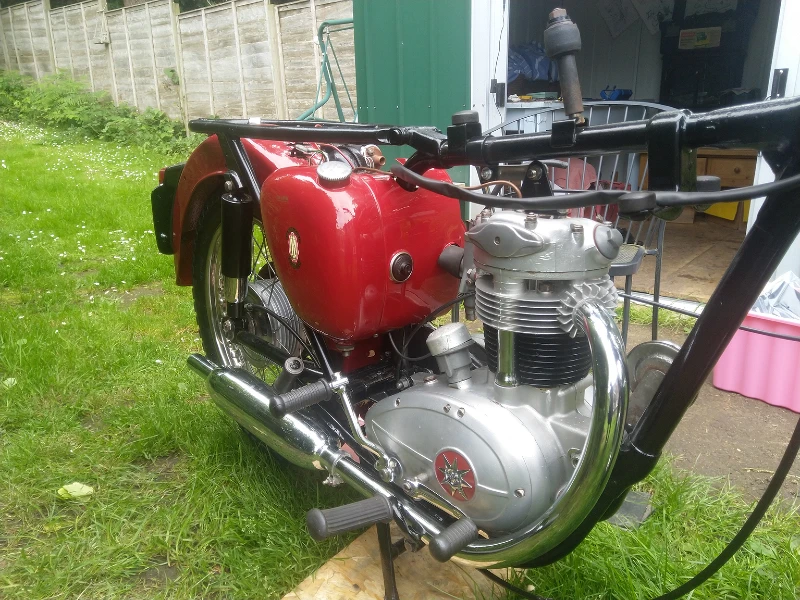
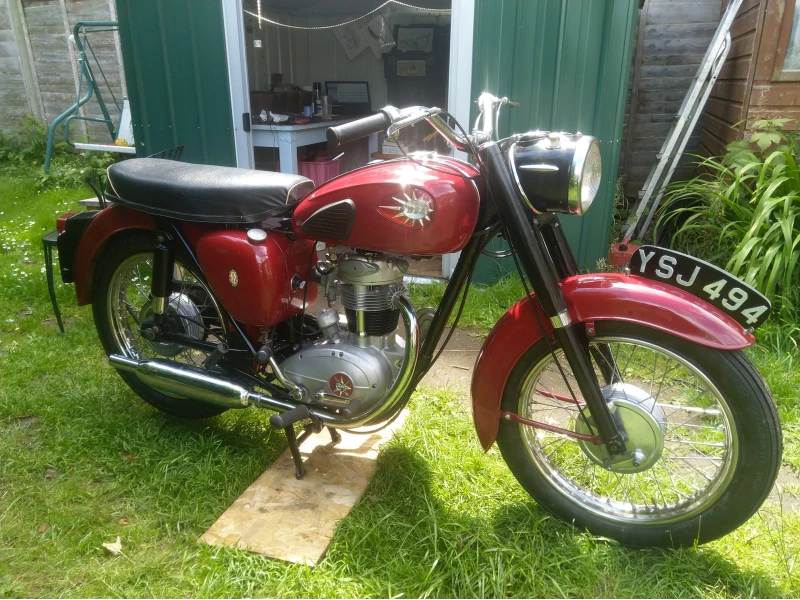
They went on and that was it. The restoration part was complete.
Now it was time to get it running and roadworthy, so some oil went into the bike and I waited to see how much came straight back out. Three parts of the bike have oil, so I did this over three nights. This would allow me to trace any leaks. First in was the chaincase – no leaks. Next was the gearbox and, again, there were no leaks.
Finally, I needed to get oil into the oil tank and use the kickstart to move this oil all around the engine. 400 kicks or so later no oil was coming back into the oil tank. Some slight disassembly showed that oil was going all round the engine but simply not managing that final bit back to the tank and the scavenger to the rockerbox. There were no blockages. I finally decided that this was because the insides of these pipes were both very clean and very narrow. Due to the viscosity of the oil I thought that liquid to surface friction might be causing this. I removed the necessary pipes and forced oil through them. Once reattached this initial friction had been overcome and the oil came through nicely. Again, I left this overnight and there were no leaks.
Finally, fuel. I put a small amount of petrol into the tank and it came straight out again at the bottom! Some quick action with a cup collected most of this and then I had to do some cleaning up and let things evaporate. Investigation led me to something I had heard about but hadn’t twigged was applicable to my bike. I discovered a cork in the petrol tap under the tank which had dried out and shrunk over the years. Boiling it in a pan of water for half an hour and then leaving it to soak overnight in petrol and it was back to its proper dimensions. Petrol went back into the tank and the tap worked nicely. And the petrol came straight back out via the carb! This leaking from the carb was my first encounter with something that would become a recurring theme for me – I hadn’t tightened things up enough. In my fear of damaging parts by overtightening them I had gone to the other extreme. Carb parts tightened and no leaks. That meant that the next stage was…….first start!
All was set. I had the bike nicely positioned. Sharon and my daughter Emily, were there to watch and film things. I gave the bike its first kickstart – nothing. Many kicks later we switched off the video as I wasn’t getting anything, not even a hint of the engine starting. It was disheartening. It was at this point I remembered to turn on the ignition! 10 kicks later and the bike burst into life. Glorious, fantastic, amazing. The bike lived.
Okay I had to have the throttle fully open and oil seemed to be coming from everywhere, but the bike ran. What a feeling. And what a lovely sound.
I had expected the bike not to run for long. That was because I was going to have to do all the necessary alterations to the timing and the carb to get a sweet running engine. But I wasn’t expecting oil to come out so much, especially after it not leaking earlier. The pressure of the engine running was obviously forcing the oil out. Repeatedly starting the engine led me to three leaks – the primary chaincase cover, the sump plate and most worryingly the outer timing cover. This was worrying because there shouldn’t be sufficient oil in that area for a leak to occur.
New sump plate parts sorted that leak. I’d tried to get away with not replacing them and it hadn’t worked. The Primary Chaincase needed a new gasket due to the number of times it had been taken off and put back on.
The outer timing cover leak was traced to the camshaft breather. Initial thoughts and advice led me to the oil pump which might need lapping. So, I did this (for a first ever time) and managed to completely overdo it and killed the oil pump (I might have sworn at this point). A new oil pump was bought from Mr. R and all was reassembled, but still the leak was there. I also noticed that oil was coming out of a drain hole in the wrong direction. The pressure is too high in the engine. Investigations into this are continuing, it appears to have people stumped at the moment.
So, we’re at a kind of a weird place now. I just need to get this leak sorted then do the carb settings. Then the bike is on the road. But I’ve also just got Covid. Fortunately, I’m not too ill (mainly fatigue and breathlessness) as I’ve had both jabs but work on the bike has stopped. Realistically I need someone in the know to come and look at this leak for me before I can progress. And help me with the carb. I’ve reached the end of what I can learn by myself and need someone to teach me.
The restoration has been a journey. So many things – I’ve learned a stunning amount and done something I never thought I would be capable of, spent more on the bike than it’s actually worth (without having to even buy it), found great craftspeople who I would highly recommend, received great advice and even written articles about it. But the two most important things? I’ve made new friends (especially Dave and Lisa Smith, to whom I owe a big thank you) and I’ve had fun.
Getting supplies has been interesting. In our emails something Dave said brought home the dangers of buying modern pattern parts. To quote: “The original thread on the kickstart cotter is 9/32″ 26tpi cycle thread. Modern replacements are often 1/4″ or even 6mm!! Horrors. As producing that size is easier and cheaper.” So, you really need to be careful and buy from somewhere with a good reputation for supplying quality parts that are fit for purpose. At least a couple of hundred pounds has been spent on parts that didn’t fit. Again, to quote Dave: “the old boys in the past actually knew what they were doing and made decisions based on good engineering principles.” I would agree – except when it comes to chainguards and distributor clamps that is!
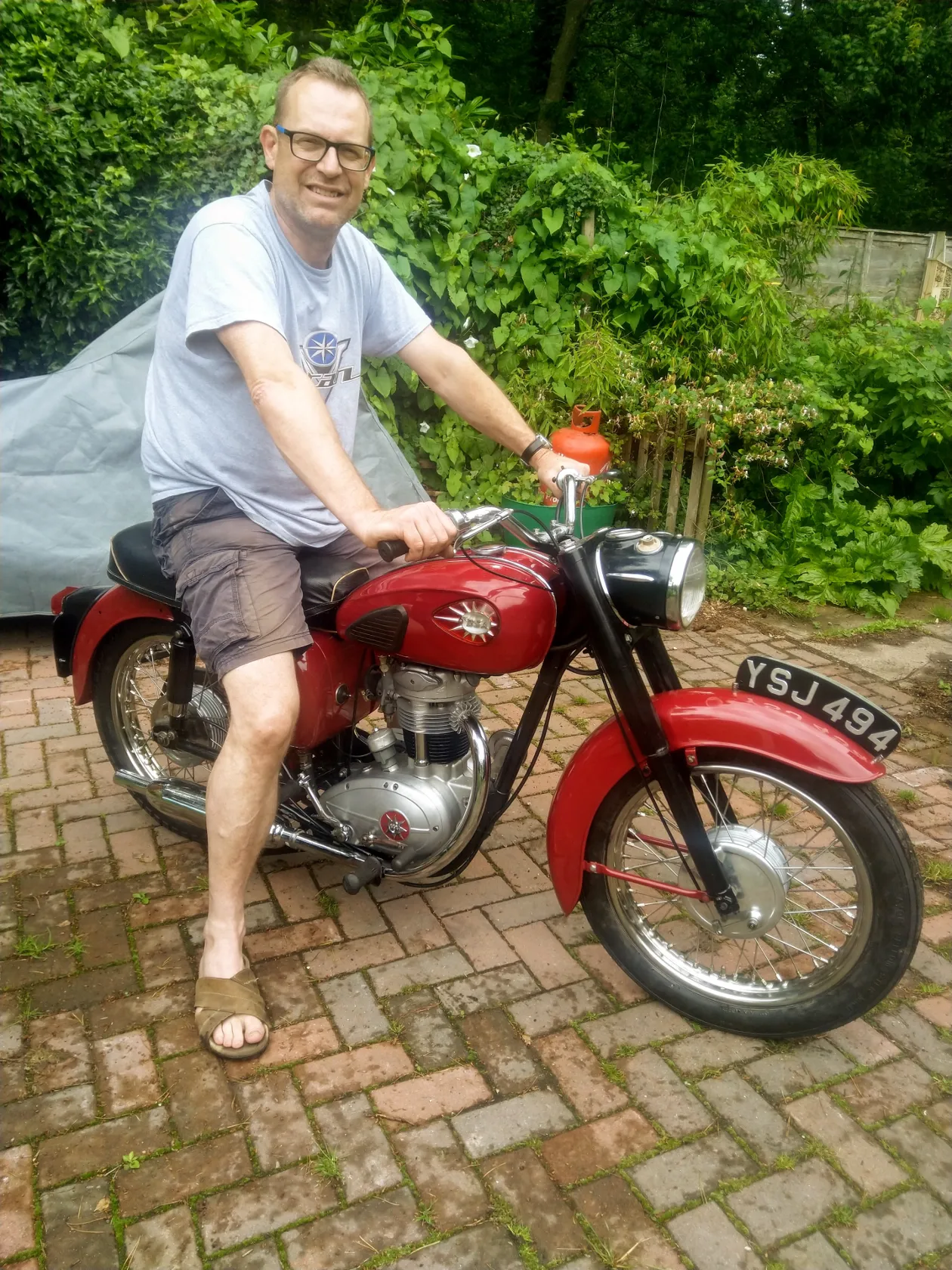
The bike isn’t roadworthy, but it runs, and I can keep the engine going. I could take it out tomorrow, but I wouldn’t get far at all, it would probably cause damage to the engine and it wouldn’t be safe – so that’s a no. I won’t have enough to write another article. All another article would say is that the leak is fixed, the carb is sorted and it’s on the road. There will always be other problems that need sorting as well, after all it’s a vintage motorbike! So, I’ll leave it here with a promise that I’ll send Salli a picture of me on the bike on the road as soon as I can. Thank you all for reading my ramblings, I hope you’ve enjoyed reading about it as much as I have enjoyed writing it. Stay shiny side up.
Part two of the tale of my trip around the renowned North Coast 500 on a Burgman with a mate who, although he has been riding for 50 years, has never taken his test – so we continue from last month’s riveting episode of our adventure…
Day four found us at the dealership and I had made a discovery. I was fiddling with my waterproof covers to my panniers when my lost gloves fell out. They had obviously got tangled up and lived there for two days. So at least I could save myself the £80 I was due to spend on new ones. Happy days.
Sadly, not so good on the screw front. I saw a guy in the showroom and explained my issue. He was a salesman and pointed to service reception, this being populated by a tall and young brunette girl apparently called Bella who oversaw that department. “Ask her for a screw,” was his suggestion. Frankly, I thought my chances would be incredibly low indeed, but I have never been one to shirk good advice – but I opted to perhaps re-phrase the question.
I pointed to the offending Frankenstein-Monster-looking bolt attached to the side of my crash helmet – explained my dilemma and asked if she had anything to cure my ills. Sadly not. Oh well, at least I had found my gloves.
La Mirage Restaurant, Helmdale
Whilst getting ready to leave in the car park we got talking to a couple of foreign guys who had just been with the lovely Bella getting a radio fitted to one of their helmets. “What part of Germany are you from?” I asked – detecting the accent – I am particularly good at accents, it’s years of practice. “Holland!” he said. I suspected he did not understand the question and therefore decided to leave it.
We were free to go and find our next stop which was Wick. This was to be a reasonable ride of about 110 miles up the East Coast. We were without breakfast and so we decided to have lunch on the way, stopped at a place called Helmsdale and found a little takeaway Fish & Chip shop called La Mirage. Another one to add to your list of places to visit – especially if you are at all hungry. We simply asked for 2 x Fish and Chip meals and proceeded to wait. We waited a little longer – and then we waited. After waiting some more, we finally got our meals. The meal consisted of about a week’s worth of chips and these were hidden underneath the remains of two porpoises.
Did I say “each”. The meals were huge – and tasted wonderful. There was no way we could finish them, but boy – what a feast. We were now at a point where it was difficult to move, but despite this we bravely managed to climb aboard and find the rest of our way to Wick.
I was due to stay at the house of someone called Elenna at the Rose Cottage in the Harbour. Despite eating the outpourings of a small country at lunchtime we were early. I sent Elenna a message asking if I could check in and she was very accommodating. We found the house so that we both knew where I was in case of emergency and told Elenna we were off to find Ian’s overnight stay.
Symptom was staying with Calum in the High Street. I emailed Calum and asked if Ian could check in early. “By all means,” replied Calum, “just come to check in at the Camps Bar in the High Street.”
Camps Bar?
The Camps bar was a little tired, and when we met Calum, (who seemed like a nice chap), we guessed where the name of the bar came from. There was nowhere for Ian to park his bike (again – insert joke here) so he padlocked it firmly to the metal fence on the harbour wall. I helped Ian carry his bags round the back of the pub up some very questionable steps and left him to settle in. At this juncture I legged it and set off to find Elenna again.
The Camps Bar
As previously described, Elenna was lovely. She was truly short in stature (a long way under 5 foot) – but boldly built, I think that is a polite way of putting it, and you should remember that I am also short and boldly built – albeit 5’6”. Elenna was shorter – struggling to make the lofty heights of 5 feet even on short steps.
“Would you like help with your bags?” she offered, at which point I pulled myself up to my full height and sucked in one of my stomachs. “I’m fine,” I said. “The stairs are rather steep,” she said, but I ignored this sage advice and suggested that I would do my luggage in two short journeys.
I shouldered arms and followed Elenna to the foot of the stairs. “I’ll lead the way,” she uttered as we approached the aforementioned obstacle. Let me say immediately they were *not* steep. I have seen steep, and these were not it. Steep was not a word that was invented to describe these stairs. They were just like the ones I had at home.
We attained the first floor without issues and started up the second flight. I was on top form, and wishing she would hurry up, but Elenna was not to be rushed. We turned the corner and made it to the landing.
“This is a 200-year-old cottage,” she told me, “therefore some of it will catch you out if you are not careful.: With this, she opened a door. I peered inside expecting to find a period, (and very tastefully decorated) room, perhaps with a nice little fireplace and sit-down windowsill.
Nope. “One more flight,” she offered.
Dear reader, what I saw is best described as a ladder. The stairway was certainly not much wider than a ladder – but it was about as steep. Elenna set off, and I followed, struggling to fit inside the space and carry two panniers. As I ascended, the age of the house appeared to try to prove itself, because someone kept turning the lights out.
It ended well I am pleased to say, after finding the room, opening the window, and taking a few lungs-full of sea-air-scented oxygen, I recovered.
“I’ll get my son to bring the rest of your luggage up,” said Elenna, and I did not have the chance – nor the breath in my body, to argue. The day was not improved by me stubbing my very black big toe on the bed three times that evening!!
To be fair – apart from the altitude the room was lovely and was bettered by a wonderful breakfast the following day. Elenna was also lovely.
Ian was not so happy; his rather tired digs were not as impressive and he was incredibly happy to move on from a sleepless night in Camps Bar.
Lairg was next on the itinerary – via John O’Groats, Dunnet Head and the most northerly part of the North coast. We rode into John O’Groats in the rain, took the obligatory picture and headed out of town without delay. Dunnet Head – 11 miles away was the actual most northern point and a lot more picturesque.
Dounreay was very military and reminded us of nasty things, we hurried past. The A836, apart from this – was lovely. We covered 137 miles – much of it on the coastline and loved every yard of it.
Nothing funny happened – sorry. Although there were some interesting place names. Brawl, Swordly, Farr, BettyHill (she went to our school), Coldbackie, Tongue, Tongue Burn. You could put any one of those into your own sentence, I’ll wait until you are done.
OK – ready – here we go again.
We arrived in Lairg and decided that it was a noticeably quiet town. Both of us were due to dwell overnight in farms, me at the top of a valley – and overlooking Ian’s domicile at the bottom of the hill. We opted to go to the chip shop for tea – arriving at 7.05pm only to find they closed at 7.00! Well why would you want a chip shop open in the evening anyway?
The Falls of Shin followed in the morning, along with a wonderful trip to Ullapool – which proved to be a reasonable stay – this even though Ian was staying in a house that backed onto Tesco, whereas I was staying in a house that looked like it came out of a showroom – it was a dream.
Dingwall, next stop – was not so dreamy. It is a dead town with one huge supermarket – the ever-popular Tesco. All the shops which sold items that were also sold in Tesco were shut and boarded up. What a crying shame.
Dingwall was to be the town which signalled the end of the Highlands for us for several reasons. Firstly – we were still a bit damp. Secondly – we were old and had covered more than 1,600 miles in 9 days. Thirdly – and this was important – each day when we woke up, we wanted clean clothes to wear. I was fine – I still had enough of everything for another 4 days. Symptom Ian on the other hand had taken a small stock-check the previous day. Clean clothes amounted to the following: 11 spare pairs of socks, enough underwear for 2 days, 4 clean pyjama tops and no clean shirts – this man cannot count!
So where were we to stay in Dingwall? Ian was with Margaret. Margaret lived on the side of a mountain. I however was due to spend the evening with stars.
One or two of you may be old enough to remember – in black and white days – a Sunday lunchtime radio program called Round the Horne. Nowadays you wonder how they got away with it on a Sunday lunchtime radio programme?
Each week Kenneth Williams and Hugh Paddick played two ex-performing “luvvies” who get little or no work and spend their lives trying to make ends meet. Their famous catchphrase was “Ooh Ello Mr Orne – My Name’s Julian and this is my friend Sandy.” Go onto You Tube and search for “Julian & Sandy – Keep Britain Bona” – you will catch my drift.
On our final leg eve – I was due to stay with two guys who shared their lives together – fair enough I have absolutely no issue with that and why should I – but how do I expect to keep a straight face when I find out what their names are – when I am of a certain age and remember Round the Horne. One was called Julian – and the other was called Sandy – their bungalow was called “Sand Jools”.
I had a pleasant night in their rather uniquely decorated pied a terre, (the bed was the absolute best I had slept in all week!!) and slipped out in the morning before they stirred – I needed to meet Ian for breakfast.
Ian’s evening was interesting. As well as parking on a 1-in-3 slope in the driveway (if you stood on the pavement, you looked down over the roof of the house) – it was a tiny drive which proved a challenge when he came to turn his bike around. More interesting than that was what Ian described as the tiniest bathroom he has ever seen. He had to close the door of his en-suite before he could sit on the loo and there were so many doors and cupboards he wasn’t sure what was what.
Ian was sharing the B&B with another couple who were also due to stay overnight. He heard them arrive and chat to the owner – apparently the walls were paper-thin.
Ian heard every word as he sat quietly in his luxury en-suite on the “throne” trying to be as quiet as possible as he “took his ease” – (refer to comment about paper thin walls and how sound carried). Actually – it was not the paper-thin walls and sound carrying that turned out to be the problem, the issue was the door which suddenly opened from the other couple’s bedroom directly into the bathroom where Ian was concentrating on the job in hand.
Double takes were duly taken – they looked at each other in surprise – Ian covered up and drew his legs close together – the woman went bright red, and as they say in the best circles, made her excuses and left. Ian did say it put him off the job he was half-way through!
Homeward Bound
And so, it ended. We rode back in two days – stopping in Erskine Bridge at a hotel that had a lift that was slower than coastal erosion and invaded by a Japanese coach party – perhaps I will detail this another time.
We rode home from there in one day – a mistake as it happens – but we did it anyway and reached home at 3.15am after almost 19 hours in the saddle and a blown headlamp bulb as we rode through the night. Like I said – perhaps another time.
Equally – I could expand on two bald guys in an Austin 7 who popped up several times on our tour, Billy Donelly (yes – that is really what he called himself) – an author we discovered at a roadside stop on the way down Loch Lomond, Billy then started to follow us.
Outside of that though – two old gits – one with L-plates – did the Highland 500 and made it home afterwards. 2,332 miles.
As a new member from end of last year, I’m in my fourth life on two wheels after some fairly lengthy gaps. So in all, my motorcycling has stretched across 1970-72, 1984-6, 1989-90 and from 2016 to date.
My TVAM journey started when I met what I presume was a bunch of WAGs, while on a trip out to Wantage, 2 years ago. Having arrived in the Market Square to stop for a coffee I found myself in the midst of about 25 bikers and joined their ride through Oxfordshire, and was made to feel very welcome. So, it was natural to later consider joining and the offer of a Taster Ride with Paul Wells as my Observer came up, thanks Paul! I described it afterwards as ‘Epic’!
FREEDOM: SIGN HERE
To go back to my first motorcycling days, I had to get to school and back. We were living in Lower Basildon and my school was in Sonning. I bought my first bike, a Suzuki 50 M15 (2 stroke, not a moped), from the proceeds of working in my school holidays. I loved the freedom it gave me and it got me on the road at the weekends, to my best school friend Steve’s house in Wargrave. He was on a chopped Triumph Tiger Cub with the registration plate, 4761 D, but it looked the part. You’ve got to remember this was the era of Peter Fonda and Captain America.
This freedom was to be dramatically cut short when I got back to school from a Saturday away football match. The bike was AWOL (Hell’s teeth!). Not a sign, but 6 weeks later, my beautiful little Suzuki was spotted sticking out of the weir at Sonning. Joy-ridden and heavily baptised in Father Thames, by a pair of (I think the term was: greeboes), who lived on the school site. Worst of all, no fingerprints left. If your name is Thompson and you’ve got a twin brother, I’m after my 28 quid!
The school insurance payout helped me move up-scale slightly to a Honda 90 C200. Okay, small beer in biking terms, especially as in those days, a 250 could be ridden on L-Plates. The next machine was a Triumph Tiger Cub with clip-ons and a very decently done cafe racer set up. White fibreglass tank and metallic green stove enamelled frame. Seized on me at 60mph on the A4!
1970s JAPANESE MIND INVASION
I can clearly remember the 6 page Honda fold-out of those years, picturing the full range from SS125 twin up to the classic super bike, the CB750. My head was turned. Superb machines and marketing, no question. BSA and Triumph were still putting out half decent bikes, like the Starfire and the Trophy, there was the Norton Commando, but the momentum had shifted to the East!
BIKER DOWN (ME) & A CHANCE REUNION 10 YEARS ON
One day on my Honda, while leaving a T-junction in Wargrave, I came to blows at low speed with a yellow Audi in broad daylight, yes, a serious lack of active scanning. I was down but alright and the gent in the Audi was very understanding. His name was Bob Noble and by some incredible chance 10 years on, we crossed paths again when I got a job with an advertising agency in London, where he was the main Partner. I think we both knew… but staying schtum seemed to work best.
MID 80s
It was to be nearly 15 years before my 2nd biker rebirth. Why such a big gap? Something to do with Minis and Capris. They also come off better at T-junctions!
My friend Steve (a constant lead in my biking life) was on a Honda Nighthawk. Trips to Thailand in 1981, where large machines could be readily hired and without full license and test, rekindled something. The scene was set for me taking my test on a Honda 125, around the streets of Tilehurst. This led to the Honda CB650Z becoming my first “serious” machine. I put myself through the Star Rider Course for some degree of mastery over this first 4 cylinder machine. Such a mighty power revelation after a 200cc single Tiger Cub, although I’d experienced Honda fours in Pattaya.
EARLY 90s. MID-LIFE CRISIS? MID-LIFE CHRISTMAS MORE LIKE
In the early 90s after my next biking interval, I went out and bought a Yamaha XV750 (imported from US). Lovely machine, semi-cruiser style. Then came the next and last gap in riding, until 2016.
PRESENT DAY: EWAN AND CHARLEY SHOW US THE ONLY WAY IS UP!
Watching those guys, I just kept smiling and Ewan’s post trip reflections resonated strongly. I think it’s fascinating how we’ve all come to being bikers, with our many varied life paths. In a club like TVAM, I can see that a membership of over 1,000 spans a broad swathe of motorbike history and is a microcosm of our favourite industry, over many decades.
My own relatively lightly trodden path has encompassed Suzuki, two Hondas, two Yamahas and two Triumphs. Perhaps the most important is Triumph, themselves reborn and unrecognisable from my early days. Thank you, Mr Bloor. My own tastes have never entered sports or adventure bike territory, so I must be stuck in retro/classic mode! I’m now on Triumph Bonneville America (2014) and Yamaha XSR 900 (2017) and I love the contrast, ranging from relaxed cruising to just pure exhilaration!
I’ve yet to be seduced by Harley, BMW, Ducati, Moto Guzzi and Kawasaki, please forgive me, I’m working on it! I am equally fascinated by certain other brands and machines like Indian and even Benelli for the future, what a great time to be a biker! Aahh, if only the garage was bigger.
What does biking represent to me? It’s the freedom, the shared culture and the semi-spiritual experience of banking round bends, akin to flying. Coming back home, still alive, but actually more ALIVE! Now I just need to learn to do it properly!
It all started when I bought a KTM RC8R a few weeks ago. I’d owned one years ago and always regretted letting it go. Long story short, the mirrors give a great view of your shoulders and not much else.
In search of some neat bar-end mirrors I decided to use a quality British supplier and gave Oberon Performance (https://www.oberon-performance.co.uk/) a ring. I’d fitted one of their clutch slave cylinders to a KTM Super Adventure in the past.
I spoke with their Customer Services guy, David Goodyear, and he helpfully deciphered the multitude of fitting options (actually 9) shown on the Oberon website before I placed the order.
During our conversation I asked if he could arrange a visit to their workshop and so, some weeks later, a hardy bunch of TVAM riders arrive like drowned rats (the rain was biblical) at the Oberon workshop in Havant; one arrived in a waterproof tin box on wheels (lightweight!!).
Steve Street, the owner, entertained us (I use the words deliberately) for over 3 hours. He should write a book. He took us through his early years as an apprentice and subsequent years of successes and failures. His interactions with manufacturers, suppliers and big-name motorcycle manufacturers were an eye opener. He has overcome struggles to obtain British components; who would have guessed it would be so difficult to source 60mm diameter convex mirror glass.
Finally he bought up an anodising plant because his supplier became so overwhelmed with orders that quality and delivery just failed dramatically.
Steve is a true entrepreneur; biker, engineer, shrewd businessman and innovative problem solver who isn’t fazed by challenges. It’s a story of biker becoming accessory manufacturer with real ambition to make a difference. The ethos of Steve’s company is simple, to offer parts which improve the performance where OEM parts may have failed or just to enhance a bike’s look and feel. Examples include clutch slave cylinders, mirrors, footpegs and clutch/brake levers.
Steve explained that OEM parts are often poorly designed; an example being the metal to metal contact of sliding surfaces in a hydraulic component and seals which fail prematurely. He has skilfully re-designed these with more appropriate tolerances and better seal design to give smoother operation and longer life. He originally designed and made his own seals (EPDM, frozen for machining – for those that are interested) although these have recently been outsourced.
His interest and expertise in mechanical engineering, materials science and chemistry has led him to be the owner and driving force behind a successful and unique enterprise.
We had to tactfully refuse his offer of more tea when we learned he’d overrun and missed an appointment with his grandson.
Some of the longer in the tooth members may remember me, probably most of you have no idea of who I am, that being said I thought some of you would be interested in my upcoming solo on and off road adventure through North, Central and South America in 2022.
In 2018 I decided that it was time to get really serious about travelling again after the Brexit referendum result forced me out of my European IT career. So I started to think about a really long overland trip. At first the enormity of what I would need to plan for, test and complete before even stepping on a bike was a bit overwhelming. So I broke it down into smaller chunks that could be simply achieved. Where to go in the world, solo or a tour group, what bike, how will I navigate, how will I stay healthy, accommodation, carnet de passage, first aid, search and rescue, the list was almost endless? This is why I initially allocated two years to planning and slowly over time I have now got a tick in 90% of the boxes on the list. I have managed this mostly on my own and with the help of the internet I have completed, or know what I need to do to complete all the tasks required for such a trip.
My initial intended start date was March 2021, now revised to February 2022. I had always has a hankering to see more of North America so adding Central and South America was an easy decision. Next up, with a tour group or solo, this was not too hard to decide as almost every tour I looked into was passing through each country far too quickly and I wanted lots of time to explore, stop and start as I wanted to, so going solo was the answer for me. However, going into these countries solo added at least one additional complication if/when I got into difficulty or worse, how will I communicate to get myself out of difficulty. So the first task was to learn Spanish which I am still doing with my now friend Eric all the way from Mexico City; got to love Zoom.
The next big decision was what bike?
As I am short, the “off the shelf” adventure bikes were just not going to work without lowering the suspension at both ends and I felt compromising the handling of the bike. Not to mention these after market rear suspension linkages breaking somewhere stranding me in the middle of nowhere with no passing traffic to assist. I also felt that the “off the shelf” bikes are built to a price and not so much built to do a job. As the bike was going to be my home, office, entire world for a long time I wanted a machine that would not let me down.
Having followed Lyndon Poskitt on his races to places and through his Dakar racing a bike like Basil tailored to my short stature seemed to be the right idea. Knowing he built the kind of bike I wanted I contacted him asking him if he would build me a similar bike. This is how Goliath became part of my life and a ruthlessly money-sucking machine.
I first presented my thoughts to the TVAM committee at the end of 2020 on how we as motorcyclists could mitigate our carbon footprint and adopt a more socially and environmentally responsible position. The thinking centred around protecting and preserving our freedoms as a bunch of enthusiastic motorcycle riders who could be seen by the public as generating unwanted carbon emissions in the pursuit of our skills training and social riding. The proposal debated, centred around both offsetting our carbon footprint whilst also improving the local environment and amenity levels by planting trees across the region where we all live and take our outdoor recreation.
One of the key things we agreed early on was that we would not go to the full membership with any form of mandatory levy. Given that the club membership fee should be spent on existing activities, we settled on a way that members could make separate voluntary donations to ‘offset’ their own personal motorcycle miles.
Three key activities quickly followed:
The publication of an article in Slipstream (to introduce the idea and raise awareness) – see January 2021 article.
The January 2021 AGM highlighted the initiative and gave a brief summary to members.
A TVAM web shop page was created with the opportunity for members to make voluntary donations to offset their own choice of annual mileage.*
The Slipstream article was generally positively reviewed with lots of messages of support gratefully received. Within a few short months we had donations covering approximately a third of what we expected to need as our annual budget. It still remains my personal long-term vison to find a way to ‘plant a tree on behalf of every member each year’, with initial estimates suggesting this would move us towards achieving carbon neutrality within 5 years, however this is not club policy and is running as purely a member driven voluntary initiative.
We have had a number of challenges to deal with in the last few months
Validating the realistic range of modern motorcycle emissions
Quantifying the clubs ‘Carbon Footprint’ into a justifiable estimate
Navigating the various restrictions, imposed on charities, regarding fund raising for none-core activity and how to spend or pass on the donations raised to a targeted charitable trust.
Searching and selecting a suitable partner organisation with the correct charitable aims and expertise to ensure that we deliver successful and sustainable results on behalf of our donors.
Where are we today and what are the next steps ?
After a search of suitable organisations to partner with we were now looking to engage with ‘TOE’ (Trust for Oxfordshire’s Environment). They meet all of our key criteria:-
Operational across TVAM’s catchment/activity area
Expertise and track record of delivering similar woodland projects throughout the Thames Valley region
Willingness to partner with TVAM and work in collaboration
Able to correctly handle & track any funds donated by TVAM members
Following the ‘Woodland Carbon Code’ and as such able to track & report verifiable performance metrics on any carbon offset achieved
The immediate activity underway is to draw up a ‘Memorandum of Understanding’ (MoU) to outline roles and expectations on both side. Then we will move into a more detailed planning phase.
Short Term Objectives
It is our aim to carry out a pilot phase of tree planting as a demonstration to TVAM members how their donations, for carbon offset, will be used and to develop the most appropriate approach to achieving a successful, sustainable outcome. It is clear without expertise on choosing sites, correct bio-diversity species choice and management experience that many such projects can fail with many saplings never reaching maturity.
Tree planting is seasonal and best done, as in nature, during Q4-Q1, we aim to have a suitable site identified and a detailed plan in place by the end of Q3-2021.
Once we have our MoU in place, I would like to pull together a small team to help drive this forwards, I will get back in touch with those that have already kindly put their names forward to help. If you feel motivated to support the initiative in any way (big or small) please drop me a line by email winstnig@outlook.com with your contact details so that I can get in touch.
I may have retired, but I refuse to lay down and expire. It seems I am also lucky enough to be attractive to the opposite sex. A young lady recently called me a bit of a looker – well voyeur was the actual word she used – but close enough for me. I do coffee most days with a long-standing mate of mine – we both use it as an excuse to get on the bikes every day.
“Let’s do the Highland 500,” says Symptom Ian. It seemed like a good idea at the time. It’s so easy to say yes when you are quite relaxed and halfway down a medium-skinny-wet-latte (two sugars) with sod-all else to do.
Symptom Ian (large cappuccino, no chocolate sprinkles but also two sugars) seemed to have it all worked out in his mind, so I went along with it as you do, thinking it would be one of those things discussed but never actioned, but bugger me – we did it.
Ian is rarely without symptoms of some sort – he boasts 17 ailments, several of which appear to make him grumpy on any given day. So, picture June of 2019 (before the current unpleasantness), Ian’s ailments were either on holiday, slightly better, not aching, not leaking, not running, not as bruised – or he had a pill for it. It is in the light of this sudden rush of normal health that he decided he was almost well enough to spend a couple of weeks away with me to experience the “Scottish 500” www.northcoast500.com
For those who don’t know it, here is the sort of official route (not necessarily the one we used) Image: Thincat, CC BY-SA 4.0, via Wikimedia Commons
Following the success of our tour of the middle-United States, Symptom Ian and myself set off again, for further adventure to the Scottish Highlands.
This is Scotland’s version of Route-66 and arguably one of the world’s best coastal routes. As I write this memoir the Scottish first minister (Jimmy Cranky) has still not managed to spoil it with drive-in self-vaccination clinics, so we decided to jump in and get a good view of it before she nationalises it and charges Sassenachs for going to look.
We were going to use A-roads to get there – avoiding any use of Motorways, thus allowing us to enjoy the route up there, sights such as the Wye Valley, Herefordshire, Derby Dales, Morecambe Bay, the Lake District, an overnight stop with a booking for a couple of rooms in Penrith.
Next day we planned to go through Gretna Green, Lockerbie, shadow part of the M6 where there are wonderful sights as we approach Glasgow and then on to circumnavigate Loch Lomond and the Trossachs National Park. At this point we enter the Highlands over the Bridge of Orchy, down to sea-level at Glencoe and on to Fort William for night two.
Sticking to just A-roads proved to be two long days, but the route was spectacular – and frankly we had plenty of time. We were both retired and did not have to rush back (in fact my wife insisted on us not rushing back – odd that?). I have driven to Fort William previously in the car, door-to-door, in 9 hours – we had 2 days.
Accommodation is interesting. We checked out hotels and guest houses on the route – and prices were spectacular. A Bed and Breakfast in some of these places was upwards of £150 per night each. It is for this reason that I introduced Symptom Ian to AirBnB. I only discovered it myself last year when I went to Harrogate. It is a sort of B&B for chavs. Pretty much just a spare room in someone’s family home, often with no breakfast – but it was cheaper than other places. The disadvantage was that often only one room was available, which meant Ian and I would normally stay at separate houses.
We thought we would probably spend about 7 days doing the “500” and enjoy the road, mountains, views, and food.
When I was but a wee lad, I spent 7 days in the Brecon Beacons with the cubs. We slept in a tent and wore pretty much the same thing for 7 days. If maturity teaches you nothing else it is to wear clean underwear every day, especially if you are going to be on a motorcycle all day. Apparently nurses frown on dirty underpinnings and nobody wants to upset a nurse.
I now had to spend about a week working out how little I need for about 13 days away and how I am going to fit this on to the back of my bike. I did take a few hours looking for disposable underwear on the worldly-wise interspace and had to delete my browsing history pretty darn quickly.
I also decided to make a few notes by way of diarising the vacation to provide an old farts guide to the Scottish 500 with all its wrinkles and joys. Most of these notes got damp and were not readable by the time I got home, so my memory has had to suffice in most cases.
I assembled various valuable travel aids and clothes and started to strap it to my trusty steed using the power of bungee straps in a manner handed down from father to son. A man of few words my old dad, but he knew one end of a bungee from another – I remember, he told me so. (I was 25 before I realised both ends are the same!!)
Suzuki Bergman 650
I suppose I should tell you what I was riding. Looking back on it, not my greatest moment, but at the time I was happy. It was a Suzuki 650 – so far so good – what’s the problem I hear you cry. It was a Burgman. Pretty much the biggest, heaviest and most powerful motor scooter you could buy.
Having bought it I never was sure if I liked it from a “chaps” perspective. “Easy rider” it is not. In its favour however, it was like riding on an armchair, was bloody fast, had very low fuel consumption (75mpg) and lots of electric toys. Space under the seat for a passenger or lots of luggage for a long trip to, round, and back from Scotland – it was the most comfortable thing on two wheels I could have chosen at the time. It would sit at 80mph all day long and not make you feel like you were cramped up or uncomfortable. It had little cubbyholes for as many cubbys as anyone could possibly own, everything was electric, heated seats and grips and if I got bored I used to move the screen up or down using the little “are you bored yet?” electric button. (Yes – I am easily pleased!)
As I say, from an image point of view, perhaps not the best, but I do miss it sometimes!
I digress. I do that. Where was I?
“Let’s do the Highland 500,” says Symptom Ian.
Ian, as the ‘vintage’ rider (he has been riding on 2 wheels for about 50 years) has surprisingly omitted one thing – he has never bothered to pass his driving test. He has single-handedly kept a small, family-run business in South Wales (the one that makes L-plates) in business all that time. The trip to and from the Highlands was destined therefore to be sans-motorway, A roads and B roads all the way. I have decided though not to complain about that because it turned out to be a particularly good shout in the end – the scenery is so much better when you get off the M6.
We were much closer to a lot of the scenery. Being this close however does beg the question, why are farmers so smelly? Also – they all smell the same – do they buy the same aftershave. As you ride past the farms the smell is awful and made worse by tractors spreading their unused aftershave all over the grass out of huge tanks. I wonder if farmers wives have a sense of smell, or is it bred out of them?
Another small catch. 500 miles does not sound that far – but in the end it was 600 to the start point – 700 miles back from the end point (we got lost coming home) and about 900 in-between messing about around the extreme northern coast of Scotland.
Also, there is the weather. We did not expect sunshine and golden sands, but it’s wet. Very wet. Billy Connolly once said there is no such thing as bad weather – simply wrong clothes.
I am on a roll, there is something else. Quite important too. After two days up there talking to people and I still had no bloody idea what they are saying to me. I kept nodding – it seemed polite. I would offer the occasional “Yes I know” or “OK then” but it’s all double Dutch.
Again – I digress.
Day one – Symptom Ian and I discussed the plans during the June 2019 nice weather. We departed for Scotland on 13th June – in the rain. I had splashed out (Excuse the pun) on a new top-box, as well as new panniers. As previously mentioned, I had no clue what to pack and neither did Symptom Ian, but we managed to start the ride with well-loaded bikes, a cheerful demeanour, too many clothes and quite poor maps.
It was not long before things went a little pear-shaped. At Birdlip in Gloucestershire, we met the end of a 7-mile traffic jam queuing to get to the Air-Balloon pub. This was going to cramp our style more than somewhat so I suggested to Ian that Google maps find a way round for us – which it did without delay.
Hindsight being what it is, perhaps I should have been a tad more specific and told Messrs Google that we were on loaded bikes and wanted to avoid open fields, farmland, and cow pats. We ended up on a very muddy single-track road between farms. There was absolutely no room to turn around and our only option was to go forwards. At one stage I nearly dropped the bike. Luckily, this was prevented by catching the bottom of the bike between the ground and my foot (my big toe on my left foot if you are looking for medical specifics). The bike was fine, but my toe was black for a week and my big toenail fell off 6 months later. Next time I will wait at the end of the traffic jam.
It would be a lie to say it rained all the way on the first day because that would be silly. It did not! It stopped for half an hour just before Preston and again about half an hour before Penrith where we were due to stay the night. Wet and bedraggled we were greeted by a hotel receptionist who wondered why it was sunny outside and we were wet. I don’t know why but she seemed to be in the wrong job. I do not expect laughter when I check in, but the odd customer-facing ‘corporate’ smile does not go amiss. This lady was not blessed with a good demeanour. Let’s be fair – she may have been treated badly by the boss, she may be feeling unwell, perhaps not having the best of times operating the computer system and feeling a tad overcome with feelings of inadequacy. Perhaps she was having nightmares about Brexit? None of these were my fault – but no smile was forthcoming.
It took 10 minutes to un-hitch, un-tie, un-hook, undo and unload all the panniers etc from the bikes as well as remove the waterproof covers. Was this an early indication that we had brought too much luggage? I say bikes – they were in fact both scooters, mine being the aforementioned 650 Burgman, Symptom meanwhile had his trusty Yamaha 125cc scooter, something that, let us face it, is not built with international touring in mind.
Not being too sure about the native Penrithianists we padlocked our rides to each other, set proximity mines and even chained them to the pillars by the reception door. Ian wandered off to his room in the annexe while I luxuriated in my room just behind reception. We were knackered but impressed with our initial day.
Day two dawned dry but threatening. It took over an hour to load the bikes, mainly because I could not find my gloves. Non-riders will not know that gloves are an important part of the uniform Village People YMCA video is surely proof enough) – but also safety, as the first thing you put down to save yourself when – sorry, if – you fall off a bike is your hands. They will become messed up and well sandpapered (a-la Australian seam bowlers) unless you have them safely ensconced in a reasonably tough pair of leather gloves. Despite looking everywhere, mine were not to be seen and so I had to resort to my spare pair (I bought two pairs in case one pair got wet and could not be dried in time to be worn comfortably again). Planning, that is planning!
290 miles to go to Fort William, our first stop in the Highlands and the real start of our adventure.
We wanted to leave promptly and aimed to be there for about 2:45pm. Glove delays did not help of course and the time had already slipped to nearer a 3:15 ETA. To those non-naval people out there, ETA means “Early Timing Attempt”. It is rarely correct and ends up meaning “Eventual Tardy Appearance”.
The B7076 also had bother plans for us. It runs parallel to the M6 and M74 and it is simply wonderful. You pick it up at Gretna Green and stay on it until a place called Elvanfoot and then it takes you to Strathclyde Country Park on the edge of Glasgow. It shadows the M6 and the M74 all the way. On no account use the motorway as this road is unmissable!!!
Image: David Hamilton / The B7076 by Harthope
However, on this occasion, it stopped being wonderful after a long straight 5-mile climb when we were 17 miles from the previous junction, where we found the road was closed for re-surfacing. We tried to get around the closed bit for 10 miles of back roads and failed. We had no choice but to go back 17 miles to go a different way. This cost an awful lot of time, our ETA (Extremely Tired Arses) complained but there was nothing that could be done.On the way back to the last junction we saw an elderly guy (who looked at least 60 years old) on a bicycle just starting the 5-mile climb – he looked very tired indeed. Obviously, we needed to tell him not to bother because of the road closure. He already looked pretty peed off and so we decided not to add to his troubles with worse news. Poor chap.
We got back to the junction and headed to Edinburgh instead of Glasgow – ETA (Edinburgh Trip Also) was now 6pm. Shops would be shut, so no chance of buying new gloves then!
Those that have ever done the run to Fort William (officially the wettest place in Great Britain – and it did not disappoint) know that we go past Loch Lomond (stunning – you really should try the Trossachs). Ultimately this leads to the absolute best part of the A82 with views that are joyful and almost life-changing for a person on 2 wheels. The road improves even more once you have gone past the famous Green Welly Stop at Tyndrum. The end of a valley at a place called “the Meeting of Three Waters” is probably the most spectacular part of this road, and without doubt, the reason that you should include the A82 as part of your return route to experience it in both directions. Even if you don’t actually go there, have a peek on Google street view.
I am quite relieved to say that we arrived at Fort William just in time before I ran out of any more superlatives. I was left wondering if any roads could beat this one in the next few days. They did.
Fort William, (apart from being the wettest place in Great Britain as I mentioned) was also the home of William Lord, the Archbishop of the Western Highlands from 1633. He was born in Broad Street, Fort William, (where W.H. Smith stands), which is evidenced by the Lord family crest of crossed pen and pencil set ardent, topped by readers’ wives rampant.
Modern Fort William is famously home to the Kenwood Mixer, named after its inventor…Ken Wood.
Our accommodation for much of this trip was our first serious venture into the use of AirBnB. Scottish hotels are expensive, traditional B&B’s are also costly, so we decided to dip our toes into this hosted accommodation experience. Ian’s Airbnb in Fort William and my own were about a mile north of town and were hard to find, but we managed. My one had a garage in which to put the bike to bed, Ian’s bike however was out on the street in what can only be described as an “iffy” housing estate. Ian was a bit concerned, but as I pointed out, it was not all bad news, after all, mine was in a garage.
Ian was staying with some Polish people who had Scottish as a second language and not a lot of English. My choice was entirely devoted to staying guests and the owner lived next door, so I was in blissful peace.
Day three dawned, it was wet, a condition which was becoming the norm. We had planned to go to Skye and then on to a place called Plockton to see a very dear friend of mine.
However, Carol Kirkwood explained that the weather on the West coast was going to be crap and that central and eastern Highlands were the place to be.
So we changed our plans and, for the day at least, we headed east to drive up the northern shores of Loch Ness and then head on to Aviemore for lunch before deciding to traverse the southern side of Loch Ness from Inverness to Fort Augustus. It was on the side of this world-famous Loch that I tried to turn the bike around on a very, very steep and very, very narrow road and nearly put it down. This time it was the third finger of my right hand that saved the bike (my toe was still black and refused to join in on this occasion) – and it bloody hurt. Resplendent with throbbing finger we retired to Fort William for the second night after visiting Morrisons for petrol and a sandwich.
Loch Ness. Image: Stefan.goette, Public domain, via Wikimedia Commons
All of this was before I had discovered the wonders of TVAM, so handling a bike was not yet second nature and, on reflection, I had a mountain to climb to improve just about everything to do with safe and rewarding bike ownership.
If I could change anything about the trip, it would be to have learnt about cornering, limit points and safe bike control from Mick Goodall before going in the first place. It would have doubled the pleasure I got from those wonderful roads.
Important point! When in the Highlands of Scotland, top up your tanks at every occasion, it can be a long way between garages despite what your satnav tells you! Remember that they need to be ones that are actually open!
Where was I? Oh yes, returning to Fort William from Loch Ness with a sore finger.
I removed my helmet in the car park of Morrisons at Fort William only to discover that the visor was hanging off on the right-hand side. My helmet had a flip-top visor, and the arrangement required a secure screw (or bolt, depending on your preference) on each side upon which the visor will hinge. I had two sides and only one screw, which proved to be an unfortunate, but vital, deficit. Remembering a suitable screw before I left home was not on my holiday list (insert joke here). One had obviously worked loose and dropped out. This had happened once before and I was left cursing because I had not checked it before leaving home.
Toe. Finger. Helmet. I was not happy. I told Ian we had to get back to our respective digs before it rained and I was not going to lose time putting wet weather gear on, so off we went. Naturally, within 90 seconds of joining the main road there was a biblical downpour and 5 minutes later, when we arrived back at our digs, we had adopted the appearance of drowned rats. Note to self: if you have wet-weather gear, use it!
It took an hour to calm down. I rung out my spare gloves over the sink. My jacket was too heavy to ring out, I removed the lining and attacked it with the hair dryer while trying to dream up new swear words.
Having said we should not put wet weather gear on I felt somewhat responsible and told Ian to come and find my digs and I would dry his gear with the hair dryer. It took hours but it worked. I was still miffed and wondering if my finger was broken, even now I am not sure if it was.
So, next job was new gloves and a repair to the helmet. I hit the worldly-wide interbook and tried to locate the nearest motorbike dealer. There was one, and believe it or not, it was in Inverness, the next stop on our tour with a hotel already booked for the following night. A slight hitch was that the next day was Sunday, so they would be closed, but they appeared to open on Monday morning at 8.00am. This was “the” Motorbike dealer in the Highlands – it was this or nothing else.
The plan for Sunday was to drive the tourist route up Loch Ness to Inverness. We would stop at Fort Augustus (they had no Fort?) and Drumnadrochit (they had no Drum). It was on the way into Fort Augustus that I noticed a bicycle repair shop, and it was open. I knew I needed an M5 screw for my helmet, and so I went in and showed them the problem and asked if they had something suitably sized to help repair my visor.
The owner mumbled something that sounded vaguely Celtic and sloped off into a back room. I knew nothing at this point – he could be on the way to get his gun or something, but no, he returned with a Tupperware container full of bits which he offered me, waving at it, then at my crash helmet and wandered off to the back of the shop. I proceeded to rifle through his odds and ends and came up with a screw that was too long, which had an Allen-key head, and to which I had to attach four washers to get it to be functional.
It worked! Genius, that’s me – pure genius. Guy Martin is a beginner!
Girvan’s bicycle shop Fort Augustas
Where was I? Oh yes, in the bicycle repair shop. I returned the box with thanks and a couple of quid and continued to Inverness, resplendent in my functioning crash helmet. It was now 3pm and we realised something odd. It had not rained yet today – who had told God to turn the taps off we wondered. The roads were clear, but coffee caught up with Ian and we needed a rest break. I have to say that I was fed up with hearing “Can you hold my helmet while I have a pee?”
I shall spare the more delicate reader some of the details at this point, but suffice it to say the look on Ian’s face as he relieved his bladder at the side of the road was one which probably only his dear late wife Anne would have ever seen. You see – dear reader – Ian had proceeded to wee onto an electric fence. I am told you only do this once.
Just as we decided that the holiday had begun, hotel life came at us from the blind-side. We had booked two rooms at the Travelodge in Inverness. We got there early – after all Fort William to Inverness is only about 66 miles and no amount of staring out into the water hoping to see Nessie was going to make it a long day in the saddle. Even at a slow bimble, we ended up arriving at the hotel at 2pm.
I say bimble. Some say pootle. That is always a bit of a challenge – what is the difference between bimbling about on the bike and pootling about on the bike?
I checked with a dictionary…
…what of tootle I know you are saying?
I find these on-line dictionaries somewhat lacking. It is, or it should be, well known that the difference between a bimble and a tootle is directly relative to the amount of faff and dither that is introduced to the equation.
Faff comes first. Faff needs to be delivered gently and with good intention, without any sort of embarrassment and well before the addition of a reasonably generous amount of dither. I believe this is well known by all, but if you are in any sort of doubt, I hope you are paying attention.
Any road up, I wanted something that looks less scooter-ish and more motorbike-ish.
Where was I? Oh yes, the Travelodge in Inverness – and we were early.
“It’s a hotel,” I said. “They have trained ninja-style housekeepers who blitz the rooms in no time at all, so we should be OK to check in.”
In we went, and we buzzed the buzzer that said buzz the buzzer if reception was empty – which it was – and a rather “nice” looking blonde, nicely-primped man (if you catch my drift) came out from a back office looking very distressed at being buzzed with the buzzer that said buzz the buzzer.
He put a false smile on his face which shouted that this was the epitome of false smiles and said, “How may I be of service?” and proceeded to stare pointedly at the buzzer – seeming to be working out how to disconnect it.
“Can we check in please?” I enquired, pleasantly.
His smile changed from being a false smile which was there to cover his annoyance, to a proper smile which was there to indicate real and very honest pleasure. “Sorry no sir,” he responded with obvious delight, now in full and certain knowledge that he was in a position of power. “Check-in is from 4pm and not a moment sooner. I am so sorry sir.” No, he was not the little bugger – he was about as sorry as a person living in Not Sorry Mansions, Not-at-all Sorry Street, Not Sorry Ville, Scotland. He was loving it. How dare you buzz my buzzer when I am sleeping on duty.
Bastard!
We sloped off and decided to waste the start of our 2 hours wait in the garden centre next door. Poor choice! £3.30 for a soft drink and surrounded by pensioners with walking frames, little yapping dogs the size of rats and an air of waiting for God to say “Next!”.
To stop ourselves slitting our wrists in despair we opted instead to go and find the motorcycle dealership we were due to visit first thing tomorrow morning so at least we knew where it was. We did, we found it, and using only our eyes by peering through the windows we determined that they had a building full of crash helmets, motorcycle gloves and motorcycles. It looked promising for the following morning. Feeling better, we returned to the hotel at about ten minutes to four and saw Mr Buzzer checking in a very leggy blonde, so we knew we had him. We’ll give him “not a second before”.
Bastard!
We waited patiently while the leggy blonde completed the formalities, signed, picked up his bags and went off to find his room and then we booked in. Our rooms were not close together, not even in the same postcode area. Ian was just behind reception on the ground floor – I was close to Glasgow on the third floor.
Bastard!
And there I must leave you until next month for the remainder of our little adventure.
Throughout the day we had seven 10-minute sessions on the Castle Combe track; three pre-lunch and four post the one hour lunch break. Prior to the first ride we had a briefing from Dave Hepworth and a safety talk from a Castle Combe official before being put into groups. From memory there were 6 groups, ranging from novices, through intermediate riders, to “speed demons”, aka the more experienced track riders.
There turned out to be five TVAM volunteer instructors, plus one Castle Combe guide – I didn’t see anything of him as he went out with the above-mentioned ‘speed demons’! I was allocated to a novice group with my instructor Bob Harrison and fellow riders Danny, Adrian and John. Bob gave us a good overview of how the day would run and answered any questions we had. I could be wrong, but I think I was the only person attending the event who had not been on a track before. Certainly, the vast majority of riders were coming back for their fix of speed without the worry of oncoming traffic.
What we thought…
This was my first Skills Day with TVAM and first time at Castle Combe, hence I did not know what to expect. I have been on over twenty commercial motorcycle track days in the last decade and I thought it was going to be something similar…how wrong I was.
I always hate to be late (I mean arriving only an hour before track time), I put enough pressure on myself anyway before the day and did not need the extra stress of being in the long queue at the signing on, at the noise test then rushing to the briefing and to the first session.
We arrived at Castle Combe Circuit just before 8 am and I was surprised about the number of people I could see around the assembly area. I have seen more people in a single group before at other events.
Signing on only took five minutes and another five minutes for the noise testing. Wow! I had enough time to set the tyre pressures, check around the bike and have some water before the briefing.
The atmosphere was so relaxed, everyone seemed excited and it was easy to have a chat with fellow riders. I was happy to see there were no track bikes, ex-racers, etc. TVAM Skills Days are only for road legal bikes and Club members. The briefing went as it should and included all the information that is required along with good banter from Dave.
The red (Experienced) group went out first, so I had no more time messing around, helmet on and go. The first two laps were led by a professional track instructor, showing the best lines while warming up the tyres. The track condition was good enough (cold but dry) for some decent speed. Such a great track, with fast corners, tricky chicanes and technical sections.
As the day went on, everything got better and better. It was easy to get along with the other participants who were a nice friendly bunch. Being observed by a professional in the second session was a great idea. I quickly became familiar enough with the track to enjoy myself a lot and I did not feel that pressure from before.
Having only nine people in our group provided real quality time on the track, I was able to ride my own pace most of the time without big traffic and extremely fast guys all around me.
The relaxed atmosphere and small groups did not mean there was any compromise on safety. It was a very well-organized day. Everything and everyone was supervised as it should be on a skills day. Unfortunately, there were a couple of minor accidents which were dealt with perfectly by the marshals and the Medical Crew.
I was really impressed with everything. The overall feeling was that I had gone for a track day with a group of friends. Dave and his team did a brilliant job!
I would definitely go again, when I can.
Tom Palinkas
It’s a first for me!
Not only was the track skills day at Castle Combe on May 25th my first time on a race circuit, it was a first for me for many other reasons too, and I’ll get into those later. Before I start, and as someone who hasn’t attended such an event before, I’ll cut to the chase and say I couldn’t recommend this skills day too highly – it was well run and I learned a lot, which is of course what being part of TVAM is all about.
To set the scene, I suppose a bit of background is in order. I drunkenly agreed, (when sharing a bottle of whisky with my two brothers), to get a motorbike over the Christmas 2018 break. We even shook on it, so there was no going back! Our idea was that we could ditch our respective partners and kids, hit the road and go on an adventure…..somewhere…..anywhere! Of course, our plans had to change due to the pandemic and our trip is stuck at the planning stage.
All three of us passed our tests and bought bikes during 2019. Personally, I passed my test in July, bought a bike in September and joined TVAM in October. I’ve been lucky to have had long-time club member Keith Yallop appointed as my Observer and we’ve been working towards my advanced test, which hopefully will happen this summer.
Back to the day itself. Registration was from 7.15am to 8.15am, so depending on where you live you may have to prepare for an early start – living in Wokingham I got up at 6am for a 6.30am start. Other firsts for the day included my longest ride on a motorway, having avoided them previously, as I considered them boring to ride on; and my first time wearing a leather one-piece suit (I bought Keith’s old suit off him – it’s useful being a similar size!). While I was a bit nervous, at least I’d look the part.
It hadn’t occurred to me, but several other participants rode down the night before in order to be on the ball and refreshed to start the day. Another dozen or so had come with their bikes in the back of a van or on a trailer. Perhaps that is why I felt slightly over-prepared wearing a rain suit and carrying both a tank bag and rucksack full of spare kit (thermals, gloves, buffs, etc.), none of which I ended up needing – but thanks to Mel Hakhnazarian (Red Zone) for that tip.
For a novice it was slightly intimidating arriving in the car park, which was full of leather-clad ladies and gents, as well as approximately 60 shiny bikes and at least three ambulances (gulp). However, everyone was very friendly and welcoming. In many ways it reminded me of riding to my first St Crispin’s gathering (a distant memory), albeit a smaller affair but with the same welcoming atmosphere.
Being relatively new to biking, I was very interested to hear how loud my Honda CBR 650F would be (it still sounds loud to me). I was disappointed after asking the guy at the testing station if my bike was very loud when he said “nah mate, no worries. It’s very quiet, probably one of the quietest here” (sigh).
Throughout the day we had seven 10-minute sessions on the Castle Combe track; three pre-lunch and four post the one hour lunch break. Prior to the first ride we had a briefing from Dave Hepworth and a safety talk from a Castle Combe official before being put into groups. From memory there were 6 groups, ranging from novices, through intermediate riders, to “speed demons”, aka the more experienced track riders.
There turned out to be five TVAM volunteer instructors, plus one Castle Combe guide – I didn’t see anything of him as he went out with the above-mentioned ‘speed demons’! I was allocated to a novice group with my instructor Bob Harrison and fellow riders Danny, Adrian and John. Bob gave us a good overview of how the day would run and answered any questions we had. I could be wrong, but I think I was the only person attending the event who had not been on a track before. Certainly, the vast majority of riders were coming back for their fix of speed without the worry of oncoming traffic.
During our initial sessions we followed the IPSGA system and our first time on track was purely about information gathering, way finding and positioning – course layout, cornering, that kind thing. Before each outing Bob told the group what we’d be focusing on, before he led us out in a line. We were like baby ducks following daddy duck!
Our second outing focused on speed and correct gear selection, and by this stage we were already upping the pace! Our final pre-lunch session worked on honing our acceleration in and out of corners and again we contined to pick up speed around the circuit.
It really was an informative first half of the day and over my packed lunch (again I had possibly over-prepared as there was a nice café on site) I was looking forward to “getting down to business” post the break. Incidentally, and to everyone’s delight, the weather remained pretty much dry throughout the day. I even got to promote our sister-IAM Club, Bristol Advanced Motorcyclists, to a fellow rider who had popped into the on-site motorsports shop for some parts.
My next first was my rear wheel sliding slightly, whilst going through one of the two chicanes on the track. In truth, it was only a minor incident, but it did knock my confidence somewhat.
However, post our fourth time on track, our group used my ‘experience’ for a good discussion – every day being a school day! At the time I wasn’t sure what I’d done wrong, but through the post-ride debrief I got to understand what I’d done. Incidentally I geared down whilst turning, causing my tyre to spin when I accelerated out of the chicane. The lesson was to ensure I had all my braking and gear changing done, whilst upright and prior to turning.
It took a few more times to get my confidence back to where it had been, but by the last time on track I’d found it and probably put in my best (fastest!) lap of the day. Yet another first was at the end of the fourth session. Due to me dropping back a bit to catch my breath, the rest of my group had increased the distance between us! In fact, I actually missed the chequered flag and overshot the pit lane! I don’t think it amused the Castle Combe officials much. It also meant that I started to be overtaken by some of the advanced riders who had come out for their turn on track. This was a bit scary, particularly at one point when I was overtaken simultaneously on both sides.
My final first was nearly running out of fuel! I am normally very conscientious of this and had refuelled the night before. I’d worked out I had LOADS of fuel to get to the circuit and take part in the day’s activities. Imagine my surprise when I accidentally looked at my fuel gauge after my penultimate time on track to discover it was on empty! It didn’t occur to me that I’d use so much fuel whilst going around the track. I had to limp to the nearest fuel station to fill up. Thankfully all worked out in the end, but my top tip would be to fill up at a fuel station near but prior to arriving at a track.
When I got back to the circuit the car park was noticeably quieter. It turns out the novice groups were last in the running order and nearly everyone else had hit the highway – there seemed to be no hanging around for a chat at the end of the day. I guess everyone wanted to get home as early as possible.
I was pretty exhausted after my ride home, which seemed both longer and more twisty than my morning ride. I’d completed the track skills day and come out unscathed; I’d learned stacks, met lots of club members and at the very least I’d have a few stories to tell my brothers, who incidentally were very jealous of the fact I was a member of a club with the clout to hire out a race track for the exclusive use of members! I may even be able to pass on a few tips when we eventually hit the road for our delayed adventure….
After eight years, my 40,000-mile Triumph Street Triple R has gone to a new home. The pandemic didn’t help, but even before the world ground to a halt the annual mileage on my featherweight naked bike was frankly pitiful. In theory, the Triumph fit perfectly into my three-bike garage with its unique selling point of light weight and a unique and raucous engine. If ever my 2012 Suzuki V-Strom 650 or Yamaha T-Max 530 started feeling too sensible, I could take the Triumph out for a spin and sate that particular thirst in short order. So why did I decide to sell it?
The problem is that the roads where I live in Northampton are the opposite of smooth continental tarmac. Even with a fully custom and regularly-serviced suspension, the Triumph made for a very bumpy ride, and I inevitably ended up wishing I’d picked up the keys to the V-Strom instead. And while heading further afield in search of smoother tarmac often rewarded me with memorable riding experiences, there was no getting away from the fact that actually getting to those far-flung roads was never a lot of fun. The last time a friend and I took our Street Triples to the Swiss Alps we both came away agreeing that, while adventure bikes would’ve given up a little bit of pure entertainment value against the raucous sporty triples, they would have repaid that debt a hundred fold in significantly better comfort, convenience, and luggage capacity.
What finally cemented my decision to let go of my well-loved Triumph was that first post-lockdown ride in spring. The engine: incredible. The brakes: fantastic. So wonderfully light and minimalist, with nothing wasted or spare. In a world of electronic rider aids and ride-by-wire throttles, we’ll never see another bike like it. But I’m no collector. Every bike I own has to justify its annual bills, and I can’t afford to keep a bike simply for the sake of a couple of short rides a year. I’m a practical motorcyclist, and my bikes need to be at least a little practical or they gather dust. It also didn’t help that it’s replacement was already parked in the garage.
Regular readers will recall that I tried out Kawasaki’s freshly updated and newly-named Ninja 1000SX last summer. My partner was considering one as a more modern, more practical, and more comfortable replacement for her long-serving 2002 Honda Fireblade 954, and my opinion was sought. As it happened, I loved it – sportsbike looks, but far more upright ergonomics, with a wide, comfortable seat and every modern amenity you could ask for. A big tank, adjustable windshield, and huge lockable panniers meant it could also double up as a touring mount: an area where her Fireblade was inevitably compromised. The Ninja had more than enough power to satisfy on the road, but tuned to deliver endlessly tractable grunt straight off idle with all the smoothness of a well-balanced inline four. I recommended she buy one.
I’ve tested a number of different bikes over the last couple of years, many considered as speculative replacements for my trusty V-Strom, in anticipation of it eventually succumbing to its advancing mileage. And yet, while many had facets that impressed, it was the experience of riding the bright green Ninja that stuck with me. And so, with the V-Strom showing no signs of slowing (and recently conquering some truly gnarly off-road work as part of a 700+ mile weekend in Wales), I began to talk myself into buying a very different kind of motorcycle.
Strapping a tailpack to a pillion seat gets tiresome quickly. Lockable hard luggage is really, really nice to have.Every now and again, someone takes my advice and buys a motorcycle I recommend!
Life is short, if we only ever bought bikes that we needed we’d all be trundling around on perfectly capable Honda CB500Xs. Anything beyond that is excess, frivolity, and can never actually be justified, only desired. I could try, of course. The Kawasaki Ninja 1000SX, with its 140bhp engine, had an almost identical power-to-weight ratio to my 675cc Street Triple, I pointed out. The riding position was almost identical, but with significantly improved weather protection, standard-fit lockable hard luggage, and even cruise control for those long 500-mile days down the French autoroute. It made sense to replace the Triumph with the Kawasaki, to upgrade to something that was better or equal in every way! But in truth, none of that really mattered, mostly, I just really wanted one.
And so I bought one! Or rather, we bought two. A couple of hard-bargaining sessions and one very resigned-looking sales manager later, my partner and I took delivery of a pair of brand-new 2020-model Ninja 1000SX’s in ‘Performance Tourer’ trim – that’s a taller touring screen, colour- and key-coded luggage and liners, some sensible crash bungs, a matching seat cowl, and an Akrapovic silencer. We bargained hard on leftover stock, which turned out to be a smarter move than we’d initially guessed. We later discovered that 2021 stock was being delayed, potentially until very late in the year, thanks to a combination of Brexit, Covid, and the Ever Given and her cargo being held, effectively to ransom, by the Egyptian port authorities. We may very well have the only two ’21-plate Ninjas in the UK right now…
The Windshield
So what’s it like to actually live with a Kawasaki Ninja 1000SX? No matter how experienced at reviewing new motorcycles you are, you still only have a limited time with the machine. Things that seem fine over a few hours or days can come to grate and annoy over hundreds or thousands of miles. And one thing that no-one ever talks about with new bike ownership is the ride-in period, a torturous 600 miles during which you’re forced to ride around at under 4,000 RPM while the super-thin running-in oil finishes honing the cylinder bores. Still, at least now I know that it’s been done properly and should mean many years and tens of thousands of miles of reliable service.
But even before running-in was over and the full rev-range could be unleashed, a couple of surprising issues reared their heads. Checking my own notes from my review last year described a significantly quieter windshield than I was now experiencing, and a notably more comfortable seat. Not only was the touring screen on my new Ninja quite noisy regardless of which position I adjusted it to, but the stock seat proved surprisingly uncomfortable, with numb bum setting in after just 30-45 minutes of riding. What was going on?
Because the ‘Performance Tourer’ spec is merely an accessory pack my dealer provided the original parts, including the standard, slightly shorter windshield. Sure enough, swapping back to the original screen (just four hex bolts) resulted in a much cleaner flow of air, and less noisy turbulence. But something I hadn’t done much testing on during my review was sustained motorway journeys, especially in cold or wet weather, and the shorter screen was directing a lot of cold, wet air onto my upper body. On balance, I’ve returned to the taller screen for the moment, but I may have to look into an aftermarket solution that can be adjusted for height on the go.
Kawasaki’s suspension supplier did good work, but there’s room for improvement.
Custom seat is so good that I’m tempted to have my other bikes upgraded too…
The Suspension
While all of this was going on, there was another area that was getting addressed: the suspension. An appointment with my preferred specialist MCT was booked as soon a delivery date was confirmed. Most people probably wouldn’t understand why I’d put time and money aside to fix something that wasn’t really broken, but the truth is that every motorcycle suspension ever made is compromised by its attempts to accommodate the weight of a mythical average rider. I weight 20-30kg less than this target figure, meaning that most bikes are too stiff, delivering a bumpier ride and deflecting easily on the side of the tyre. Oil, springs, and shim stacks are selected at the factory, and while some manufacturers do a better job than others of hitting that one-size-sorta-fits-all sweet-spot, there’s always room for improvement.
In the case of the Ninja, it turns out Kawasaki did a good job. Darren was able to get the forks spot-on using only the external adjusters, spending a good 20 minutes or so bouncing the front end and measuring responses while he twiddled away with spanners and screwdrivers. The shock was a different matter, with disassembly and a rebuild with a different shim stack required to get good results. I’d asked when making the booking if, like my V-Strom and T-Max, an aftermarket shock would be desirable. But apparently Kawasaki had done a good job here too, cutting very few corners in the manufacture of what would normally be a low-precision mass-manufactured item. I was told that a far cheaper rebuild would deliver results in the same range as a top-quality Nitron, and I never need convincing to save money!
The Other Stuff
Other modifications were smaller in scale, though still important. A 12-volt, 3-amp USB charger wired in to the battery and paired with a new QuadLock mount in the steering stem means that my phone stays charged while playing music and providing satellite navigation on my adventures. A BikeTrac tracker had to be installed by a specialist but will provide peace-of-mind when parked up outside a B&B or Hotel while on tour. It’s entirely transparent in operation, with the system arming and disarming with the ignition key, so you never need to think about it. But if someone tries to move the bike with the ignition off a 24/7 call centre can track the location of the bike anywhere in the world and will alert me (and the police) by text and phone that someone’s making off with my shiny new Ninja.
Podcasts, Audiobooks and music keep me sane while Scenic and Google Maps stop me from getting lost.
Paddock stand bobbins are a frustrating necessity for chain maintenance, thanks to the lack of a centre stand. Even an aftermarket option is impossible, owing to the location of the primary exhaust silencer in front of the rear wheel. Kawasaki found a way to solve this problem on their closely-related Versys 1000, so this is certainly an annoying oversight, though not one I can’t work around. Finally, I did briefly have a fender extension installed on the front mudguard to protect the exhaust headers, but despite copious use of the provided double-sided sticky pads it was dislodged and lost after just a couple of dry rides. I should order another, remove the front wheel, brakes, cable guides, reflectors, and mudguard to drill and more securely install it the second time around. But honestly, I’m too busy riding the thing.
The Ride
After 2,000 miles, everything I said about the riding experience in my review last year is still true; it really is an excellent motorcycle for everything from short blasts to day-long trips, with excellent LED headlights making even cold, wet commutes tolerable. I’ve come to the conclusion that the Ninja name is a bit of a misnomer, with the previous Z1000 moniker more accurately reflecting its ‘naked bike with a fairing’ heritage. Try and slice down road with a body-forward position like on a true sportsbike and you’ll find the Ninja to be a bit of an imprecise and overweight handful. Get on top of the flat, raised clip-ons and boss it around like you would a big naked bike and you find making smooth, rapid progress far easier.
The relatively high 235kg kerb weight, though low compared to the big adventure bikes, means that a smoother, flowing riding style is rewarded more than a high-energy stop/turn/go approach. The power reserves may not be prodigious compared to the likes of BMW’s S1000R or XR, but what it gives up in top-end it makes up for in an engine that can pull smoothly from 1,500RPM in sixth gear without so much as a shudder. You can ride in any gear at any speed, the only feedback being a slight turbine-like whine and a satisfying wave of acceleration as you overtake anything on four wheels with ease. Explore the upper third of the rev range and things start to tingle through the seat and bars, with a bit more of a rasp from the otherwise muted airbox. But even wide-open and snapping through the gears with the quickshifter, you never have the same sense of awe and faint terror that you’d get on the old Fireblade. Nor do you get the same raw, angry roar that the Street Triple would emit when encouraged to really let loose, which is definitely something I miss.
The ride-by-wire throttle is direct enough, but the lack of an actual connection to the engine is certainly felt. This is not a fizzing, raucous machine, and were it not for the faint drone of the barely-audible exhaust at idle you could easily be convinced that this was Kawasaki’s first electric drivetrain. I’ve been told that the fully-stock exhaust on my Yamaha T-Max is louder on approach than the Akrapovic silencer of my Ninja, and above walking pace the exhaust is entirely inaudible to the rider. I could invest in the matching set of de-cat headers and associated remap to liberate both noise and an extra 10bhp, or I could embrace the silence, slipping unnoticed between sleepy countryside villages and safe in the knowledge that I’m not going to find myself barred from riding in the increasingly noise-averse Austrian Alps. And with more than double the power of my V-Strom, sometimes its better not to draw attention to oneself.
It looks good and cuts almost 3kg of weight, but the paperwork confirms that it’s no louder than stock.
The brakes are excellent, though I’m sure some more aggressive pads would add a bit of extra bite. The clutch is one-finger light and utterly unnecessary for upshifts, though I need to talk to my dealer about downshifts. In theory the quickshifter should auto-blip and make shifting down through the gears as seamless at it does going upwards. In practice it’s anything but, and you get much smoother changes by dipping the clutch and handling things yourself. I need to find out if I’m expecting too much or if there’s a problem that needs investigating.
The dashboard is easy to read and has all the data even I could wish for, though the interface for changing settings isn’t as intuitive as it could be. In my experience, no-one has figured this one out yet, with both cars and motorcycles either relying on byzantine menus or complicated, memorised combinations of long and short presses of a few multi-function buttons. Resetting the various trip meters on the Ninja 1000SX is a bit like using morse-code to order a takeaway.
It has to be said, we’re deep in serious nit-pick territory now. The distance-to-empty calculation on the dashboard is utter lies, ambitiously suggesting I can still get more than 100 miles on a quarter tank before rapidly changing its mind as reality begins to bite. In practice, averaging over 50mpg in mixed riding (which is impressive in and of itself) means more than 200 miles between fill-ups. It’s not the 250+ miles I can easily get from the V-Strom, but it’s better than the ~160 miles the T-Max manages. And given what I’ve heard about the new Ducati Multistrada V4’s 35MPG thirst, I’ll take what I can get! Kawasaki claim 19 litres of fuel capacity, but on one rather ambitious run to empty I actually managed to squeeze more than 20 litres under the filler cap, so it sounds like they’re playing the opposite game to Triumph on that score.
The standard-fit Bridgestone S22’s aren’t fantastic, with questionable cold and wet grip, but at least don’t exhibit any of the handling-blunting traits that OEM rubber reported on other Kawasakis. What looks like a pretty rapid rate of wear may end up being a blessing if I can throw on some Michelin Road 5 or Metzeler Z01 alternatives in short order.
I will admit that, when trickling through slower traffic on the commute, I have wondered if I shouldn’t have taken the time to test out Kawasaki’s closely-related Versys 1000 instead. It’s an even softer version of the same engine hauling around an even heavier chassis, but it does have the more upright ergonomics I enjoy so much in adventure bikes. But once up to speed it matters far less, and the reality is that you never get the same direct connection to the front wheel that inspires so much confidence to press on through a set of risers. But the extra cost of a Versys makes the compromises it offers harder to stomach, and given the fact that I rarely carry a pillion these days, the Ninja still feels like the right choice. And it goes without saying that if I change my mind, you’ll be the first to know.
Until then, I’m looking for every opportunity to get out on the Ninja, but still find my other two bikes receiving regular attention. My three-bike garage now has three sensible, touring-capable motorcycles, all suited to very different kinds of riding, and only time will tell if any of them end up gathering more dust than others. Then again, I do still have a couple of motorcycling niches left to fill…
Part Six – It’s Starting to look like a Motorbike!
Last we spoke the bike was slowly starting to come together. So how much would I get done this month? Loads! Partly down to taking a week’s holiday, but also due to the prep and planning I had in place. However, you may remember from last month that there was an elephant in the room. So – first of all……
The gearbox. Oh Gawd. It was time to man up and get it done. My excuses had finally run out. I was convinced that it wasn’t right, and in the end I was correct. I did lots of reading, got advice and finally went for it. I took it apart and started again. Nope, it still didn’t work. Repeat a couple of times and it was sorted, so I sealed it all up. And then there was nothing again. Argh. It took me three days (with initial research, emails, cleaning, exasperation breaks, etc. etc.), but it was time well spent and quite an education. It ended up with all the individual components being laid out and closely examined for defects. They appeared to be in good order, hence it was down to my assembly.
Well at least I knew who the problem was! I started yet again, having been given a specific order in which to assemble. The partially completed whole was working correctly as each individual part was installed. I was being more methodical and taking more time with my assembly, testing the mechanism after each component went in. The final piece went in and it all seemed good. I was now convinced it was assembled correctly, but it still didn’t change gear smoothly. Then a final bit of advice from Mr R did the trick – rotating the mainshaft as I moved the gear change lever. This facilitated the inner workings moving into place. Blindingly obvious when you think about it! When you change gear the engine is running, things are moving and allow the gears to slip into place easily. I was trying to do this without the engine running.
Engine in frameWiring loom in placeHeadlight shroud and dash completeWelded rear mudguard
This was a milestone as I could now get the engine back into the frame….and it was loose. Eh? I’d had to engage in a serious battle of wills to get that thing out of the frame and now it was loose? Ah, that was what those random washers were that I’d found on the floor when initially removing the engine. Carefully photographed, labelled and stored as ‘unknown washers – engine area’ (I knew that system would pay off). They shimmed the engine in perfectly. Now it was a lovely snug fit with no movement at all.
You may remember from my second article I talked about the wonders of Small Heath design and the way in which the chain and chainguard were assembled. i.e., having to get your hands under the chainguard to remove the chain before you could remove the chainguard itself. Very awkward and fiddly – perfectly designed to increase the creativity of your vocabulary.
Well, this daft way round of doing things also applies when reassembling, only it’s ten times more awkward, especially when trying to feed a chain over various sprockets whilst they are covered by the chainguard. I mean – why put the chainguard on before the chain? I eventually got it done, but not without having to loosen the rear wheel, do some serious fiddling around, lie on the ground with my head under the bike for a while, cut myself numerous times and maddeningly, scratch a newly chromed part. Fortunately, the scratch is not too obvious, but still, it is infuriating.
This done, I went back to the engine and the drive side. I was hoping that the drive side would be simpler that the timing side and so it was, but it did need new parts ordering. The clutch plates were worn and needed replacing. I also needed new roller bearings and cush drive rubbers for the clutch hub amongst other bits and pieces.
These were all ordered and the wait allowed me to do some planning for the piston. I knew absolutely nothing about pistons, apart from the fact that they go up and down. All this talk of compression ratios, bores, standard and oversize pistons, etc. was well over my head. Again, I had to research and ask questions, read and watch videos. Exchange emails with Mr Ratio, who gave lots of great advice and sold me some original piston rings to replace my broken pattern parts. Feeler gauges and a glaze busting tool were also ordered – my poor bank balance!
Whilst I waited for these to arrive the clutch parts were delivered, so I re-assembled the clutch and alternator. It was then pointed out to me that the primary chain was too loose a fit. Yes, I suppose it was. Dagnamit! Take the clutch and alternator apart again and more parts were ordered. Fortunately this was during my week’s holiday so I wasn’t losing any time. I was waiting for piston and drive side parts and had nothing I could do on the engine. So only one thing for it – the wiring!
This was something else I had been absolutely dreading. Electronics is a dark art and in my humble opinion, anybody who understands it studied under Snape at Hogwarts. This fear did lead me to being well prepared and planning what to do in advance though. I sourced more than one wiring diagram and, most importantly, went very slowly over two days. I will say that it is wired as per the wiring diagrams. Whether it will work or not is a totally different matter. I haven’t got a clue what any of it means – a green and yellow wire is attached to one of the terminals on the rectifier, etc. That’s all I know. Time will tell as and when I buy a battery and put some juice through the system. Doing the wiring did mean that I could get the headlight finished off though and that’s always nice visually.
I was also able to collect the welded mudguards. They looked a lot better and were soon taken back to Mike at Triple C. Understandably though I had lost my place in his job queue. Having to get the extra work done on these parts meant Mike moved on with his next jobs. Therefore, I will have to wait until he can fit me in again. Frustrating, but it would be unreasonable to expect him to just wait for me.
Whilst finishing the wiring the primary chain arrived, so I was now able to re-re-assemble the clutch and stator. Okay, maybe the old primary chain was too loose. I connected the clutch cable up and the clutch worked – remarkable. Stator wiring was soldered in place. Goo and gasket on, and the drive side was finished. I must add that any future owner of this bike who opens the drive side and looks at my soldering on the stator will wonder what muppet worked on the bike previously. Let’s just say that I’m not very good at soldering!
Whole engine – drive side
Tax disc
The piston rings and glazing tool had also arrived, so I went onto the barrel and piston. I had also needed a new gudgeon pin and circlips. The rings went on smoothly, as did the assembly of the piston, gudgeon pin and conrod. Then it was time to anneal the copper gasket and put the barrel on. Annealing – this was something else I hadn’t done. Videos showed that it should be fairly easy, but I didn’t have the necessary heating equipment. After previous disclosures in this fine publication, I was banned from the kitchen under threat of actual bodily harm and maybe even the silent treatment. I fluttered my eyelids but that failed miserably. So it was time to improvise again and out came the camping stove! Fortunately it worked nicely, and it was as easy as hoped.
With the piston in and the barrel on, it was time to finish off the timing side by putting on the kickstart and gear change levers. Now the timing side, drive side and barrel were finished and I could see if the engine turned over. And joy of joys, it did! The rear wheel went round, the gears changed and the piston went up and down. This building a motorbike lark might actually work!
Now I could move on to the final part of the engine – the head which included the valves, valve springs and the part I had questioned the existence of in part 1, the rocker box. The valves themselves were black with carbon, but a good soak in petrol and some gentle persuasion gradually removed it all and they were okay. They fitted nicely in the valve guides, (which was a mighty relief), as needing to redo these would have been a major issue for me. I did need some new springs, as the old ones were too compressed, but everything else was in good order. Dave, of Rupert Ratio fame, supplied me with some NOS (New Old Stock) springs, still in their 50-odd year-old grease. He also suggested that I grind in the valves regardless so that I was confident of a good seal. This needed a new tool, which always holds a bit of excitement. Then I discovered that this expensive piece of equipment was actually a rubber sucker on the end of a stick. Phew!
So, the valves were ground in and fitted, along with the springs and the rest of the cylinder head parts. The rockers were taken out of the rocker box to be cleaned and once they were put back in the two parts could be put together and inserted into the frame with the rest of the engine. The engine block was complete.
The final thing I managed to do this month was a nice bit of bling. The bike had an empty tax disc holder, but obviously tax discs are a thing of the past. I found somewhere that can reproduce year accurate tax discs. So I got a tax disc for 1961, the year the bike was first sold and the issuing stamp to be Bradford. When I first bought the bike and gave the engine and frame numbers to the BSA Owners Club, they had told me that the bike was originally sent to a dealer in Bradford from the Small Heath factory. Although I did find out that the bike has probably been re-registered at some stage, as its registration number is an Isle of Bute number, these historically unused numbers are often used as age-related re-issues.
And that’s you up to date. I’m going to leave it open as to whether I write anything next month. The fact is that I made so much progress on the engine this month that I only have the valve clearances, distributor and carburettor left to do engine-wise, which is not enough to fill an article. And I can’t really do any more on the frame until I have the tinware back and I don’t think that will be this month.
So, I’ll leave it open. If the tinware comes back earlier than I expect, I’ll be here next month. If not, I’ll see you in a couple of months. Keep safe.
I’ve owned and ridden several motorcycles over my 30 years of riding, and like many of us have not had much experience with cruisers. I am however working for a car/motorcycle manufacturer, and one of the perks is to have a company motorcycle which is changed every 5 months. Given this amazing opportunity, I ensure that I pick something different each time, although I have had some favourites over the years. To my delight and excitement, I managed to get one of the first R18 1st Editions which I picked up in December 2020.
I arrived at the site where we swap over our bikes. I was giving back a BMW F900R, which is quite a different machine to the huge, low chrome covered monster that awaited me. It was time to ride it home. Clutch in, press the starter button and the huge 900cc pistons fired into life with a side-to-side shudder, although much quieter than I’d hoped!
The ride home was very damp and an accident on the M3 caused me to have to negotiate some muddy back roads. With brand new tyres and 1800cc of grunt, the bike handled everything I threw at it without a stutter. After an hour and a half in the saddle, I got off feeling as comfortable as if I’d been on a touring bike. After only 2 more rides we’re back into lockdown, so the beast was put back in the garage with 100 miles on it and onto trickle charge.
After what seems like forever, April finally arrived, and I get to go out on a peer-to-peer ride with another Observer who’s on a BMW R1250RT. The first thing I notice is that the R18 is slow to steer into corners. I adapt my riding style to go slower in and use the huge grunt to fire out. My friend commented that as they are following me, they had to really twist the throttle on the RT to stay with the R18, such is the bottom end and mid-range. After a couple of hours out on it, I still feel comfortable and am enjoying the torque and the surprisingly good front twin disc brakes.
Second ride after lockdown, we were off on a small social ride to the Cod and Waffle in Leighton Buzzard. Lots of fast A Roads and nice twisty back roads. There is a mixture of sports bikes, tourers and super nakeds and the R18 didn’t let me down at all. It has no problem on the straights or the twisty bits, and to quote what Bike magazine said, “ride it like a big retro, not like a cruiser”! Once you get your head around this it works perfectly.
Now what seems like only a couple of weeks and a few observed rides in mostly bad weather, its time to give the big beast back and onto the next one. I’ve really enjoyed the massive torque, excellent brakes, comfy seat and riding position, and despite what your mind tells you, I’ve never had an issue with ground clearance. Only negative side is that it gets absolutely covered in muck every time you go out, and takes ages to clean it and the suspension is a bit on the hard side.
I will really miss the R18. It has put a big smile on my face during the short amount of time I’ve been able to ride it, and I would definitely have another one. I’d encourage anyone, regardless of what you ride, to pop into your local BMW bike retailer and take a test ride on one of these amazing machines. I guarantee you’ll be surprised, and it will put a big smile on your face!
The following morning it was cold but dry so after plenty of coffee and a filling breakfast we loaded up and headed back south to Agoudal where we turned off onto the R704. I’m not sure what the letters mean in front of the road names but in this case the R stood for ‘rough’. The 60km was an unmade road, only formed through usage by the locals over years.
We stopped to turn off rear ABS and traction control to low. On loose ground we needed the power delivery to stay on, especially riding up an incline, traction control cutting the power halfway up so you come to a complete stop and having to descend down backwards does not make for an enjoyable ride. Likewise, heading downhill, we didn’t want ABS kicking in when we really wanted the back wheel to lock and dig in to give some speed control.
Initially the track was soft soil which was largely dry, the rear wheel sliding around a bit on the damper sections. After a few miles we stopped to take it all in, we really were miles from anything here, just mountains and a track ahead of us which snaked and at times split before re-joining itself.
As we looked around a shepherd appeared as if from nowhere. Marije translated and we found out Amastan had hundreds of sheep in the surrounding area and due to the cold he was out checking on them.
As we rode further towards the mountains the track was largely gravel with larger rocks off to the sides. At one point the track split and I carried straight on before realising this way had larger rocks, the size of baby heads. Marc and Marije took the alternative which was much smoother but longer. I paused a moment and decided it would probably be harder to turn around than ride onwards. With a light touch on the bars, relaxed arms and fingers covering the controls the Africa Twin soaked it all up as long as I kept the momentum going, front wheel bouncing over the top rather than being deflected from side to side.
As we climbed higher the track become rougher and Marc sped ahead, his knobbly tyres biting into the rocks and loose sections. Our road tyres were performing remarkably well although this was in the dry, if it had been wet I think we would have struggled in places. Marc had stopped just as the valley down came into view and had put the kettle on, having his stove and brew kit in his top box. From this point we could look back at the path we’d ridden and Marc told us he could see us weaving as we hit the softer sections where he had powered through at speed, his DCT model handling all the gear changes to make sure the power delivery was smooth.
Amastan the shepherd
Looking down the valley ahead we could see the track was rough rock, covered in stones and gravel, with downhill straight sections and switchbacks with steep drops on one side. There wouldn’t be any look, lean and roll skills used today, sliding off could be a messy affair. After checking the ABS and traction control again, (which has the annoying feature of turning back on to max each time you switch the ignition off and on again), we headed down. The views down the valley were spectacular and the ride started to get more challenging, having to keep enough momentum going to ride out the bumps, controlling the speed with gentle inputs on the rear brake and letting the bike move around rather than forcing a line.
Starting down into the valley
At this point I should say that Marije isn’t really that keen on off road riding but she had agreed to give it a go on the proviso that if she dropped the bike, I would be the one to pick it up. As I rode down one straight section I heard over the intercom “Oh, for goodness sake”. I stopped and looked in my mirror to see her bike on its side halfway around a switchback with Marije standing off to one side looking in my direction. I asked if she was ok, silence. Marije stood watching and waiting so I left my bike where it was and walked back up.
As we picked the bike up I asked what happened and she said it just went off balance when she’d hit a rock coming slowly around the bend. So rather than try and keep the heavy bike upright she’d let it go and stepped off, a good call, better than risking hurting herself. I started to explain that keeping some momentum going would help bounce over the rocks. I got the look. Time to shut up Damien.
A low speed tip over, slightly bent pannier rack, fixed with a hammer
I was really impressed Marije was giving this a go even though it was well outside her comfort zone, especially after 50km of this terrain. I think if there had been a chance of getting a taxi at this point that bike may have been parked up for me to go back and collect!
Just as we re-joined tarmac road, Rob the fixer on his black Africa Twin passed us heading up towards the piste. We later found out when we met him on the return ferry that he’d got to the section Marije had taken a break on and decided it wasn’t wise to ride further on his own.
An hour later we got to the Dades gorge, a series of tight switchbacks and steep descent. We had a spirited ride down, then back up and down again. Who knew when we’d be back?
At this point we’d been riding every day for almost a week and the weather forecast for the following day showed thunderstorms and hail so we decided to take a day off in Ouarzazate, a town well known for film making. We checked in to a tourist hotel and explored the local markets and film museum, enjoyed a few cold beers and some Moroccan wine and sheltered from the storm.
The Dades Gorge, on and off road sat-navs mounted together
Marc and I played pool against the locals in the hotel bar on a pool table that looked like it had been surfaced in shag pile carpet, an interesting change! We had a hookah pipe brought to our table to share as this seemed to be the custom looking around. Although most Moroccans don’t drink and it’s a largely dry country, this seems to be by personal choice and there were several locals enjoying a beer in the bar. There was a small door that led to the street outside so they could enter without going through the hotel.
Open countryside tracks on the way to Merzouga
On the second night Marc and Marije synchronised watches as it had become a standing joke that we would be late for breakfast depending on which clock we looked at. We agreed to meet for breakfast at eight, pack up and head for Merzouga and the sand dunes of Erg Chebbi. This time Marc was late and after we’d eaten we packed up and waited for him in reception. Little did we know but back in the UK the clocks had gone forward, as had Marije’s clock, but this wasn’t observed in Morocco so we were an hour early. Marc relished the opportunity to enjoy breakfast and laugh at us all ready to go while he loaded up, it was usually the other way around!
Road to Merzouga
We left Ouarzazate and headed east on the N9, leaving dark storm clouds in our mirrors and the mountain adventures behind. The main roads here are good smooth tarmac and we could have ridden these almost all the way to Merzouga, but there are numerous small tracks off the road heading through open countryside. There are no barriers or fences to stop you picking a direction and heading straight off the main road to ride as you wish. We explored a few. The hardpacked sandy soil sections we did were easy to ride on but we had no idea where they went or if they remained like this all the way, they weren’t on any map or sat nav we had. It was also much slower than the main road so we eventually met up with the tarmac again and picked up the pace.
You may hear stories of zealous police doing speed checks and handing out big fines and we did encounter several police checkpoints, but only one was doing speed checks just after entering a town. At the rest of the checkpoints they pulled over vehicles seemingly at random, but they all waved us through apparently disinterested in foreigners.
Erg Chebbi
We had used booking.com to book a couple of days at the La Vallée des Dunes, a small auberge outside the main town with views of the dunes from the terrace. Erg Chebbi is roughly 28km long and 6km wide, a pre steppe to the Sahara, the sand rising up to 150m, it’s constantly changing dunes formed by the winds. On arrival we were greeted by the owner Mr Ali in both English and Dutch. Over the years he had picked up thirteen languages well enough for casual conversation – amazing! Once settled he directed us to a café bar where we could pick up some cold beers, our supply having been exhausted in Imilchil, while he prepared us dinner.
Riding the dunes
In the morning Ali offered to lead us to the dunes so we removed our panniers from the bikes in an attempt to make them as light as possible. As we followed him in his 4×4 towards the dunes we hit the soft sand and the bikes started to squirm around, having little to grip. As you ride, sand builds up in front of the front tyre until it’s high enough to deflect the wheel. It’s not a surface I’m adept at riding on. Marc struggled even with his knobblies and we decided to let some air out of the tyres at the base of the dunes to try and get more grip.
Having let the tyre pressures down I found it made little difference with my road tyres, riding on sand was just not going to work for me. Marc tried for a bit longer but even with his knobblies he gave up before even attempting a dune. The bikes were just too heavy, definitely not the right ones to try and learn dune riding on! But we’d given it a go and learned it really is a skill you have to work on.
Marije wanted to walk up to the top of the dunes but with shifting sand under every footstep it would have been an arduous climb so we settled on booking some quad bikes Mr Ali had advertised at the auberge. After a few pictures we headed back, Marc and I continued to slide around while Marije seemed to take to it well, riding confidently across the sand with much more finesse than us.
An hour before sunset our quad bikes and guide arrived at the auberge. Our guide appeared to be about fourteen but he seemed to know his stuff as he briefed us on the controls and the importance of keeping in his tracks. We hit the dunes and realised these quads were ideal, they flew up with ease and we were all soon enjoying ourselves. At one point I cut across the edge of a dune, trying to keep up with our speedy guide but not following the tracks as instructed. I found myself leaning over as the quad fought to scramble up. I turned towards the bottom of the dune rather than risk rolling over and rode up the opposite side and back to re-join the others.
After half an hour we were high up overlooking a sea of sand and stopped to take in the views as the sun started to set. What a magical place to be! The low sun throwing the shapes of the dunes into relief and no signs of humanity in any direction.
As the group rode back through the dunes we came across tourists on camel trains and even a photoshoot with a woman in a meditation pose on top of a dune. It’s certainly popular here. Having parked up, our guide asked, “Did you enjoy? All good?”. Marc said, “It was a little slow.” “No really?” our guide replied looking surprised. “Like little old lady,” Marc responded. Everyone laughed and bill paid and guide tipped, his crew arrived and took the quads away. The forty euros it costs to hire one of these is without doubt worth it.
High up in the dunes of Erg Chebbi
Puncture and the KTM shop
It was time to turn northwards having explored the areas we had set out to see and with two days before getting the ferry back to Spain. As we headed out from Merzouga, Marc rode up next to me and shouted “Puncture”, while pointing to the back of my bike. I pulled over to the side and looked at my rapidly deflating rear tyre. We’d planned for this as the Africa Twin runs tubed tyres and each of us carried some of a spares kit that worked for all the bikes. Included were two front and rear tubes, tyre irons and a compressor as well as the necessary tools. I had even practiced changing tubes in my garage at home.
Just as I was preparing to get tools out a young guy appeared and asked me if I wanted him to fix it. It seemed we had stopped outside a local bike mechanics shop, he had even painted KTM on the wall outside in orange paint! The owner was called Said and he ran the shop with his young son. They quickly had the back wheel off and replaced the tube with one of our spares and then patched and returned the old one, fantastic service and only £10. This was the only mechanical issue we had the whole trip.
The remainder of the ride north through Maroc was uneventful and we stayed a final night in the blue city of Chefchaouen, exploring its maze of backstreets and bazaars.
Sai and his son, owners of Garage Said Merzouga
Spain
On arrival at the Tanger Med port we booked the next ferry and handed back our temporary import slips at customs. No x-ray for the bikes this time and the ferry was on time. We stopped in Madrid to have dinner with some friends of mine after a day of torrential rain and hail, neither of which worked for Marc’s well-worn knobbly tyres. We found out that northern Spain had been hit by the worst snowstorms in twenty years so needed to change our route on the final day to avoid the now closed high roads.
The twenty-four hour ferry crossing gave us another break and a chance to reflect on the trip as well as meet some of the bikers such as ‘Rob the fixer’ who we had met on the way down and exchange stories.
Looking back we wouldn’t have changed much. We had still packed too much, as on the Balkans trip. We should have camped in the open desert, given an ideal opportunity to ride away from the main roads in almost any direction and set up a camp.
Will we go back? Morocco is pretty much on our doorstep, has friendly people, amazing terrain and is culturally mixed, encompassing Berber, Arab, African, Mediterranean, and Jewish influences it feels vastly different to Europe. It would be great to experience it once more, perhaps on a longer trip once we’re able to travel again.
Marije may even agree to ride the R704 again, especially as I’ve heard it’s being paved over now.
If anyone ever tells you that restoring a classic motorbike is a rewarding experience, they are telling the truth. But what they are omitting is that it is also one of the most frustrating experiences known to humanity. Every time you make some progress, something else happens that makes you have to back track. This is even more true when you are learning as you go along because you lack certain basic skills and knowledge. I have taken to likening myself to a novice baking a cake!
However, what my cake recipe does not and simply cannot do is tell you how to perform the basic tasks. Or include a culinary dictionary. It would be 400 pages long if it did. It might say, ‘break 2 eggs into a bowl’ or ‘fold the ingredients together’. It does not tell you how to break those eggs, or how to ‘fold’. And how you break those eggs and stir the ingredients can make all the difference. The same goes for the ‘tablespoon’ amount, the quality and cocoa content of chocolate, etc, etc. The recipe must assume a basic level of knowledge, ability and quality of ingredient.
I have all the ingredients (the bike and its parts) and the recipe (Rupert Ratio and BSA Service Sheets). I really want a mouth-watering, moist, tasty cake at the end! But as well as learning how to do the complicated bits I’m having to learn how to break the eggs, sometimes by trial and error, sometimes by asking for help. I am lucky to have found the BSA C15 Facebook group, and in particular Dave and Lisa (Mr. and Mrs. Ratio) who are so utterly generous with their time and knowledge.
Completing individual tasks can also be further complicated by the issue of not knowing whether you have actually done it correctly. An experienced chef will know things are going well at all stages. Their experience and knowledge will tell them that. If it’s wrong, they can correct it then and there. The average novice (me) will not know that they have destroyed the mix and will carry on regardless, only to realise it is wrong when their cake looks and tastes like something you lost under a sofa cushion six months ago. There’s a lot of learning going on here. There are going to be teething problems at the end that need ironing out. I have no doubt that the second bike will be an easier process due to the amount I have learned from my work and mistakes on this first bike.
Restored shocks in placeRestored front forks in placeComplete rear wheel
Anyway, the month started with a bit of a road trip. The chrome was finally ready, so I combined collecting this with a trip to Dynotech in Bramley to let Andy have a look at the front tyre I had waved the white flag at. Basically, my compressor wasn’t powerful enough! Andy removed the valve (useful tip, that) and blasted the air in a couple of times until the bead sat correctly. Sorted – cheers Andy. And a tip from a professional. Forget all the tyre soap and expensive tyre lubes – Fairy Liquid. Not supermarket own label, it has to be Fairy due to the lack of other nasty ingredients. Feeling all pleased with myself I then got home and realised I had left a couple of bits of chrome at AK Moto and had to go and collect those 2 weeks later.
This month was to be full of things that started getting the bike back together again. Now I had the chrome I could get on with my next goal of getting a rolling chassis. I assembled the shocks and posted Steve his tool back. I started to assemble the wheels and then realised I had ordered/had been sent the wrong size hub caps – fiddlesticks! The wrong hubs were returned and the correct ones ordered. In the meantime I assembled the forks which fought me every step of the way on a very physical and frustrating day, but I got there in the end. The correct hubs arrived and the wheels were assembled. Once I got the knack of getting in the brake shoes they went together very nicely.
One day, when I came out of work, a voicemail saying: ‘Got the parts back from the sandblasters. Would it be possible for you to pop in?’ Eek. This was from Mike at Triple C Paint. My wallet immediately came out in a cold sweat at the thought of this. I did ‘pop in’ to see Mike and it was going to hurt my wallet. Some schools of thought say that I shouldn’t have sandblasted the tinware, but I decided to on the premise that the aggressiveness of this method would show up any inherent weaknesses in the metal and it did exactly that. The broken stay mentioned last month showed that some of the tinware was not in the best of nick. Mike and I also knew that the rear mudguard had previously been repaired, but not very well. A crack across the centre of the mudguard had been bronzed and a plate riveted in rather than it being welded and repaired properly. General age-related corrosion also resulted in several other holes. There was minor stuff on the front mudguard (apart from the stay) and a couple of other parts needed attention. Fortunately, and most importantly for my wallet the oil tank and petrol tank were fine. The rear mudguard was not usable in its present state and would need to be repaired. The front mudguard stay would have to be repaired before it could be used as well. And I figured that I might as well get the other minor bits done also. Looking at a specialist business these repairs were heading on for £450. Ouch – not in the budget! I tried to source another rear mudguard instead, but these seem to be as rare as the proverbial rocking-horse droppings. I could not find an original one anywhere, even in America or India. So I’ve gone with my usual method and taken them to a local guy down the road – AIM Sheet Metal. Apart from supporting small local businesses, I find it is cheaper than a big company and the quality of the work often better. I prefer to send business the way of people whose work is their calling card. I’m looking forward to collecting these parts and getting them back to Mike.
So I was now able to crack on with getting a rolling chassis. Shocks, forks, wheels were all put on the frame. With wheels being on, I needed the bike to be able to stand up on its own, so the centre and side stands were added as well. My next goal of a rolling chassis had been achieved.
I could now get the engine back in the frame. This was an ideal stage to do this as the engine wasn’t too heavy or awkward, and once in the frame it would still allow me access to start work on the drive side and the top of the engine. However, I was reluctant and kept putting it off. This was because my gut was still telling me the gearbox wasn’t right. It was all assembled and sealed up, but I just felt that it wasn’t right. It felt rough and only 2 of the gears seemed to be engaging properly each and every time I tried. To be honest, I was avoiding dealing with this like the plague as I didn’t have a clue how to remedy it. I kept pushing it to the side and doing something else.
So, I ended up assembling other bits and bobs on the frame all the while putting off the inevitable. The handlebars went on, headlight shroud, battery box, foot pegs, rear brake pedal and brake mechanism were assembled (bit of a faff there – the placing of things needed tweaking as the nearside pillion footrest rubbed against the rear brake rod). I even ended up electrical testing and fitting the horn, rectifier and ignition coil as well. All to avoid dealing with the gearbox. Parts were ordered and received also. I received the decals and delivered them on to Mike. There is one decal I need to do myself as well. I’ve got the dreaded wiring loom. That alone will be an ‘adventure’. But that’s a little bit down the line. But the gears are still not sorted. I must get them done otherwise I am going to grind to a halt, both figuratively and literally!
Finally, there was a first that made me feel all pleased with myself. One day whilst flicking through the BSA C15 Facebook group someone asked a question about the number and orientation of the fork seals and the fork seal holders themselves. I knew the answer to that. I looked like a teenager using both hands speed typing on a phone for once, rather than a middle-aged bloke squinting at the screen and hitting it repeatedly with one finger. Boy, answering that question made me feel good. And then I hit the books and checked my messages from Mr and Mrs R to check that I had actually given the correct answer. Honestly, I hadn’t asked the same question myself 2 weeks earlier. I did sound all knowledgeable though, even if I say so myself. There was a definite strut to my step as I went to tell Sharon about this personal achievement!
As explained in the February issue 2021 our ultimate plan was a big trip to New Zealand to see friends with no time frame which was meant to have kicked off in 2020 until Covid struck. Here we relate the second of our preparation shakedown trips. The first was in 2018, to Eastern Europe and the Balkans (see Slipstream Feb/Mar issues 2021) and then in 2019, this trip to Morocco.
Six, Five, Four, Three….. Go!
Bike insurance – check. AA breakdown cover – check, not that either would be valid for most of our upcoming trip. In fact, due to timing and Brexit we’d also need green cards and international driving permits. The UK was due to leave the EU on 31st March 2019 and we were planning to be in Morocco a week before then, returning a week after. This made for some interesting conversations with our UK insurers, as they wanted us to contact them the week before when they would be able to confirm if a green card was needed. How they thought they would get them to us I don’t know, but I’m sure we weren’t going to be the only people travelling abroad at that time. The potential penalty for not having one could be confiscation of our bikes, so pretty serious stuff. Most people under a certain age wouldn’t have even heard of green cards, Brexit was going to bring even more complexity than needing a separate piece of paper alongside your insurance for Europe, but that’s another story.
Planning for the trip had started several months ago with a group of six on a mix of bikes. The route would take us from Portsmouth to Santander on the ferry, south through Spain, ferry to Morocco then head south. The ferry would leave on Friday afternoon and we’d be in Morocco by Monday lunchtime. Much like our previous Balkans trip, we did very little pre-booking to give us flexibility on the road.
Once in Morocco we’d head south past Casablanca and Marrakesh, through the Tazi n Test pass before turning eastwards towards Ouarzazate, north into the High Atlas mountains via the Todra Gorge to Imilchil, then south again into the Dades gorge on the piste. Next, we’d head to Merzouga to ride the Erg Chebbi sand dunes, before turning north and homewards, stopping in the blue city of Chefchaouen before the ferry back to Spain.
I’d met Chris Scott and bought his book Morocco Overland at a Horizons Overland event, and it was invaluable for planning, showing a number of pistes over the Atlas and High Atlas mountains, graded by difficulty and bike size, which was pretty important as none of us were experienced off road riders. I had a Garmin Montana which is great for off road routes so I loaded them all, marking by difficulty so we could decide when we were close. I mounted it next to my TomTom SatNav on the bike so they could be used side by side.
The routes were often remote, many miles from the nearest villages, no breakdown or emergency services out here, so we’d be on our own. I had bought a Garmin InReach Mini in anticipation of our big trip, which would attach to my jacket. This little gadget communicated via a direct satellite link and featured an SOS button hidden under a small flap. You didn’t want to hit this by accident as it would signal a control centre to start a rescue with local emergency services wherever you were in the world. A bit overkill for Morocco but a great backup.
Researching the paperwork we’d need, we found we would need specialist travel insurance that would cover us riding large adventure bikes off road. Most insurers will only cover a 125cc abroad and then on road only. Navigator Travel Insurance would cover us and included emergency repatriation should the worst happen. Next up was motorcycle insurance. None of our existing policies would cover us and neither would any we could take out in the UK. Insurance would be available at the port in Tanger Med and would be 3rd party only. Two of the group dropped out due to this, not wanting to risk a complete loss in the event of an accident, which was understandable. Another dropped out as he decided his bike wasn’t up to riding any pistes. We were down to three – Marc, Marije and I, all riding Africa Twins.
The journey from the UK to Tarifa where we planned to cross was uneventful, Marc winning the Orca quiz challenge on the ferry and a pleasant overnight stop in Frómista. All the bikes had new tyres, Marije and I opting for road tyres and Marc going for knobblies. After dinner in Tarifa we found out that no ferries would run the following day so we aimed for an early start to get to Algeciras for the ferry, which would take longer to cross. We turned up at 7:30am, got our tickets and joined the queue. The next ferry was cancelled, the following we went through and lined up only for it to be cancelled, so we had to go back to the pre-check queue to wait, only for that to be cancelled. It looked like they would only sail when they had enough vehicles to make it worthwhile. We chatted to the other bikers in the queue, one being Rob, a fixer for Russian oligarchs in the UK, who was on an original Africa Twin he’d rebuilt himself.
Breakfast at the Palm Auberge, Marrakech
Finally the barrier went up and being at the front of the queue I shot through. Having been through and checked once already I didn’t even notice the raised hand of the customs officer. Marije came over the intercom. “Best come back, he looks really pissed off and he’s armed.” After circling the car park I backed up to the booth and sheepishly handed over my documents. He checked them, handed them back and smirked, “Now go.”
Once on the ferry we had our first taste of bureaucracy. Everyone had to complete a police form, queue up in a long line and once at the window the officials would take the details, stamp and return it. We had known this would happen so made sure we got in the queue quickly, as it wasn’t uncommon for it to take hours to process everyone, possibly even longer than the crossing. Off the ferry and as we rode towards a set of booths we were summoned aside to put the bikes through a giant x-ray machine, big enough to x-ray trucks. Once done, our universal translator Marije spoke to one of the port workers to find out where to go next.
It turned out the x-rays were for people leaving, we’d just paused to work out where to go next in exactly the wrong place! Once headed the right way we stopped again to have our paperwork processed. V5 ownership document, police slip from the ferry and passport details were all entered into the computer. Marc swore under his breath when he pulled his documents out. His original V5 was still on the copier at home and he only had the copy with him. In true comradery we wished him a good ride back to the UK, we’d send him pictures as we went. Miraculously the customs office accepted his copy and issued a temporary import slip which we’d need to hand back when we left the country.
The summer in Morocco can see temperatures north of forty Celsius, and the winters can be quite cold and wet. The best times to travel are early spring or early autumn and we’d chosen late March. As we headed to Marrakech we could see dark clouds on the horizon, then lightning, then torrential rain started. I asked Marc over the intercom if he wanted us to stop so he could put on waterproofs. “Too late, soaked through already,” came the reply. Marije and I had our Richa kit we’d used for the Balkans which kept us dry. It was pricey, but we were glad we’d invested in it.
I’d put a few places to stay in my SatNav, so we headed to the Palm Auberge on the south side of Marrakech, where the owner opened the gates so we could ride our bikes into the foyer. It was just big enough to get all three in and allow other guests to still walk through. After checking in and finding we could have food but no beer, I rode to a nearby supermarket to stock up, which was a good move as we wouldn’t find any more for days to come. Two pounds for a 330ml can, in case you’re wondering.
The rain continued all evening, the beer flowed, the tagine was excellent and Marc dried out.
Schoolkids on the way to the Tizi n Test pass
The Tizi n Test
The following morning the sun was shining, a great time for a ride through the Tizi n Test pass, described on the Dangerous Roads website as one of the most spectacular drives in the country. Not for the faint-hearted.
We stopped for fuel near a large open air car park that had dozens of 4×4’s parked in it for tourists to be driven up the pass. It also meant it was a tourist trap and we spent more time saying no to souvenir salesmen who surrounded us at the pumps than we did fuelling up.
Earlier on in the day we had stopped for a quick brew next to a lake, only to find we had stopped next to a school. After the children had surrounded us, asking questions and skilfully extracting every snack bar all three of us possessed, I had pulled back onto the road only to find I was on the wrong side when I came face to face with a local driver.
The Tizi n Test pass on the way up in the sunshine
As we headed up the pass, I kept reminding myself to keep right, there are no road markings and the edges are weathered and worn. There are few barriers and the ones that exist are more likely to flip you into the valleys below than save you. The road twists and winds with regular switchbacks and little traffic and stunning views across the valleys – a truly spectacular route.
Nearing the top of the pass we hit the clouds and drizzle. Visibility dropped to a few metres and the road surface broke up, not yet having been repaired after a wet winter and freezing temperatures. Now I was riding in the middle of the road, sheer rock face on one side and what looked like a steep drop on the other.
This is when I found out that Moroccans don’t use their lights in these weather conditions. They do use their hazard lights which allows you to see something through the mist, but as I made out the yellow flashers ahead I realised it doesn’t help with working out which way they are facing. I moved to the right just in case, but fortunately the car was heading the same way as us so we just followed, giving it as much space as we could without losing him.
Todra Gorge
The clouds cleared and the road opened up a bit, the surface improved and the local we’d been following accelerated. The road down was as spectacular as the route up but instead of mountains ahead, in the distance we could see desert stretching for miles. We turned eastwards onto the N10 and we rode across seemingly endless desert, only slowing for camels crossing the road.
The Todra gorge gave us a stunning entry into the Atlas Mountains, with steep cliffs up to five hundred feet high either side of the canyon, and a river running through it. As you look up, the upper portions of the cliffs look golden where the sun reaches down to illuminate them. Alongside it, the road runs, twisting and turning as we ascend. The gorge runs for about twenty five miles and once we got higher it gets colder and the roads crumble. Kids run out at the sound of the bikes trying to high five all three of us. At first it’s fun but after a while I got nervous about running them over as they dart out, or losing my glove as they hang on to the fingers of it.
We encountered a couple of sections of road which had been washed out, resulting in forty foot long fords to traverse, leaving us covered in water and muck. We looked a state when we arrived in Imilchil and pulled into the impressive looking Auberge Chez Bassou. The front doors were covered in stickers from previous two and four wheeled adventurers. We hadn’t pre-booked, but the owner stood outside as if expecting us.
The owner of Chez Battou was seemingly waiting for us
In the evening as we were drinking the last of our beers over dinner, an American couple and their college-aged son arrived in the darkness. They were due to stay with a Moroccan family another couple of hours drive through the mountains and asked if they were heading in the right direction, and if it was safe. The owner recommended they wait for daylight as the roads were unlit and animals ran wild.
The father looked at our beers, smiled and asked the owner “Can I get beer here if we stay, or is there a store?” to which the owner pointed out of town and said “Beer about three hours that way, but if you have any you’re welcome to drink it here”. We shared our last cans.
As we looked over the maps the owner came over, so we asked what was the piste down to the Dades gorge like. “On your bikes it’s fine, as long as it’s dry.” That was it, tomorrow the piste.
Blimey, has another month gone already? Time flies when you’re having fun. I think I’ll go all Hollywood for the start of this month’s article. (- cue deep, manly voice) Previously on Confessions of a First Time Restorer – the speedo had been restored, the engine casings were being vapour blasted, the petrol tank was in to be treated, the wheels had been restored, a painter had been chosen, the frame had been powder coated, I had started some DIY painting on small bits, the chrome had gone in and most importantly, I had survived my heater confession.
The month got off to a good start as I collected the engine casings from RD Cox in Reading and the beautifully treated petrol tank from Jeep in Waterlooville. There had been a delay on the engine casings as one of Doug’s people was off work with Covid. Thankfully, they made a full recovery and I was able to collect the engine parts on the 2nd. Getting these back was key to progress. I couldn’t start on the frame as I needed the chrome back to be able to do that. The first parts required on the frame both had chrome components. With hindsight I should have got the chrome in earlier, but there we go. Getting the engine casings back did mean that I could start on the engine though. And they looked great. What a difference to before.
Restored engine casingsBattery holder pre repairBattery holder post repair
Starting on the engine did worry me, and to be honest, this worry won’t go away until I can ride the bike without it grinding noisily to an expensive halt. I might think that I’ve done it correctly and I may think that all the various components are in good working order, but I don’t know for sure. I don’t have that knowledge or experience yet, although it is amazing the amount I have learned. Will it work? Time will tell. I have no doubt there will be teething problems, but that is to be expected. I continue to study the books, learn from videos, get great advice off people online, and Dave and Lisa (Rupert Ratio) are kind enough to help me out every time I ask for help. But advice can only be as good as the questions asked. Ask a question on Facebook and you are guaranteed to get at least three different answers. Am I asking the right questions and getting the right answers? I guess these are the normal doubts of someone who is trying something for the first time so outside their skillset.
A great, and massively frustrating (embarrassing?) example of this has been my nemesis of the month, the tubes and tyres. I thought this would be simple. I’d been putting tubes and tyres on bicycles since I was a kid. I’d also watched some YouTube videos just to be sure. How hard could it be? The answer? Very when your name is Jon Case. On my first attempt I put the tubes and tyres on and eagerly pumped them up. Nothing! No air appeared to be going in. Eh? Valve faults, pump faults, twists in the tube. All investigated and discounted. I took everything apart and realised that I had managed to puncture both tubes putting them on. Not small holes either. Plonker! So new tubes were ordered. Take 2, being a lot more careful this time I tried again. I even wore gloves. Both appeared to have been a success, until the next morning when the front was flat again. Somehow I had managed to puncture the front tube again. I probably pinched the tube with the tyre spoons. This time the hole was much smaller though, so I decided to use a puncture repair kit until I was happy I could do it properly. I would then put in a new tube. Take 3, on it went again and it stayed up this time. However I did notice that the bead was not sitting evenly around the rim. More investigation. Takes 4, 5, 6 etc, etc, over inflation, tyre soap, silicon lubricant, bouncing. Letting it down and re-inflating repeatedly. All done to no effect. Meditation to stop throwing a complete tantrum, perfected. I have now inserted a new tube and am going to take it down to Andy at Dynotech in Bramley for some help. The white flag has well and truly been waved on this. I’m assembling an engine but can’t put a tyre tube in! As I said, embarrassing.
Back to the engine though. An important part of the process was cleaning out the sludge trap. This removed all old particles of muck and debris that had accumulated in the depths of the engine. You may also remember that I got a new crank sleeve – (from Austria of all places)? I had to get this fitted before I could put the crankcase halves together. This was a loose fit, whereas I had to battle to remove the original it was so tight. So, on advice from Mr. R I used Loctite to fix it in place. I could then put the crankcase halves together but trying this highlighted another issue that I had not considered. The bush that this sleeve went into was now too small for the new sleeve. Upon investigation I discovered that this meant I needed to do some ‘reaming’. I’d read that word lots of times but didn’t have a clue what it meant. For those with my level of knowledge it means increasing the internal diameter of an object so that another object will fit into it snugly. For engines, the objects going into the bush need to be an exact and very snug fit so that rotation within the bush can occur but there is no unwanted lateral movement.
Now this needed equipment that I did not have access to (I have found some proper tools since) lateral thinking time again. I came up with a method that I think will work. Again, time will tell. If I’m wrong it’s going mean a lot more work. Basically, I horizontally secured my drill in place and used an abrasive attachment on the drill to carefully increase the internal diameter of the bushes. I did this very slowly, one circuit of the bush at a time so not to go wrong. I then polished the bronze so it was smooth. They fit snugly, rotate very nicely and there is no give in them. Back to that worry part. I think it is okay, but don’t know for sure yet. There are potentially many people out there shaking their heads in disgust.
Doing this reaming allowed me to put the crankcase halves together and start work on the timing side of the engine. I have previously mentioned that the distributor drive shaft and drive pinion both had teeth missing. I now believe this was because the drive shaft bush had not been inserted correctly allowing the shaft to move up and down instead of staying vertically in position and resultantly break against the pinion. I needed new of both. They also needed to be a matched pair. I found the shaft in the Netherlands but couldn’t find the pinion anywhere. As for a matched pair, nothing! I also came up with two part numbers for the shaft. Mr R to the rescue again. He told me that upgraded shafts and pinions had been introduced in 1960 because of excessive wear and tear, hence the two part numbers old and new. He also said that he had a matched pair he could sell me. Result! Ordered and installed. Then came the oil pump, sump plate and the trickiness of the gears, camplate and quadrant, etc. I think I have put the gears in as per the books and schematics, but my gut tells me they are not quite right yet. I’m hoping Jim Bates will be able to come over next month as we start to exit lockdown. I’m going to ruthlessly use his knowledge and see what he thinks. It may well involve some disassembly but so be it.
Restored timing side
The next part was the engine casings which needed to be vapour blasted. Recommendations on BSA Facebook groups led me to RD Cox in Reading. For the petrol and oil tanks, Andy Kennett at Dynotech in Bramley (where I take my Yamaha), recommended a gentleman called Jeep in Waterlooville. Only the petrol tank needed work, the oil tank is fine – some money saved! The shiny bits have gone off to AK Moto in Goring – more on that in a sec. Small privately-owned businesses whose work is their calling card and their future business, apart from Jeep, who I assume does it as a hobby during his retirement. I am eagerly anticipating the return of all these items as I will then be able to start re-assembly.
I had another ‘spreadsheet’ moment when it came to the chrome parts. I was quite shocked when I got the quote through. It was significantly more than I expected. Some parts were excellent value, others way more than I thought. It was actually cheaper to buy new for several parts. This was disappointing as it would have been nice to use the original parts, but sense had to prevail – first time for everything.
You’ll note from the background of the photo that I have gained an assistant, Murphy one of our dogs. He has taken to lying outside the shed keeping me company. Nothing to do with the supply of dog treats I have in the shed. I get regular nudges reminding me it is time for his next treat. Usually at a particularly trick moment of course.
The other things that have been completed this month are my painting of parts that I could not get powder coated. I did numerous layers of primer and plenty of coats of black. They have come out looking lovely. I have also repaired the battery holder which had an arm missing. It would have been nice to have welded another arm on, but, once again I do not have access to that type of equipment and improvised. I did coat and spray the parts I used, so I am pleased with the result.
So the timing side was in place and it was time to get the outer timing cover on. Gasket goo done and cover on. When I first started reassembling I had decided to print out copies of the schematics so that I could tick off each part as it went back in or on. There were various reasons for doing this. Not only did it mean that I was assembling in the correct order, but it also meant I could ensure I used all parts I had taken off. And alert me to missing parts. The only problem being when the piece you’re scratching your head over is on a different schematic to the one you would expect and is meant to be on the other side of the cover you’ve just gooed into place! Darn. Cover off, goo cleaned off, part inserted, goo reapplied and cover reinstalled. Annoying, but it immediately proved the worth of the system.
This was as far as I wanted to go on the engine without it being in the frame. As mentioned, I couldn’t put the engine back in the frame until I had a rolling chassis (due to bits of the engine protruding outside of the frame). And I couldn’t have a rolling chassis until I got the chrome back. I am stuck until I get the chrome back, which is not only taking longer than I anticipated it has also had an additional delay.
Only one more thing I could potentially do this month. As I had the petrol tank back from Jeep, I could get the tinware to Mike at Triple C if he was ready for it. He was, so it has gone in. There will be some additional work to the front mudguard though, as when I picked it up (correctly, I hasten to add) to take it in one of the stays just snapped off. I was quite annoyed until I realised that this was probably the ideal time for this to happen if it had to.
So on the last weekend in February I ground to a halt. I still couldn’t start on the frame and I didn’t want to do any more to the engine. I was assured that I would be able to collect the chrome a week and a half later. We’ll see.
To that end I’m signing off until the next instalment. I have plenty of non-motorbike things that need catching up on now lockdown measures are going to be easing. I will try to get some bike stuff done but can’t guarantee it.
I hope you are getting your jab dates through. Maybe we’ll have a St. Crispin’s Sunday before too long?